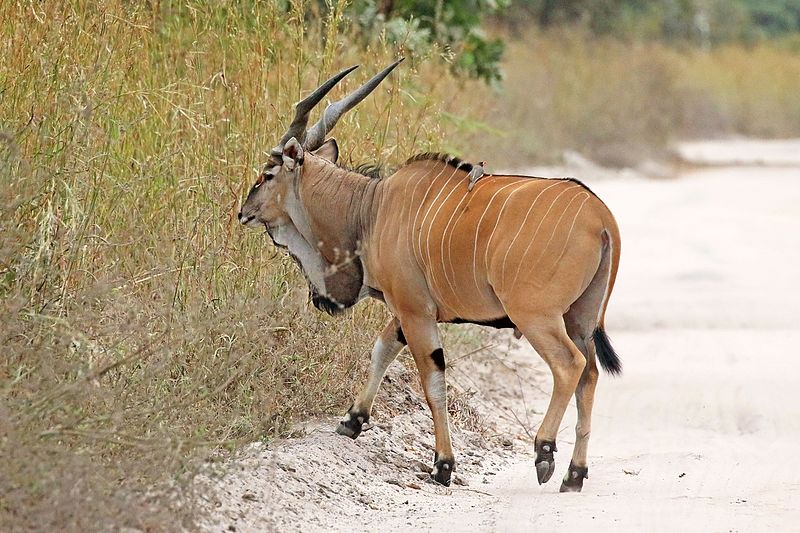
File:Giant_eland_(Taurotragus_derbianus_derbianus)_male.jpg · Wikimedia Commons · See Wikimedia Commons
OverviewAI-generated
The giant eland, scientifically named *Taurotragus derbianus*, is a species within the genus *Taurotragus*. It belongs to the class Mammalia. The longest observed lifespan for this organism is 20.3 years.
The species has been recorded in 130 observations on iNaturalist. It is referenced by 414 other encyclopedia articles.
Synthesized by Vinony from 13 facts across 3 sources: Wikidata, iNaturalist, Vinony graph. Generated from structured data (not the Wikipedia text) and checked against those facts — may still contain errors.
Species
Giant Eland
species
Maximum longevity: 20.3 years (captivity) Observations: One wild born specimen was about 20.3 years old when it died in captivity (Richard Weigl 2005).
via
Wikidata facts
- Instance of
- taxon
- Parent taxon
- Taurotragus
- Image
- Taurotragus derbianus.jpg
Show 5 more facts
- taxon rank
- species
- Commons category
- Taurotragus derbianus
- taxon name
- Taurotragus derbianus
- Commons gallery
- Taurotragus derbianus
- longest observed lifespan
- 20.3
Sources (1)
via Wikidata · CC0
~21 min read
Encyclopedic overview
The giant eland (Taurotragus derbianus), also known as Lord Derby's eland or greater eland, is an open-forest and savanna antelope. A species of the family Bovidae and genus Taurotragus, it was described in 1847 by John Edward Gray. The giant eland is the largest species of antelope, with a body length ranging from 220–290 cm (7.2–9.5 ft). There are two subspecies: T. d. derbianus and T. d. gigas.
The giant eland is a herbivore, eating grasses, foliage and branches. They usually form small herds consisting of 15–25 members, both males and females. Giant elands are not territorial, and have large home ranges. They are naturally alert and wary, which makes them difficult to approach and observe. They can run at up to 70 km/h (43 mph) and use this speed as a defence against predators. Mating occurs throughout the year but peaks in the wet season. They mostly inhabit broad-leafed savannas, woodlands and glades.
Excerpted from Wikipedia’s “Giant eland” article, available under the CC BY-SA 4.0 licence.