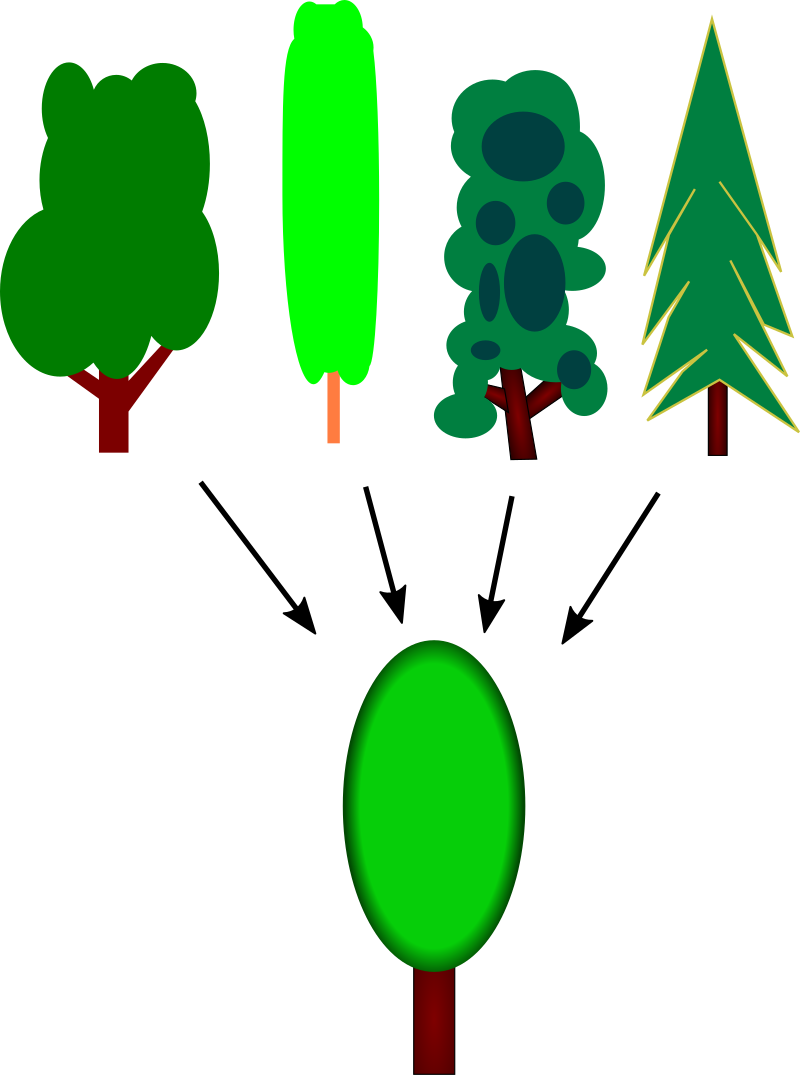
File:Generalization_process_using_trees.svg · Wikimedia Commons · See Wikimedia Commons
Also known as generalisation, Generalize, general case, wider case
A generalization is a form of abstraction whereby common properties of specific instances are formulated as general concepts or claims. Generalizations posit the existence of a domain or set of elements, as well as one or more common characteristics shared by those elements (thus creating a conceptual model). As such, they are the essential basis of all valid deductive inferences (particularly in logic, mathematics and science), where the process of verification is necessary to determine whether a generalization holds true for any given situation.
Wikidata facts
- Instance of
- relation
- Subclass of
- concept
- Part of
- epistemology
- Image
- Generalization process using trees PNG version.png
Show 2 more facts
- opposite of
- special case
- has cause
- thought
Sources (3)
via Wikidata · CC0
Article · 中文
广义化(英語:Generalize),又称一般化、通常化、普遍化、概念化,與之相對的是。概括作用是指将事物的定义进行修改或者补充以使其适用于更加大的范围,過程會伴隨將該主體的定義或概念抽象化。 一个将事物广义化的简单例子是归类。例如:将“大雁”广义化(归类)之后是“鸟类”,将“鸟类”广义化(归类)之后是“动物”。 当然,这样的定义并不严谨。 从逻辑学的角度来定义,当且仅当满足: 1. * 任何一个B概念的实例也是A概念的实例 2. * A概念的实例并不一定是B概念的实例 则可说“A是广义化之后的B”或“A是广义上的B”。 就之前的例子,因为每只“大雁”(B)都是“鸟”(A),但是“鸟类”并不一定是“大雁”,所以我们可以说:“鸟类”是广义上的“大雁”。 在机器学习上的定义:广义化是分类器性能的一个重要的指标之一。良好的分类器应可适应多样的未知数据,对训练集拟合度过高的分类器往往广义化程度很低。 可利用正則化處理提高分類的廣義程度降低過擬合可能性。
Abstract from DBpedia / Wikipedia · CC BY-SA