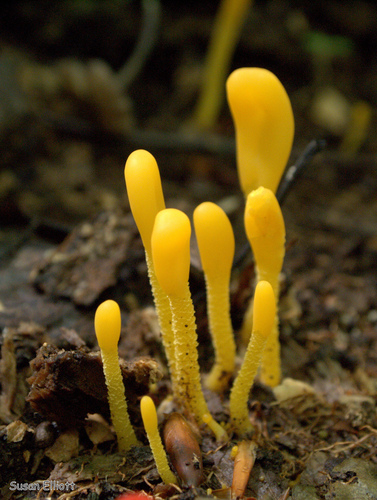
(c) Susan Elliott, some rights reserved (CC BY-NC), uploaded by Susan Elliott · cc-by-nc
Geoglossum
Sign in to saveGeoglossum is a genus of fungi in the family Geoglossaceae. They are commonly called earth tongues. The type species is Geoglossum glabrum. Geoglossum species are distinguished from the related genus Trichoglossum by the lack of setae on the spore bearing surface. Geoglossum species are characterized by dark, club-shaped, terrestrial ascocarps with a fertile hymenium continuing downward from the apex of the ascocarp along the stipe, eventually intergrading with a sterile stipe. The ascospores of Geoglossum range from translucent to dark brown, and are fusiform, and multiseptate. Identification
Species
orange earthtongue
GENUS
- KingdomFungi
- PhylumAscomycota
- ClassGeoglossomycetes
- OrderGeoglossales
- FamilyGeoglossaceae
via GBIF
Museum specimens
- Specimen records
- 577
- With media
- 176
- Family
- Geoglossaceae
- Collections
- MICH, MEL, CUP, F, NCU, FLAS
- Recorded in
- United States, Australia, India, Costa Rica, France, Brazil, China
Wikidata facts
- Instance of
- taxon
- Parent taxon
- Geoglossaceae
- Image
- Elaphocordyceps ophioglossoides - Lindsey 2.jpg
Show 6 more facts
- taxon name
- Geoglossum
- taxon rank
- genus
- Commons category
- Geoglossum
- topic's main category
- Category:Geoglossum
- taxonomic type
- Geoglossum glabrum
- taxon author citation
- Pers.
Sources (2)
via Wikidata · CC0
~5 min read
Encyclopedic overview
7 sectionsContents
- Taxonomy
- Description
- Distribution
- Selected species
- Conservation
- References
- External links
Geoglossum is a genus of fungi in the family Geoglossaceae. They are commonly called earth tongues. The type species is Geoglossum glabrum. Geoglossum species are distinguished from the related genus Trichoglossum by the lack of setae on the spore bearing surface. Geoglossum species are characterized by dark, club-shaped, terrestrial ascocarps with a fertile hymenium continuing downward from the apex of the ascocarp along the stipe, eventually intergrading with a sterile stipe. The ascospores of Geoglossum range from translucent to dark brown, and are fusiform, and multiseptate. Identification of species is based on the gross morphology of the ascocarp, color and septation of the ascospores, and shape and ornamentation of the paraphyses.
==Taxonomy== Geoglossum was described by Christian Hendrik Persoon in 1794, who created the genus to accommodate Clavaria ophioglossoides L. and three other species: Geoglossum hirsutum (now Trichoglossum hirsutum (Pers.) Boud.), Geoglossum lilacinum (now Thuemenidium atropurpureum (Batsch) Kuntze), and Geoglossum viride (now Microglossum viride (Pers.) Gillet). Persoon expanded the genus in several subsequent publications and the name was sanctioned by Elias Magnus Fries in his 1821 Systema Mycologicum I. Several mycologists have treated the genus extensively since Persoon's first work, including George Edward Massee, Elias Judah Durand, Curtis Gates Lloyd, Fred Jay Seaver, and Edwin Butterworth Mains.
Excerpted from Wikipedia’s “Geoglossum” article, available under the CC BY-SA 4.0 licence.