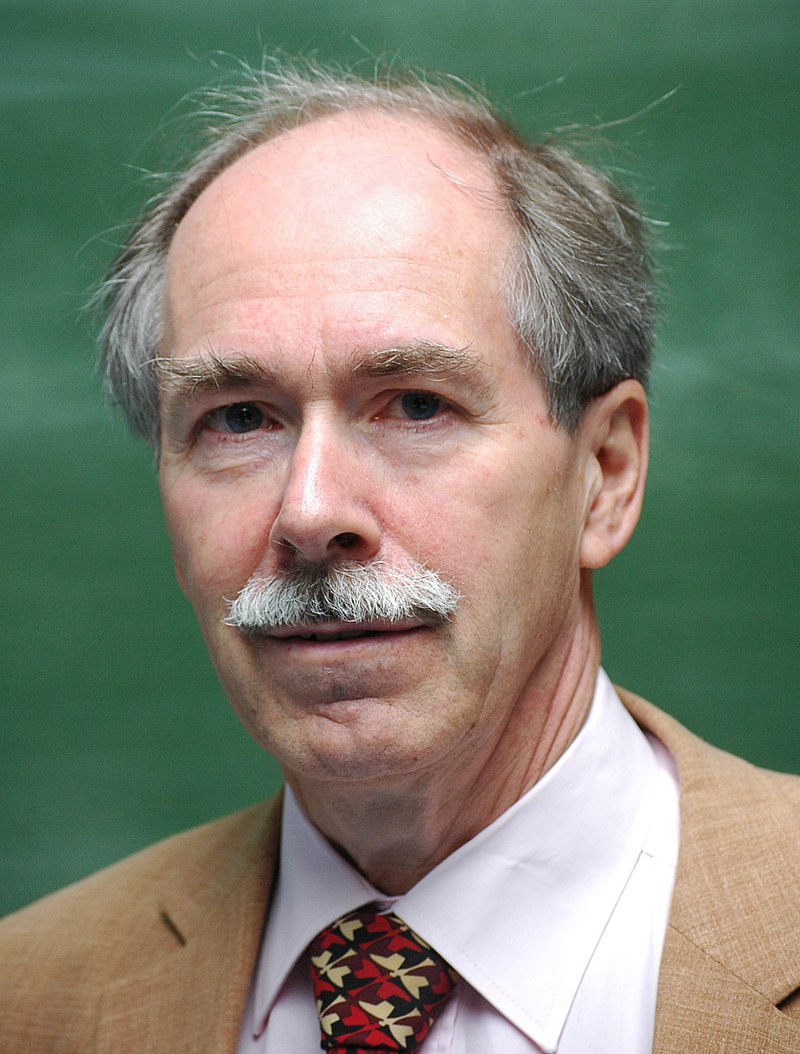
File:Gerard_'t_Hooft.jpg · Wikimedia Commons · See Wikimedia Commons
Gerard 't Hooft
Sign in to saveAlso known as Gerardus (Gerard) 't Hooft, Gerardus 't Hooft, G.W. 't Hooft, Hooft, Gerard ’t Hooft, G. Hooft, Gerardus, Gerard
Dutch theoretical physicist
Gerard 't Hooft is a Dutch theoretical physicist who made groundbreaking contributions to our understanding of fundamental forces in nature. His work has been highly influential in modern physics, helping to advance the theoretical frameworks that physicists use to explain how the universe works at the smallest scales.
AI-generated from the Wikipedia summary — may contain errors.
Nobel Prize
- The Nobel Prize in Physics1999
“for elucidating the quantum structure of electroweak interactions in physics”
Shared · 1/2 portion
Wikidata facts
- Instance of
- human
- Gender
- male
- Citizenship
- Kingdom of the Netherlands
- Place of birth
- Den Helder
- Occupation
- university teacher
- Educated at
- Utrecht University
- Employer
- CERN
- Languages spoken
- English language
- Native language
- Dutch
- Academic degree
- doctorate
- Doctoral advisor
- Martinus J. G. Veltman
- Field of work
- physics
- Official website
- webspace.science.uu.nl/~hooft101
- Image
- Gerard 't Hooft.jpg
Show 9 more facts
- Commons category
- Gerardus 't Hooft
- date of birth
- 1946-07-05
- Erdős number
- 6
- Commons gallery
- Gerardus 't Hooft
- name in native language
- Gerardus (Gerard) 't Hooft
- on focus list of Wikimedia project
- Wikipedia:Vital articles/Level/4
- maintained by WikiProject
- WikiProject Mathematics
- interested in
- theoretical physics
Sources (7)
via Wikidata · CC0
~16 min read
Encyclopedic overview
Gerardus "Gerard" 't Hooft ( Dutch: [ˈɣeːrɑrt ət ˈɦoːft]; born July 5, 1946) is a Dutch theoretical physicist and professor emeritus at Utrecht University, the Netherlands. He shared the 1999 Nobel Prize in Physics with his thesis advisor Martinus J. G. Veltman "for elucidating the quantum structure of electroweak interactions."
His work concentrates on gauge theory, black holes, quantum gravity and fundamental aspects of quantum mechanics. His contributions to physics include: a proof that gauge theories are renormalizable; dimensional regularization; and the holographic principle.
Excerpted from Wikipedia’s “Gerard 't Hooft” article, available under the CC BY-SA 4.0 licence.
Gallery (3)
Available in 73 languages
- Español
- Français
- Deutsch
- 中文
- 日本語
- Русский
- Português
- Italiano
- العربية
- हिन्दी
- Aragonese
- Armenian
- Asturian
- azb
- Bahasa Indonesia
- Bangla
- Basque
- Belarusian
Show 54 more
- Bulgarian
- Catalan
- Croatian
- Czech
- Danish
- Egyptian Arabic
- Esperanto
- Estonian
- Finnish
- Galician
- Haitian Creole
- Hakka Chinese
- Hebrew
- Hungarian
- Ido
- Irish
- Kazakh
- Kurdish
- Latin
- Latvian
- Low German
- Macedonian
- Malagasy
- Malay
- Marathi
- Mazanderani
- Nederlands
- Newari
- Norwegian
- Norwegian Nynorsk
- Occitan
- Polski
- Romanian
- Sanskrit
- Scottish Gaelic
- Serbian
- Serbian (Latin)
- simple
- Slovak
- Slovenian
- Svenska
- Swahili
- Tatar
- Tiếng Việt
- Türkçe
- Ukrainian
- Urdu
- Waray
- Western Panjabi
- Wu Chinese
- Yoruba
- zh_yue
- فارسی
- 한국어
via Wikidata sitelinks · CC0