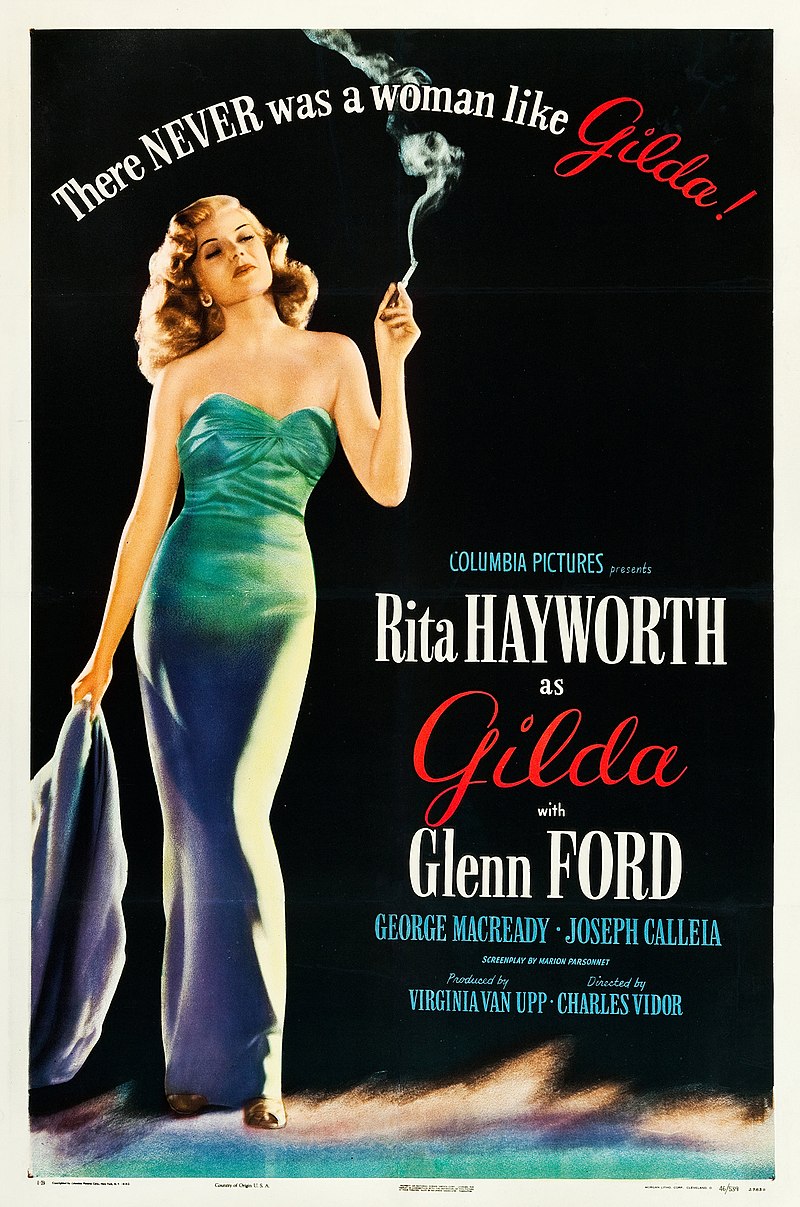
File:Gilda_(1946_one-sheet_poster_-_Style_B).jpg · Wikimedia Commons · See Wikimedia Commons
OverviewAI-generated
Gilda is a 1946 American drama film directed by Charles Vidor and produced by Columbia Pictures. The screenplay was written by Ben Hecht and Virginia Van Upp, who also served as producer. The film stars Rita Hayworth, Glenn Ford, George Macready, and Joseph Calleia. Hugo Friedhofer composed the music, with Rudolph Maté handling cinematography. The production team included editor Charles Nelson, production designer Stephen Goosson, and costume designer Jean Louis.
The narrative is set in Argentina and focuses on gambling. It is classified as a film noir, romance, and thriller. The movie was released in 1946, with specific dates listed as February 14 and April 25. It runs for 110 minutes and is presented in black-and-white. Distribution has occurred through Columbia Pictures, Netflix, and iTunes in formats including video on demand and DVD. The film has an assessment regarding the Bechdel test.
Synthesized by Vinony from 38 facts across 3 sources: Wikidata, TMDb, IMDb. Generated from structured data (not the Wikipedia text) and checked against those facts — may still contain errors.
Film · TMDB
7.5A gambler discovers an old flame while in Argentina, but she's married to his new boss.
Cast
- Rita Hayworth as Gilda
- Glenn Ford as Johnny Farrell
- George Macready as Ballin Mundson
- Joseph Calleia as Det. Maurice Obregon
- Steven Geray as Uncle Pio
- Joe Sawyer as Casey
Themes
- jealousy
- casino
- penalty
- nightclub
- buenos aires, argentina
- tricks
- patent
- film noir
- argentina
- extramarital affair
This product uses the TMDB API but is not endorsed or certified by TMDB.
Key facts
- Directed by
- Charles Vidor
- Screenplay by
- Marion Parsonnet Ben Hecht (uncredited)
- Adaptation by
- Jo Eisinger
- Story by
- E.A. Ellington
- Produced by
- Virginia Van Upp
- Starring
- Rita Hayworth Glenn Ford George Macready Joseph Calleia
- Cinematography
- Rudolph Maté
- Edited by
- Charles Nelson
- Music by
- M. W. Stoloff , Marlin Skiles
- Color process
- Black and white
- Production company
- Columbia Pictures
- Distributed by
- Columbia Pictures
- Release dates
- March 14, 1946 ( 1946-03-14 ) (New York City) April 25, 1946 ( 1946-04-25 ) (United States)
- Running time
- 110 minutes
- Country
- United States
- Language
- English
- Budget
- $2 million
- Box office
- $6 million (rentals)
via Wikipedia infobox
Wikidata facts
- Instance of
- film
- Part of
- National Film Registry
- Genre
- romance film
- Country of origin
- United States
- Original language
- English language
- Main subject
- gambling
- Director
- Charles Vidor
- Cast member
- John Tyrrell
- Composer
- Hugo Friedhofer
- Producer
- Virginia Van Upp
- Production company
- Columbia Pictures
- Cinematographer
- Rudolph Maté
- Narrative location
- Argentina
- Duration
- 110
- FilmAffinity ID
- 943832
- Distribution format
- video on demand
- Image
- Gilda trailer rita hayworth2.JPG
Show 10 more facts
- Commons category
- Gilda
- publication date
- 1946-00-00
- title
- Gilda
- film editor
- Charles Nelson
- production designer
- Stephen Goosson
- color
- black-and-white
- costume designer
- Jean Louis
- different from
- guild
- assessment
- Bechdel test
- review score
- 90%
Sources (15)
via Wikidata · CC0
~11 min read
Encyclopedic overview
Theatrical trailer Gilda is a 1946 American musical film noir directed by Charles Vidor and starring Rita Hayworth and Glenn Ford.
The film is known for cinematographer Rudolph Maté's lush photography, glamorous setting, costume designer Jean Louis's wardrobe for Hayworth (particularly for the dance numbers), and choreographer Jack Cole's staging of "Put the Blame on Mame" and "Amado Mio", sung by Anita Ellis. Over the years Gilda has gained cult classic status. In 2013, the film was selected for preservation in the United States National Film Registry by the Library of Congress as being "culturally, historically or aesthetically significant".
Excerpted from Wikipedia’s “Gilda” article, available under the CC BY-SA 4.0 licence.