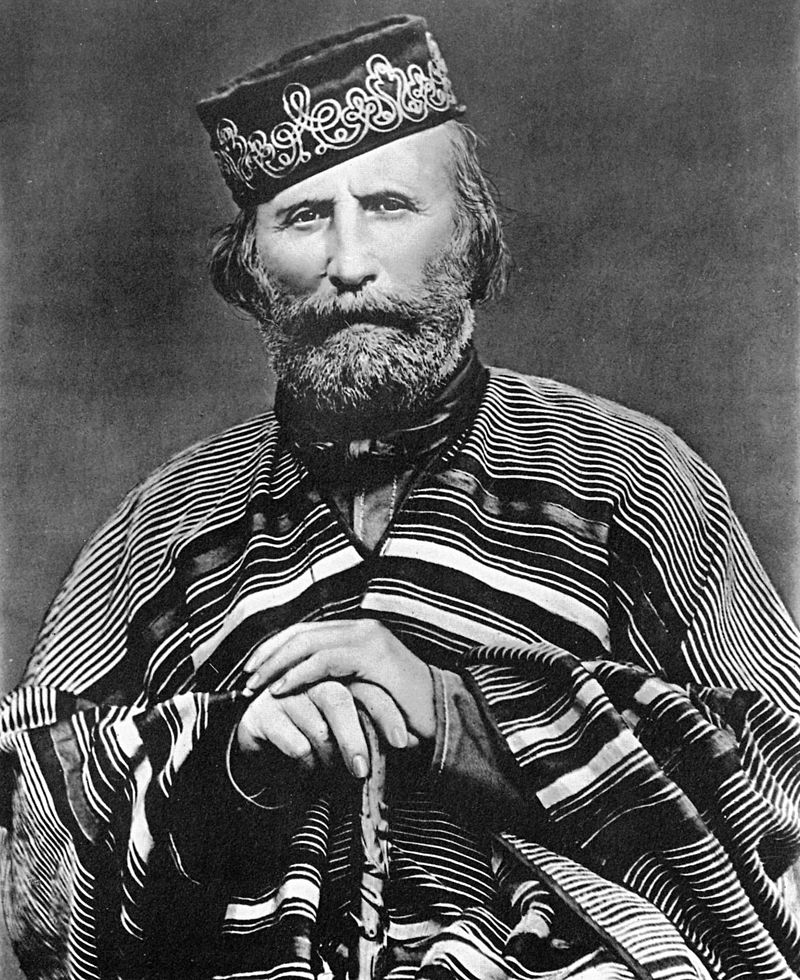
File:Garibaldi_(1866).jpg · Wikimedia Commons · See Wikimedia Commons
Giuseppe Garibaldi
Sign in to saveAlso known as Joseph-Marie Garibaldi, Garibaldi, Giuseppe Maria Garibaldi
Italian general, patriot and republican (1807–1882)
Giuseppe Garibaldi was an Italian military leader and patriot who lived from 1807 to 1882 and played a major role in unifying Italy during the 19th century. He is remembered as one of history's most influential figures in the Italian independence movement, known for his military campaigns and his commitment to republican ideals.
AI-generated from the Wikipedia summary — may contain errors.
Wikidata facts
- Instance of
- human
- Family name
- Garibaldi
- Gender
- male
- Citizenship
- Peru
- Place of birth
- Nice
- Place of death
- Caprera
- Child
- Menotti Garibaldi
- Occupation
- mercenary
- Political party
- Young Italy
- Languages spoken
- German
- Native language
- Italian
- Religion
- Catholicism
- Notable work
- Unification of Italy
- Conflict
- Battle of Calatafimi
- Military branch
- army
- Military rank
- general
- Image
- Giuseppe Garibaldi 1861.jpg
- Work location
- Paris
Show 20 more facts
- ethnic group
- Italians
- medical condition
- rheumatoid arthritis
- P12749
- Meinisberg
- unmarried partner
- Elpis Melena
- Commons category
- Giuseppe Garibaldi
- described by source
- Granat Encyclopedic Dictionary
- date of birth
- 1807-07-04
- date of death
- 1882-06-02
- Commons gallery
- Giuseppe Garibaldi
- Commons Creator page
- Giuseppe Garibaldi
- topic's main category
- Category:Giuseppe Garibaldi
- name in native language
- Giuseppe Garibaldi
- commander of (DEPRECATED)
- navy
- place of burial
- Caprera
- start of work period
- 1835-00-00
- end of work period
- 1882-06-02
- has works in the collection
- Biblioteca Virtual Miguel de Cervantes
- patient of
- Nikolai Pirogov
- different from
- Garibaldi
- on focus list of Wikimedia project
- Wikipedia:Vital articles/Level/4
Sources (15)
via Wikidata · CC0
~40 min read
Encyclopedic overview
Giuseppe Maria Garibaldi (/ˌɡærɪˈbɑːldi/ GARR-ib-AHL-dee, Italian: [dʒuˈzɛppe ɡariˈbaldi] ; 4 July 1807 – 2 June 1882) was an Italian general, revolutionary and republican. He contributed to the Unification of Italy (Risorgimento) and the creation of the Kingdom of Italy. He is considered to be one of Italy's "fathers of the fatherland", along with Camillo Benso di Cavour, King Victor Emmanuel II and Giuseppe Mazzini. Garibaldi is also known as the "Hero of the Two Worlds" because of his military enterprises in South America and Europe.
Garibaldi was a follower of the Italian nationalist Mazzini and embraced the republican nationalism of the Young Italy movement. He became a supporter of Italian unification under a democratic republican government. However, breaking with Mazzini, he pragmatically allied himself with the monarchist Cavour and the Kingdom of Sardinia in the struggle for independence, subordinating his republican ideals to his nationalist ones until Italy was unified. After participating in an uprising in Piedmont, he was sentenced to death, but escaped and sailed to South America, where he spent 14 years in exile, during which he took part in several wars and learned the art of guerrilla warfare. In 1835 he joined the rebels known as the Ragamuffins (farrapos), in the Ragamuffin War in Brazil, and took up their cause of establishing the Riograndense Republic and later the Catarinense Republic. Garibaldi also became involved in the Uruguayan Civil War, raising an Italian force known as Redshirts, and is still celebrated as an important contributor to Uruguay's reconstitution.
Excerpted from Wikipedia’s “Giuseppe Garibaldi” article, available under the CC BY-SA 4.0 licence.
Gallery (12)
Available in 111 languages
- Español
- Français
- Deutsch
- 中文
- 日本語
- Русский
- Português
- Italiano
- العربية
- हिन्दी
- Adyghe
- Afrikaans
- Albanian
- Albanian
- Aragonese
- Armenian
- Asturian
- Aymara
Show 92 more
- Azerbaijani
- Bahasa Indonesia
- Bangla
- Basque
- be_x_old
- Belarusian
- Bosnian
- Breton
- Bulgarian
- Buriat
- Burmese
- Catalan
- Central Kurdish
- Croatian
- Czech
- Danish
- Egyptian Arabic
- Esperanto
- Estonian
- Filipino
- Finnish
- Friulian
- Galician
- Gan Chinese
- Georgian
- Greek
- Gujarati
- Hebrew
- Hungarian
- hyw
- Icelandic
- Ido
- Irish
- Kannada
- Kazakh
- Kotava
- Kyrgyz
- Latin
- Latvian
- Ligurian
- Lithuanian
- Lombard
- Luxembourgish
- Macedonian
- Malagasy
- Malay
- Malayalam
- Marathi
- Mazanderani
- Mingrelian
- Neapolitan
- Nederlands
- Nepali
- Northern Frisian
- Norwegian
- Norwegian Nynorsk
- Occitan
- Ossetic
- Piedmontese
- Polski
- Punjabi
- Quechua
- Romanian
- Sardinian
- Scots
- Serbian
- Serbian (Latin)
- Sicilian
- simple
- Slovak
- Slovenian
- Svenska
- Tajik
- Talysh
- Tamil
- Tatar
- Telugu
- Tiếng Việt
- Türkçe
- Turkmen
- Ukrainian
- Urdu
- Uzbek
- Venetian
- Waray
- Welsh
- Western Frisian
- Western Panjabi
- Wu Chinese
- zh_yue
- فارسی
- 한국어
via Wikidata sitelinks · CC0