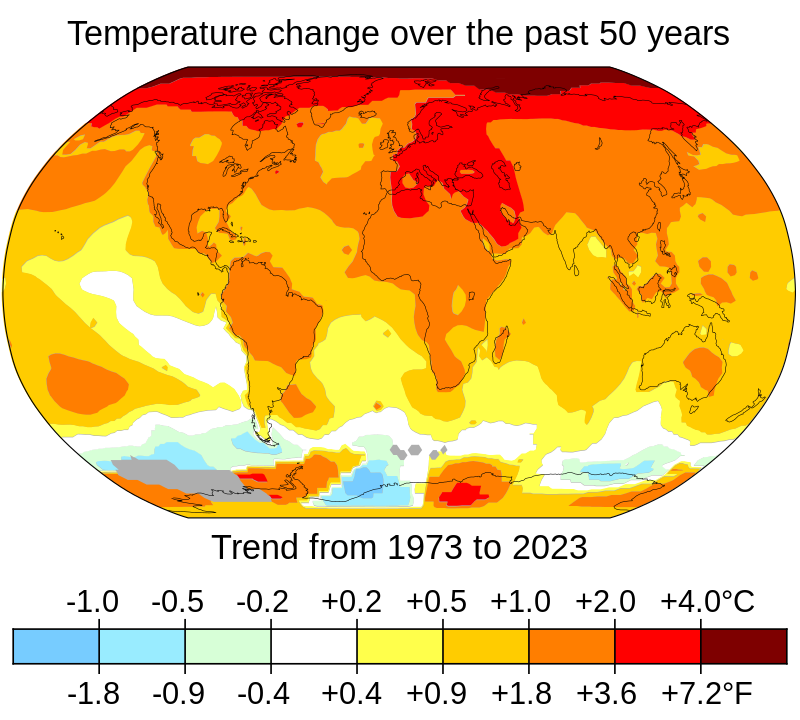
File:Change_in_Average_Temperature_With_Fahrenheit.svg · Wikimedia Commons · See Wikimedia Commons
global warming
Sign in to saveAlso known as anthropogenic global warming, global heating, climate warming
change in the statistical distribution of weather patterns for an extended period
Global warming is a long-term shift in typical weather patterns around the world, meaning that conditions like temperature, rainfall, and storms are changing from what we've historically experienced. It matters because these changes to our normal weather patterns can affect where and how we live, what we grow for food, and the natural environments that support life on Earth.
AI-generated from the Wikipedia summary — may contain errors.
Research
26,626 papers- Global Warming, Climate Change, and Environmental Pollution: Recipe for a Multifactorial Stress Combination Disaster.ReviewTrends in plant science · 2021Zandalinas SI, Fritschi FB, Mittler RDOI: 10.1016/j.tplants.2021.02.011
- Assessing ExxonMobil's global warming projections.ReviewScience (New York, N.Y.) · 2023Supran G, Rahmstorf S, Oreskes NDOI: 10.1126/science.abk0063
- Global warming and obesity: a systematic review.Obesity reviews : an official journal of the International Association for the Study of Obesity · 2018An R, Ji M, Zhang SDOI: 10.1111/obr.12624
- Global warming and mosquito-borne diseases in Africa: a narrative review.ReviewThe Pan African medical journal · 2023Khezzani B, Baymakova M, Khechekhouche EA et al.DOI: 10.11604/pamj.2023.44.70.37318
- Global warming and plant-pollinator mismatches.ReviewEmerging topics in life sciences · 2020Gérard M, Vanderplanck M, Wood T et al.DOI: 10.1042/ETLS20190139
- [Community pharmacy and global warming].ReviewFarmaceuticos comunitarios · 2025Estrada Riolobos GDOI: 10.33620/FC.2173-9218.(2025).15
- Global warming changes biomass and C:N:P stoichiometry of different components in terrestrial ecosystems.Global change biology · 2023Wan L, Liu G, Cheng H et al.DOI: 10.1111/gcb.16986
- Global warming: the implications for urologic disease.ReviewThe Canadian journal of urology · 2019Loughlin KR
via PubMed
Wikidata facts
- Instance of
- human impact on the environment
- Subclass of
- climate change
- Image
- Change in Average Temperature With Fahrenheit.svg
Show 10 more facts
- has effect
- water scarcity
- Commons category
- Global warming
- topic's main category
- Category:Global warming
- on focus list of Wikimedia project
- Wikipedia:Vital articles/Level/4
- opposite of
- global cooling
- WordLift URL
- data.thenextweb.com/tnw/entity/global_warming
- has cause
- deforestation
- contributing factor of
- arctic sea ice decline
- has contributing factor
- coal-fired power station
- handled, mitigated, or managed by
- climate change mitigation
Sources (7)
via Wikidata · CC0
~40 min read
Encyclopedic overview
Present-day climate change includes both global warming—the ongoing increase in global average temperature—and its wider effects on Earth's climate system. Climate change in a broader sense also includes previous long-term changes to Earth's climate. The modern-day rise in global temperatures is driven by human activities, especially fossil fuel (coal, oil and natural gas) burning since the Industrial Revolution. Fossil fuel use, deforestation, and some agricultural and industrial practices release greenhouse gases. These gases absorb some of the heat that the Earth radiates after it warms from sunlight, warming the lower atmosphere. Earth's atmosphere now has roughly 50% more carbon dioxide, the main gas driving global warming, than it did at the end of the pre-industrial era, reaching levels not seen for millions of years.
Climate change has an increasingly large impact on the environment. Heat waves and wildfires are becoming more common. Amplified warming in the Arctic has contributed to thawing permafrost, retreat of glaciers and sea ice decline. Higher temperatures are also causing more intense storms, droughts, and other weather extremes. Rapid environmental change in mountains, coral reefs, and the Arctic is forcing many species to relocate or become extinct. Even if efforts to minimize future warming are successful, some effects will continue for centuries. These include ocean heating, ocean acidification and sea level rise.
Excerpted from Wikipedia’s “global warming” article, available under the CC BY-SA 4.0 licence.
Gallery (12)
Available in 135 languages
- Español
- Deutsch
- 中文
- 日本語
- Русский
- Português
- Italiano
- العربية
- हिन्दी
- Afrikaans
- Albanian
- Amharic
- Angika
- Aragonese
- Armenian
- Assamese
- Asturian
- Bahasa Indonesia
Show 116 more
- Bangla
- Bashkir
- Basque
- bat_smg
- Bavarian
- be_x_old
- Belarusian
- Bhojpuri
- Bosnian
- Breton
- Bulgarian
- Buriat
- Burmese
- Catalan
- Cebuano
- Central Kurdish
- Chechen
- Chuvash
- Cornish
- Croatian
- Czech
- Danish
- Egyptian Arabic
- Esperanto
- Estonian
- Faroese
- Fiji Hindi
- Finnish
- fiu_vro
- Friulian
- Galician
- Ganda
- gcr
- Georgian
- Greek
- Guarani
- Haitian Creole
- Hebrew
- Hungarian
- Icelandic
- Ido
- Igbo
- Iloko
- Interlingua
- Jamaican Creole English
- Javanese
- Kannada
- Kazakh
- Kyrgyz
- Latin
- Latvian
- Lezghian
- Limburgish
- Lingua Franca Nova
- Lithuanian
- lld
- Lombard
- Low German
- Luxembourgish
- Macedonian
- Malagasy
- Malayalam
- Marathi
- N’Ko
- Nederlands
- Newari
- Northern Frisian
- Northern Sami
- Norwegian
- Norwegian Nynorsk
- Occitan
- Odia
- Old English
- Oromo
- Pampanga
- Piedmontese
- Polski
- Punjabi
- Romanian
- Romansh
- Rusyn
- Sardinian
- Saterland Frisian
- Serbian
- Serbian (Latin)
- simple
- Sindhi
- Sinhala
- Slovak
- Slovenian
- Sundanese
- Svenska
- Swahili
- Tajik
- Tamil
- Tatar
- Telugu
- Tiếng Việt
- Toki Pona
- Türkçe
- Ukrainian
- Urdu
- Walloon
- Waray
- Wayuu
- Western Panjabi
- Wu Chinese
- Yakut
- Yiddish
- Zaza
- zh_classical
- zh_min_nan
- zh_yue
- Zulu
- ไทย
- 한국어
via Wikidata sitelinks · CC0