(c) Hans Hillewaert, some rights reserved (CC BY-NC-ND) · cc-by-nc-nd
Gonionemus
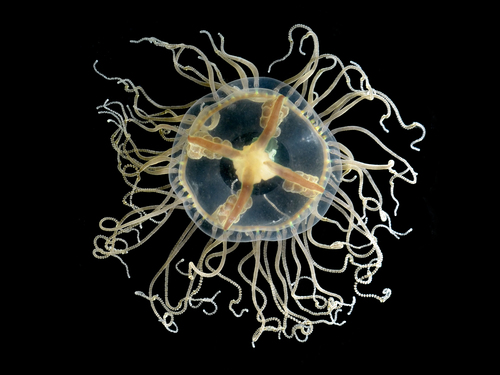
Sign in to saveGonionemus is a genus of hydrozoans that use adhesive discs near the middle of each tentacle to attach to eelgrass, sea lettuce, or various types of algae instead of swimming. They are small (bell diameter to 25 mm) and hard to see when hanging onto swaying seaweed. Nevertheless, they are capable of swimming when necessary. The bell is transparent, revealing the four orange to yellowish-tan gonads that lie along most of the length of the four radial canals. The pale yellow manubrium has four short, frilly lips. Up to 80 tentacles line the bell margin, with about an equal number of statocy
Species
カギノテクラゲ属
GENUS
- KingdomAnimalia
- PhylumCnidaria
- ClassHydrozoa
- OrderLimnomedusae
- FamilyOlindiidae
via GBIF
Museum specimens
- Specimen records
- 15
- With media
- 10
- Family
- Olindiidae
- Collections
- CMN, NMV, YPM, NHMUK, UF, UPS
- Recorded in
- Canada, Australia, United States, United Kingdom, Saudi Arabia, Japan
Wikidata facts
- Instance of
- taxon
- Parent taxon
- Olindiidae
- Image
- Gonionemus (YPM IZ 083683) 001.jpeg
Show 4 more facts
- taxon name
- Gonionemus
- taxon rank
- genus
- Commons category
- Gonionemus
- taxon author citation
- A. Agassiz, 1862
Sources (2)
via Wikidata · CC0
~2 min read
Encyclopedic overview
2 sectionsContents
- Species
- References
Gonionemus is a genus of hydrozoans that use adhesive discs near the middle of each tentacle to attach to eelgrass, sea lettuce, or various types of algae instead of swimming. They are small (bell diameter to 25 mm) and hard to see when hanging onto swaying seaweed. Nevertheless, they are capable of swimming when necessary. The bell is transparent, revealing the four orange to yellowish-tan gonads that lie along most of the length of the four radial canals. The pale yellow manubrium has four short, frilly lips. Up to 80 tentacles line the bell margin, with about an equal number of statocysts. Copepods are a favored prey.
This marine hydrozoan is common in warmer waters. The conspicuous stage in the dimorphic lifecycle is the small medusa. The polypoid stage is present as a tiny, solitary polyp which feeds on protozoans and other small plants and animals. The polyp stage closely resembles Hydra.
Excerpted from Wikipedia’s “Gonionemus” article, available under the CC BY-SA 4.0 licence.