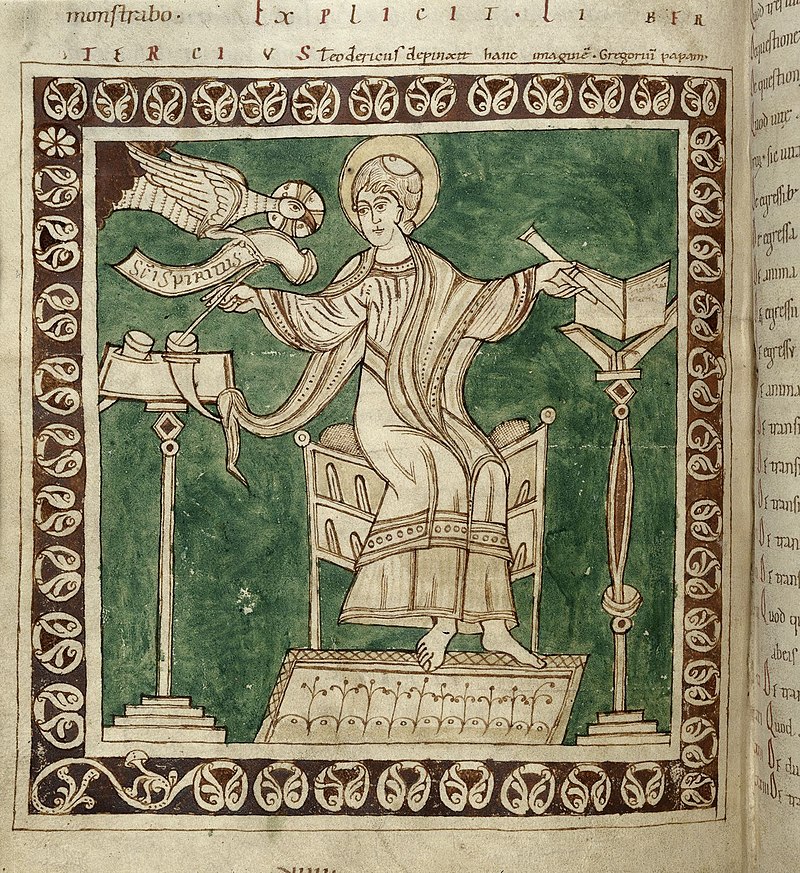
File:Gregory_the_Great_with_the_Holy_Spirit.jpg · Wikimedia Commons · See Wikimedia Commons
papa Gregorio I
Sign in to saveAlso known as Pope Gregory I, Saint Gregory the Great, St. Gregory the Dialogist, Gregory, Gregory the Great, St Gregory, Saint Gregory, Pope St. Gregory I
64° vescovo di Roma e papa della Chiesa cattolica dal 590 al 604
OverviewAI-generated
Gregory I, also known as Gregorius PP. I, was a male Pope and Doctor of the Church. Born in Rome on November 30, 540, to Saint Silvia and the Anicia gens, he served as a diplomat, Latin Catholic priest, and writer. He was a member of the Benedictines and adhered to the Catholic Church, speaking Latin. His notable works include *Pastoral Care* and *Moralia in Job*.
He died in Rome on March 12, 604, and is buried in St. Peter's Basilica. Gregory I is recognized as a saint with feast days on March 12, March 25, and September 3. His writings, such as *Sancti Gregorii magni, Romani Pontificis* and *Dialogorum libri quattuor*, are described in sources including the *Nordisk familjebok* and the *Jewish Encyclopedia of Brockhaus and Efron*. He is included in the Popes collection.
Synthesized by Vinony from 29 facts across 4 sources: Wikidata, Open Library, Europeana Sparql, Vinony collections. Generated from structured data (not the Wikipedia text) and checked against those facts — may still contain errors.
Person · Open Library
- Born
- ca. 540
- Died
- 604
- Works
- 187
Top works
- Sancti Gregorii magni, Romani Pontificis
- Pastoralis cure liber diui Gregorii pape. In sole aureo vici sancti Jacobi Parnhisiis venalis habetur
- La regola pastorale
- Dialogorum libri quattuor
- 對話
via Open Library + Wikidata
Wikidata facts
- Instance of
- human
- Gender
- male
- Place of birth
- Rome
- Place of death
- Rome
- Mother
- Saint Silvia
- Occupation
- writer
- Languages spoken
- Latin
- Religion
- Catholic Church
- Family
- Anicia gens
- Image
- Pope Gregory I illustration.jpg
- Work location
- Rome
- Residence
- Rome
- Religious order
- Benedictines
Show 20 more facts
- Commons category
- Gregorius I Magnus
- date of birth
- 0540-00-00
- date of death
- 0604-03-12
- canonization status
- saint
- Commons Creator page
- Gregorius I Magnus
- described by source
- Wikitólica
- topic's main category
- Category:Pope Gregory I
- place of burial
- St. Peter's Basilica
- name in native language
- Gregorius PP. I
- honorific prefix
- Doctor of the Church
- feast day
- September 3
- P6482
- Gregory I
- has works in the collection
- J. Paul Getty Museum
- diocese
- Diocese of Rome
- writing language
- Latin
- on focus list of Wikimedia project
- Wikipedia:Vital articles/Level/4
- name
- pape Grégoire
- P13311
- Afghanistan
- subject has role
- Pope
Sources (12)
via Wikidata · CC0
Works in European collections
36 objects attributed to papa Gregorio I, held across European museums, libraries & archives · via Europeana

Heid. Hs. 3298,30

Homiliar, Fragment

Theologische Sammelhandschrift

Moralia sive Expositio in Iob. Libri I-XIX

Moralia sive Expositio in Iob. Libri XXI-XXXV
In expositionem Iob moralium libri XXIII-XXXV - Cod. Aug. pap. 66
Moralia in expositione Iob, pars III (libb. 11-16) - Cod. Aug. perg. 3
Gregorii M. expositio euangeliorum - Cod. Aug. perg. 259
Gregorii M. in Euangelia liber II - Cod. Aug. perg. 200
Gregorii M. homiliae in Evangelia - Cod. Aug. perg. 145
Liber regulae pastoralis - Cod. Aug. perg. 240
Dialogorum libri IV. Fragmentum [II 3, 8, 35; III 4, 7, 13-20, 24-28]
Moralia, bierna Expositio w Iob. Libri XVIII-XXXV

Dialogorum libri IV
Moralia sive Expositio in Iob. Libri XIX-XXXV

Sermones in Psalmum XC. Excerpta

Moralia sive Expositio in Iob. Libri I-V

Textus varii

Moralia. Libri I-XVI
Omelias that I fix the blessed Sant Gregorio (...) on the book of the holy Propheta Ezechiel [Manuscript]
Ms 9916-17, Gregorius Magnus, Dialogi, fol. 36: Saint Benedict makes a lost sickle emerge from the water
Ms 9916-17, Gregorius Magnus, Dialogi, fol. 65v: Exorcism of a house by Saint Datian, Bishop of Milan
Ms 9916-17, Gregorius Magnus, Dialogi, fol. 48: Two distinguished nuns are punished for their high courage
Ms 9916-17, Gregorius Magnus, Dialogi, fol. 84: Der heilige Quadragesimus erweckt einen Toten
Ms 9916-17, Gregorius Magnus, Dialogi, fol. 20: The beggar at the table of Saint Boniface of Ferento is killed by a stone
Ms 9916-17, Gregorius Magnus, Dialogi, fol. 52: Ein Gefäß füllt sich wunderbarerweise mit Öl
Ms 9916-17, Gregorius Magnus, Dialogi, fol. 30: Saint Benedict repairs the sieve of his Amme by miracle
Ms 9916-17, Gregorius Magnus, Dialogi, fol. 54v: Saint Benedict raising a peasant’s son
Ms 9916-17, Gregorius Magnus, Dialogi, fol. 46: Two monks complain before Saint Benedict about the famine in the area
Ms 9916-17, Gregorius Magnus, Dialogi, fol. 86: The monk Benedict is put into the oven by the soldiers of Totilas
Ms 9916-17, Gregorius Magnus, Dialogi, fol. 23v: Saint Fortunatus, bishop of Tudertum, (Todi) healing an obsessed
Ms 9916-17, Gregorius Magnus, Dialogi, fol. 71: Der heilige Sabinus, Bischof von Piacenza, beendet die Überschwemmung des Po
Ms 9916-17, Gregorius Magnus, Dialogi, fol. 87v: The devil attaches the shoes to the priest Stephan
Ms 9916-17, Gregorius Magnus, Dialogi, fol. 40v: Two repentant monks before Saint Benedict
Ms 9916-17, Gregorius Magnus, Dialogi, fol. 45: Surrender of one of two vessels by exhilaratus to Saint Benedict; in the other there was a serpent
Ms 9916-17, Gregorius Magnus, Dialogi, fol. 49v: Saint Benedict makes the body of a young monk come to rest
Article · Italiano
Gregorio I, detto papa Gregorio Magno ovvero il Grande (Roma, 540 circa – Roma, 12 marzo 604), è stato il 64º vescovo di Roma e Papa della Chiesa cattolica, dal 3 settembre 590 fino alla sua morte. La Chiesa cattolica lo venera come santo e dottore della Chiesa. Anche le Chiese ortodosse lo venerano come santo.
Abstract from DBpedia / Wikipedia · CC BY-SA
Gallery (11)
Available in 94 languages
- Español
- Français
- Deutsch
- 中文
- 日本語
- Русский
- Português
- Italiano
- العربية
- हिन्दी
- Afrikaans
- Albanian
- Albanian
- Armenian
- Asturian
- Azerbaijani
- Bahasa Indonesia
- Basque
Show 75 more
- Bavarian
- be_x_old
- Belarusian
- Bikol
- Breton
- Bulgarian
- Catalan
- cdo
- Cebuano
- Corsican
- Croatian
- Czech
- Danish
- Egyptian Arabic
- Esperanto
- Estonian
- Faroese
- Filipino
- Finnish
- Galician
- Georgian
- Greek
- Hakka Chinese
- Hebrew
- Hungarian
- Ido
- Iloko
- Irish
- Javanese
- Latin
- Latvian
- Ligurian
- Lithuanian
- Lombard
- Low German
- Macedonian
- Malagasy
- Malay
- Malayalam
- Marathi
- Mazanderani
- Nederlands
- Norwegian
- Norwegian Nynorsk
- Occitan
- Old English
- Polski
- Quechua
- Romanian
- Rusyn
- Sardinian
- Serbian
- Serbian (Latin)
- Sicilian
- simple
- Slovak
- Slovenian
- Svenska
- Swahili
- Tamil
- Tiếng Việt
- Türkçe
- Ukrainian
- Urdu
- Venetian
- Waray
- Welsh
- Wu Chinese
- Yoruba
- Zaza
- zh_min_nan
- zh_yue
- فارسی
- ไทย
- 한국어
via Wikidata sitelinks · CC0