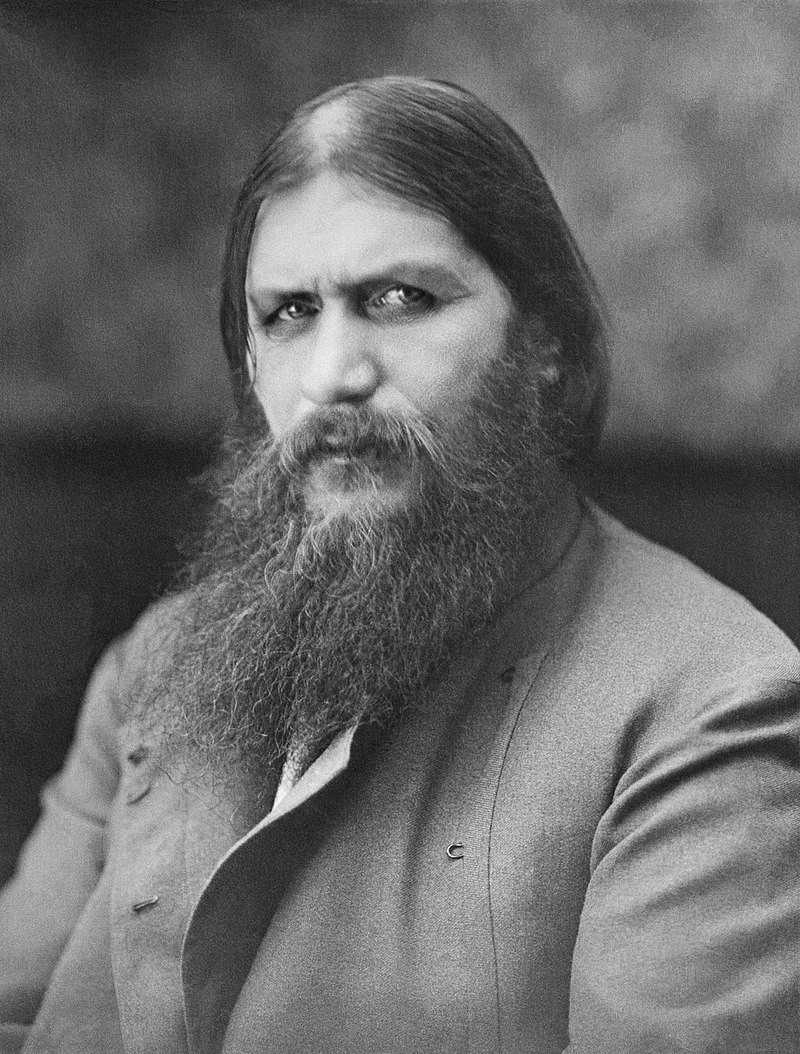
File:Rasputin_PA.jpg · Wikimedia Commons · See Wikimedia Commons
Grigori Rasputin
Sign in to saveAlso known as Rasputin, Grigori Yefimovich Rasputin
Russian mystic (1869–1916)
OverviewAI-generated
Grigori Rasputin (Григорий Распутин) was a male human born in 1869 in Pokrovskoye, Siberia, within the Russian Empire. He held the occupations of mystic, politician, peasant, and monk. Rasputin practiced Christianity and a lifestyle centered on mysticism. He spoke Russian and English. He was named after Gregory of Nazianzus.
Rasputin died in 1916 in Saint Petersburg. The cause of his death involved drowning and a gunshot wound, classified as homicide. He had a child named Maria Rasputin. His life has been described by the Armenian Soviet Encyclopedia and the Granat Encyclopedic Dictionary.
Synthesized by Vinony from 22 facts across 2 sources: Wikidata, TMDb. Generated from structured data (not the Wikipedia text) and checked against those facts — may still contain errors.
Film & TV
Pokrovskoye, Siberia, Russian Empire
Grigori Yefimovich Rasputin was a Russian mystic and self-proclaimed holy man who befriended the family of Tsar Nicholas II, the last monarch of Russia, and gained considerable influence in late imperial Russia.
Known for
- Battle of the Psychics — Self (Archive Footage)2007
- The Most Evil Men and Women in History2001
via TMDB
Wikidata facts
- Instance of
- human
- Named after
- Gregory of Nazianzus
- Gender
- male
- Citizenship
- Russian Empire
- Place of birth
- Pokrovskoye
- Place of death
- Saint Petersburg
- Child
- Maria Rasputin
- Occupation
- monk
- Languages spoken
- English language
- Religion
- Christianity
- Image
- Rasputin PA.jpg
Show 12 more facts
- Commons category
- Grigori Rasputin
- date of birth
- 1869-01-09
- topic's main category
- Category:Grigori Rasputin
- date of death
- 1916-12-17
- described by source
- Granat Encyclopedic Dictionary
- Commons gallery
- Григорий Ефимович Распутин
- cause of death
- gunshot wound
- lifestyle
- mysticism
- name in native language
- Григорий Распутин
- name in kana
- グリゴリー・エフィモヴィチ・ラスプーチン
- on focus list of Wikimedia project
- Wikipedia:Vital articles/Level/4
- manner of death
- homicide
via Wikidata · CC0
~31 min read
Encyclopedic overview
Grigori Yefimovich Rasputin (21 January [O.S. 9 January] 1869 – 30 December [O.S. 17 December] 1916) was a Russian mystic and faith healer. He is best known for having befriended the imperial family of Nicholas II, the last Emperor of Russia, through whom he gained considerable influence in the final years of the Russian Empire.
Rasputin was born to a family of peasants in the Siberian village of Pokrovskoye, located within Tyumensky Uyezd in Tobolsk Governorate (present-day Yarkovsky District in Tyumen Oblast). He had a religious conversion experience after embarking on a pilgrimage to a monastery in 1897 and has been described as a monk or as a strannik (wanderer or pilgrim), though he held no official position in the Russian Orthodox Church. In 1903 or in the winter of 1904–1905, he travelled to Saint Petersburg and captivated several religious and social leaders, eventually becoming a prominent figure in Russian society. In November 1905, Rasputin met Nicholas II and his empress consort, Alexandra Feodorovna.
Excerpted from Wikipedia’s “Grigori Rasputin” article, available under the CC BY-SA 4.0 licence.
Gallery (12)
Available in 94 languages
- Español
- Français
- Deutsch
- 中文
- 日本語
- Русский
- Português
- Italiano
- العربية
- हिन्दी
- Afrikaans
- Albanian
- Armenian
- Asturian
- Azerbaijani
- Bahasa Indonesia
- Bangla
- Bashkir
Show 75 more
- Basque
- Bavarian
- Belarusian
- Bikol
- Bosnian
- Breton
- Bulgarian
- Catalan
- Central Kurdish
- Chuvash
- Croatian
- Czech
- Danish
- Egyptian Arabic
- Esperanto
- Estonian
- Filipino
- Finnish
- Galician
- Georgian
- Greek
- Hebrew
- Hungarian
- Icelandic
- Ido
- Interlingua
- Irish
- Kannada
- Kazakh
- Kyrgyz
- Latin
- Latvian
- Lithuanian
- Macedonian
- Malagasy
- Malay
- Malayalam
- Maltese
- Marathi
- Mingrelian
- Mongolian
- Moroccan Arabic
- Nederlands
- Nepali
- Norwegian
- Occitan
- Pashto
- Polski
- Punjabi
- Romanian
- Scots
- Serbian
- Serbian (Latin)
- simple
- Sinhala
- Slovak
- Slovenian
- Standard Moroccan Tamazight
- Svenska
- Swahili
- Tamil
- Tiếng Việt
- Türkçe
- Ukrainian
- Urdu
- Waray
- Welsh
- Western Frisian
- Western Panjabi
- Wu Chinese
- zh_classical
- zh_yue
- فارسی
- ไทย
- 한국어
via Wikidata sitelinks · CC0