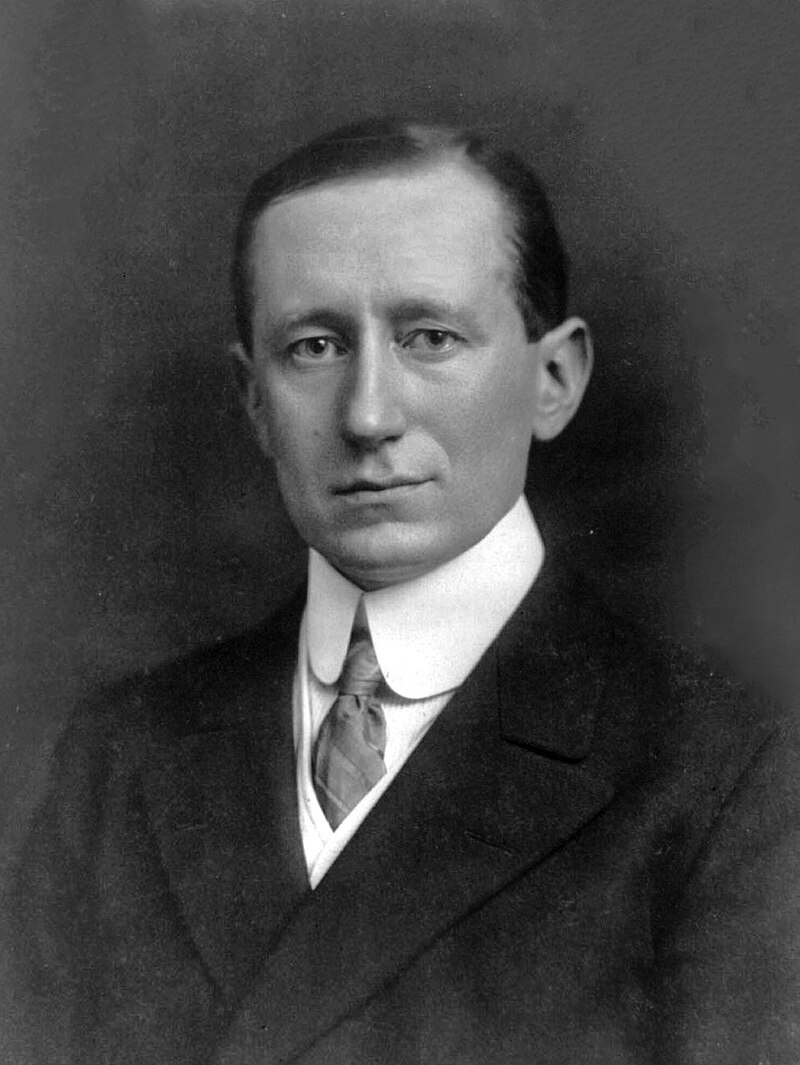
File:Guglielmo_Marconi.jpg · Wikimedia Commons · See Wikimedia Commons
Guglielmo Marconi
Sign in to saveAlso known as Guglielmo Marchese Marconi, Senatore Guglielmo Marconi, Guglielmo Giovanni Maria Marconi, 1st Marquis of Marconi
Italian inventor and radio pioneer (1874-1937)
OverviewAI-generated
Guglielmo Giovanni Maria Marconi was an Italian physicist, engineer, politician, and businessperson born in Bologna in 1874. He was a member of the National Fascist Party and served in the Royal Italian Navy during World War I. Marconi held the noble title of Marquess and was a Catholic who spoke Italian. He died of natural causes in Rome in 1937 and is buried in the Basilica of Santa Croce.
He received the Nobel Prize in Physics, the John Fritz Medal, the IEEE Medal of Honor, and the Wilhelm Exner Medal. Marconi was educated at the University of Bologna and was a member of the Pontifical Academy of Sciences, the Accademia Nazionale delle Scienze detta dei XL, the Royal Swedish Academy of Sciences, and the National Academy of Sciences. His works include *Radio communications*, *The Wireless World*, and *Guglielmo Marconi e l'Italia*.
Synthesized by Vinony from 32 facts across 4 sources: Wikidata, Open Library, Nobel Prize, Vinony collections. Generated from structured data (not the Wikipedia text) and checked against those facts — may still contain errors.
Person · Open Library
- Born
- 1874
- Died
- 1937
- Works
- 5
Top works
- Guglielmo Marconi e l'Italia
- Per la ricerca scientifica
- Radio communications
- Scritti di Guglielmo Marconi
- The Wireless World
via Open Library + Wikidata
Nobel Prize
- The Nobel Prize in Physics1909
“in recognition of their contributions to the development of wireless telegraphy”
Shared · 1/2 portion
Wikidata facts
- Instance of
- human
- Gender
- male
- Citizenship
- Kingdom of Italy
- Place of birth
- Bologna
- Place of death
- Rome
- Occupation
- scientist
- Educated at
- University of Bologna
- Employer
- University of St Andrews
- Political party
- National Fascist Party
- Languages spoken
- Italian
- Religion
- Catholicism
- Award
- John Scott Award
- Noble title
- Marquess
- Field of work
- physical science
- Conflict
- World War I
- Military branch
- Royal Italian Navy
- Image
- Guglielmo Marconi.jpg
Show 16 more facts
- Commons category
- Guglielmo Marconi
- date of birth
- 1874-04-25
- date of death
- 1937-07-20
- topic's main category
- Category:Guglielmo Marconi
- Commons gallery
- Guglielmo Marconi
- Commons Creator page
- Guglielmo Marconi
- member of
- Royal Academy of Italy
- manner of death
- natural causes
- birth name
- Guglielmo Giovanni Maria Marconi
- nominated for
- Nobel Prize in Physics
- place of burial
- Basilica of Santa Croce
- name in native language
- Guglielmo Marconi
- on focus list of Wikimedia project
- Wikipedia:Vital articles/Level/4
- maintained by WikiProject
- WikiProject Mathematics
- P12749
- Cureglia
- interested in
- physics
Sources (10)
via Wikidata · CC0
~40 min read
Encyclopedic overview
Guglielmo Giovanni Maria Marconi, 1st Marquess (25 April 1874 – 20 July 1937), was an Italian radio-frequency engineer, inventor, and politician known for his creation of a practical radio wave-based wireless telegraph system. This led to his being largely credited as the inventor of radio and sharing the 1909 Nobel Prize in Physics with Ferdinand Braun "in recognition of their contributions to the development of wireless telegraphy." His work laid the foundation for the development of radio, television, and all modern wireless communication systems.
As an entrepreneur and a businessman, Marconi founded The Wireless Telegraph & Signal Company (later the Marconi Company) in the United Kingdom in 1897. In 1929, he was ennobled as a marquess (Italian: marchese) by King Victor Emmanuel III. In 1931, he set up Vatican Radio for Pope Pius XI.
Excerpted from Wikipedia’s “Guglielmo Marconi” article, available under the CC BY-SA 4.0 licence.
Gallery (12)
Available in 118 languages
- Español
- Français
- Deutsch
- 中文
- 日本語
- Русский
- Português
- Italiano
- العربية
- हिन्दी
- Afrikaans
- Albanian
- Amharic
- Aragonese
- Armenian
- Asturian
- Awadhi
- azb
Show 99 more
- Azerbaijani
- Bahasa Indonesia
- Bangla
- Basque
- be_x_old
- Belarusian
- Bosnian
- Bulgarian
- Burmese
- Catalan
- Central Kurdish
- Corsican
- Croatian
- Czech
- Danish
- Divehi
- Egyptian Arabic
- eml
- Esperanto
- Estonian
- Faroese
- Filipino
- Finnish
- Friulian
- Galician
- Georgian
- Greek
- Haitian Creole
- Hakka Chinese
- Hebrew
- Hungarian
- hyw
- Icelandic
- Ido
- Iloko
- Irish
- Javanese
- Kannada
- Kazakh
- Kurdish
- Latin
- Latvian
- Ligurian
- Lithuanian
- Luxembourgish
- Macedonian
- Malagasy
- Malay
- Malayalam
- Maltese
- Marathi
- Mazanderani
- Mingrelian
- Mongolian
- Neapolitan
- Nederlands
- Nepali
- Newari
- Norwegian
- Norwegian Nynorsk
- Occitan
- Odia
- Pashto
- Piedmontese
- Polski
- Punjabi
- Quechua
- rki
- Romanian
- Sanskrit
- Serbian
- Serbian (Latin)
- Sicilian
- simple
- Slovak
- Slovenian
- Sundanese
- Svenska
- Swahili
- szy
- Tamil
- Tatar
- Telugu
- Tiếng Việt
- Türkçe
- Ukrainian
- Urdu
- Uzbek
- Venetian
- Waray
- Welsh
- Western Panjabi
- Wu Chinese
- Yoruba
- zh_min_nan
- zh_yue
- فارسی
- ไทย
- 한국어
via Wikidata sitelinks · CC0