
Guinea
Sign in to saveAlso known as Guinea-Conakry, Republic of Guinea, gn, GUI
stato dell'Africa Occidentale
OverviewAI-generated
Guinea, officially the Republic of Guinea, is a sovereign state in Western Africa. Its capital is Conakry. The country shares borders with Ivory Coast, Guinea-Bissau, Liberia, and Mali. It is a member of the United Nations, African Union, World Trade Organization, and Organisation of Islamic Cooperation. The head of state is Mamady Doumbouya, and the head of government is Bah Oury. French is an official language, alongside other languages of Guinea.
The population is recorded as 14,363,931 or 14,754,785. The area is 245,857 square kilometers. The highest point is Mount Richard-Molard. Administrative entities include Boké Region, Conakry, Faranah Region, and Kankan Region. The currency is the Guinean franc or Guinean syli. The telephone country code is 224, and the top-level Internet domain is .gn. The anthem is Liberté.
Synthesized by Vinony from 67 facts across 9 sources: Wikidata, REST Countries, Openweathermap, Open Meteo, World Bank, OpenStreetMap, PubMed, Vinony graph, Geo. Generated from structured data (not the Wikipedia text) and checked against those facts — may still contain errors.
Weather now
cached 6h ago7-day forecast
via Open-Meteo
Country
- Capital
- Conakry
- Population
- 14,363,931
- Region
- Africa · Western Africa
- Demonym
- Guinean
- Currencies
- GNF (Fr)
- Languages
- French
- Calling code
- +224
- Drives on
- Right
- Gini
- 33.7 (2012)
- FIFA code
- GUI
- TLD
- .gn
- Timezones
- UTC
- Borders
- CIV, GNB, LBR, MLI, SEN, SLE
via REST Countries
Indicators · World Bank
- GDP
- $25B(2024)
- Population
- 14,754,785(2024)
- Life expectancy
- 60.9 yrs(2024)
- Unemployment
- 5.2 %(2025)
- Urban population
- 38.1 %(2024)
- Internet users
- 33.3 %(2024)
- Forest area
- 24.7 %(2023)
- Renewable energy
- 66.6 %(2022)
via World Bank Open Data · CC BY 4.0
Wikipedia views (30d)
65,154 totalvia Wikimedia Pageviews API
Key facts
- Country.conventional_long_name
- Republic of Guinea
- Country.common_name
- Guinea
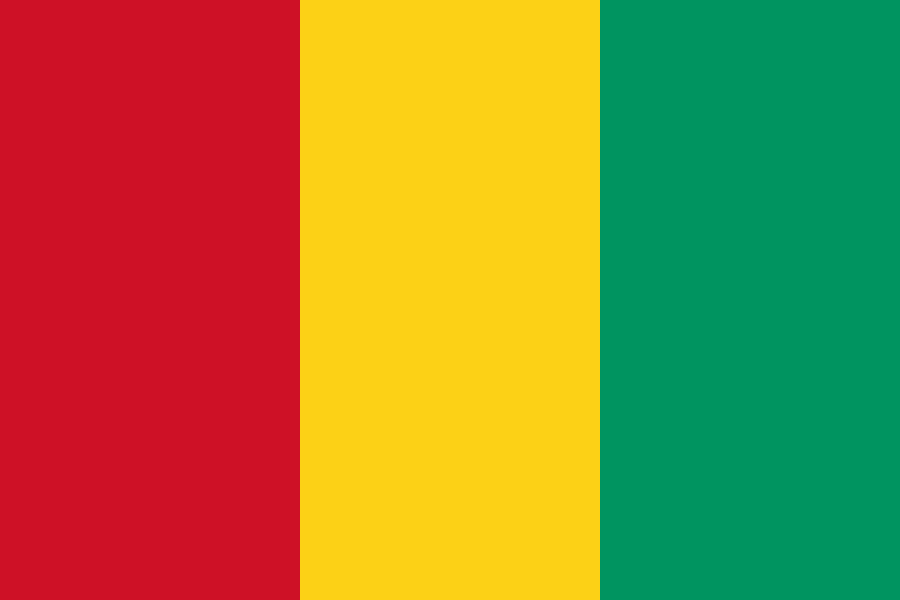
- Country.image_flag
- Flag of Guinea.svg
- Country.alt_flag
- Flag
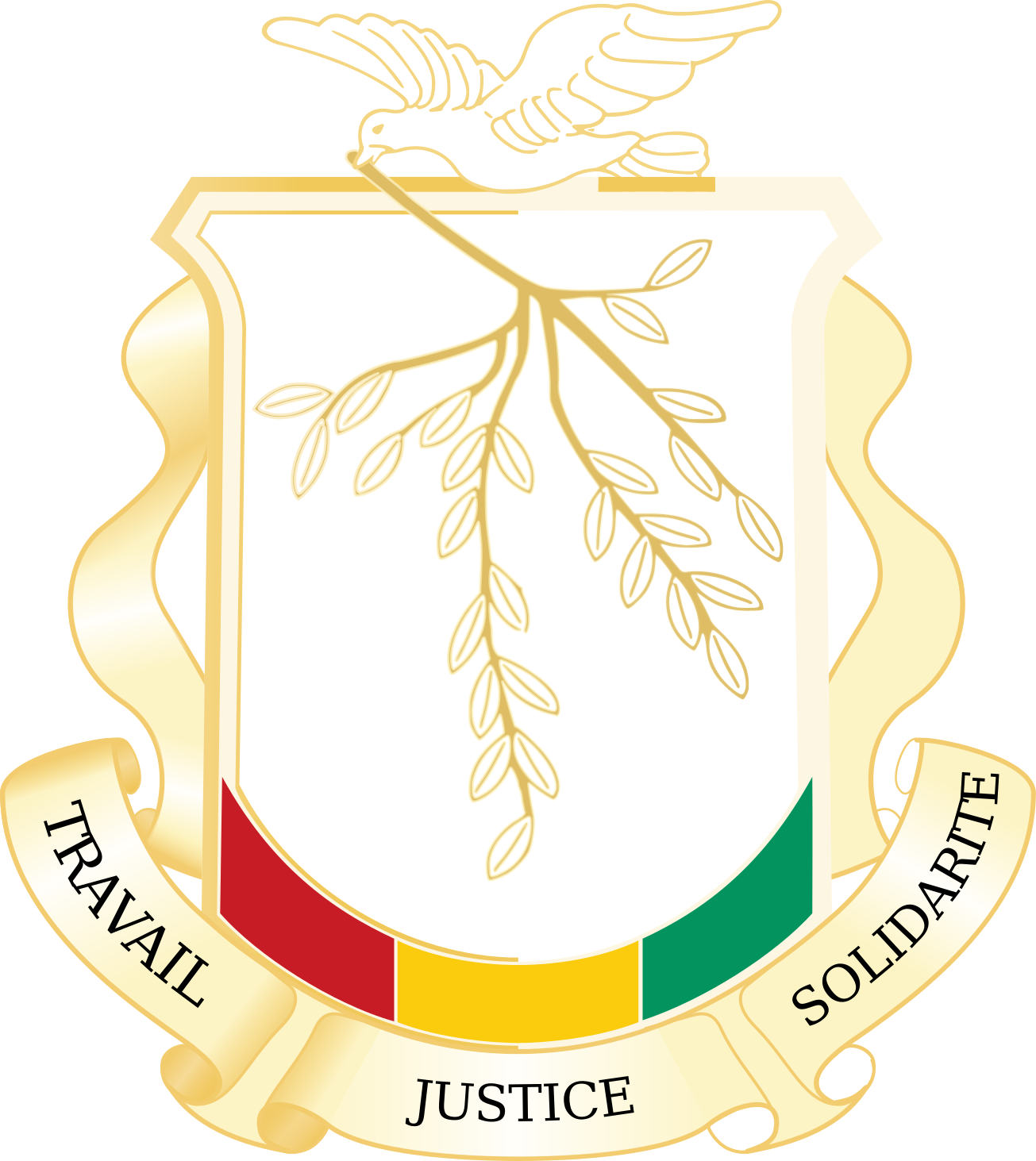
- Country.image_coat
- Coat of Arms of Guinea.svg
- Country.symbol_type
- Coat of arms
- Country.englishmotto
- Work, Justice, Solidarity
- Country.national_anthem
- "Liberty"
- Country.capital
- Conakry
- Country.largest_city
- Conakry
- Country.official_languages
- French
- Country.languages_type
- Spoken languages
- Country.ethnic_groups_year
- 2018 est.
- Country.religion
- 85.2% Islam 13.4% Christianity 0.2% animism 1.2% none
- Country.demonym
- Guinean
- Country.government_type
- Unitary presidential republic
- Country.leader_title1
- President
- Country.leader_name1
- Mamady Doumbouya
via Wikipedia infobox
Research
171,645 papers- SARS-CoV-2 Circulation, Guinea, March 2020-July 2021.ReviewEmerging infectious diseases · 2022Grayo S, Troupin C, Diagne MM et al.DOI: 10.3201/eid2802.212182
- Guinea's response to syndemic hotspots.BMJ global health · 2021Kolie D, Van De Pas R, Fofana TO et al.DOI: 10.1136/bmjgh-2021-006550
- Guinea.Department of State publication. Background notes series · 1985United States. Department of State. Bureau of Public Affairs
- [Guinea].Jeune Afrique (Paris, France : 1980) · 1996
- Guinea.Population policy compendium · 1980United Nations. Department of International Economic and Social Affairs, United Nations Fund for Population Activities UNFPA
- Neglected tropical diseases in Republic of Guinea: disease endemicity, case burden and the road towards the 2030 target.ReviewInternational health · 2023Cherif MS, Keita M, Dahal P et al.DOI: 10.1093/inthealth/ihad036
- Guinea 2012 DHS.Studies in family planning · 2015DOI: 10.1111/j.1728-4465.2015.00018.x
- Analysis of cardiovascular risk factors: a retrospective epidemiological study in Guinea in 2022.ReviewCurrent problems in cardiology · 2024Gun M, Diallo MDM, Barry MA et al.DOI: 10.1016/j.cpcardiol.2023.102232
via PubMed
Wikidata facts
- Instance of
- country
- Official name
- ߖߌ߬ߣߍ߬ ߞߊ߲ߓߍ߲
- Demonym
- 几内亚人
- Country
- Guinea
- Contains
- Nzérékoré Region
- Continent
- Africa
- Capital
- Conakry
- Official language
- languages of Guinea
- Currency
- Guinean syli
- Population
- 17521167
- Area
- 245857
- Body of water
- Atlantic Ocean
- Head of government
- Bah Oury
- Head of state
- Mamady Doumbouya
- Form of government
- republic
- Legislature
- National Assembly
- Anthem
- Liberté
- Shares border with
- Senegal
- Highest point
- Mount Richard-Molard
- Official website
- www.presidence.gov.gn
- Image
- LocationGuinea.svg
- Life expectancy
- 60.015
- Nominal GDP
- 25600000000
- Unemployment rate
- 2
Show 54 more facts
- Calling code
- +224
- Licence plate code
- RG
- Mains voltage
- 220
- Motto
- Gwaith, Cyfiawnder, Undod
- Flag
- flag of Guinea
- Coat of arms
- coat of arms of Guinea
- top-level Internet domain
- .gn
- Commons category
- Guinea
- topic's main category
- Category:Guinea
- category for people born here
- Q8050375
- category of associated people
- Category:Guinean people
- Commons gallery
- Guinée
- lowest point
- Atlantic Ocean
- mobile country code
- 611
- diplomatic relation
- North Korea
- driving side
- right
- geography of topic
- Geography of Guinea
- age of majority
- 18
- topic's main Wikimedia portal
- Portal:Guinea
- category for people who died here
- Category:Deaths in Guinea
- office held by head of state
- President of Guinea
- number of out-of-school children
- 1749523
- located in/on physical feature
- West Africa
- total fertility rate
- 5.013
- maritime identification digits
- 632
- inception
- 1958-10-02
- Unicode character
- 🇬🇳
- replaces
- French Guinea
- central bank
- Central Bank of the Republic of Guinea
- history of topic
- history of Guinea
- VAT rate
- 18
- BTI Status Index
- 4.6
- BTI Governance Index
- 5.07
- economy of topic
- economy of Guinea
- native label
- République de Guinée
- demographics of topic
- demographics of Guinea
- different from
- Guinea
- Democracy Index
- 3.08
- Human Development Index
- 0.465
- P11012
- tobacco
- hashtag
- Guinea
- on focus list of Wikimedia project
- Wikipedia:Vital articles/Level/4
- Gini coefficient
- 29.6
- Happy Planet Index score
- 38.1
- Inequality-adjusted Human Development Index
- 0.299
- P12749
- José Joaquín Pérez
- birth rate
- 33.855
- male population
- 6854020
- death rate
- 9.87
- rural population
- 8638804
- female population
- 9068256
- urban population
- 5220537
- most populous urban area
- Conakry
Sources (15)
via Wikidata · CC0
Travel guide
Understand
Guinea is a remarkable country with very warm, genuine people but little infrastructure. While they have tremendous natural resources (which include around one half of the world's reserves of bauxite, and many major deposits of jewels, as well as gold and other metals), they rate very poorly in the UN's quality of life index. Guinea is roughly the size of the United Kingdom.
Get in
thumb|375px|A map showing the visa requirements of Guinea, with countries in green having visa-free access
Get around
thumb|Crossing the river in Guinea There are no buses. Traffic in Conakry can be very heavy. The local transport vans in Conakry seem to be the most congested in all of West Africa. Taxis are very inexpensive, even if you want to rent one for a half or whole day. Expect to have to stop for gas almost immediately after you get in the car. The Government and business centre of the city is unfortunately located at the tip of a long and narrow peninsula which is only connected to the rest of Conakry, which sprawls onto the mainland, by two roads. This can be particularly frustrating at rush hour. Queues at gas stations in Conakry can be quite long and disorganized at certain times. Much of the infrastructure around the airport is being rebuilt, so trips to downtown or to la miniere might take unusual detours. thumb|Petrol station. Bush Taxis ("504", for the common Peugeot 504 model) are used for transport from city to city. Keep in mind that there is a curfew at night, and if you try to drive into Conakry you will have to wait outside the city until morning. Local transport is usually able to leave Conakry after dark. Departure times are never set for local transport. In the early morning you might be told that a taxi will be leaving "toute suite" (right away) but will not get out of Conakry until well after dark. Intercity travel in Guinea requires a great deal of patience and a loose schedule. It is also possible to fly from city to city, but get to the airport early and bring …
See
thumb|Mount Nimba rainforest
In Conakry, there is the National Museum which highlights the distinct ethnic tribes in Guinea and various traditional instruments, masks, etc.
The main port is located at the tip of the peninsula in Conakry, near the President's Palace. You can take a boat from there to the islands of Loos for a day or overnight trip. It's a bustling place where fishermen offload their daily catch.
Cape Verga has some of the best beaches in Guinea for exploration.
Mount Nimba is the highest mountain peak in Guinea for trekking.
Do
In Conakry, one of the best places to grab a beer and hangout is the beach bar in Taouyah, an area with a large market and mostly residential with some night clubs and restaurants. Many expats, including the Peace Corps headquarters, live here and meet up at the beach around sunset for great pizza or fish or chicken dishes. There is a great breeze, live music, and lots of locals playing soccer games until the sunsets, especially on the weekends.
Music in Guinea is one of the best cultural activities the country has to offer. Some of the best Kora players in the world are from Guinea. There are many bars that offer live music.
The French-Guinean Cultural Centre has some great musical shows, movies, plays, and ballets (i.e. traditional West-African dance), and hosts exhibitions and conferences. It also has a library and multi-media centre. Members can take out books and use the computers and internet. This is a great place to meet expats, and local musicians, and artists. Most people there will know the best places to go see a show that week.
Outside of Conakry, there are many attractive tourism destinations for the adventurous traveler. Infrastructure, such as hotels, roads etc. is lacking outside of the capital but you can find basic places to stay with limited electricity powered by generators.
The Foutah Djallon area has superb hiking, sweeping vistas, waterfalls and cliffs. Fouta Trekking is a local non-profit that promotes equitable tourism. They offer hiking tours…
Eat
thumb|Beans with fried ripe plantain Many options are available for dining. For FG20,000 (€2 or roughly US$3), you are able to dine on delicious, nutritious food. If your taste buds would prefer something international, many other choices are available as well. The beef in Guinea is very good, and is highly recommended. Pork isn't served because of the dominance of Islam but is eaten among the forest people of the South east (Guinee Forestiere). There are good restaurants that are Lebanese which have European-styled breakfasts.
Outside of the capital, Conakry, you can often enjoy local dishes (consisting of Guinean style rice and one of the 4 main sauces with sometimes beef or fish in some cases) at a hole in the wall local restaurant for less than US$1 (FG3,000-6,000 depending on the exchange rate). You will leave full!
In Kankan, Guinea (Haute Guinee), there are few places to choose from if you wish to eat at a more decent restaurant. There is Hotel Villa and Hotel Bate. As of mid-2008, these were the top two places for lodging and meals. A typical plate can cost anywhere between FG35,000 and FG55,000. Note that prices of food and drinks can often dramatically increase at the spur of the moment and without any explanation!
Fruits are very inexpensive here, especially compared to the higher costs in neighboring countries (Mali, Ivory Coast and Senegal). For those who love pineapples, on the national road (which literally goes from the North of the country to Conakry in th…
Drink
Canned European beer is available as well as local "Guiluxe" and "Skol" lager beers.
Water bottled in the name of Coyah is available everywhere for about US$0.50 per 1.5 litre bottle and is very good. Conakry's tap water is generally not safe unless filtered/boiled.
Stay safe
thumb|Labe downtown Guinea is a rather unsafe nation, due to the fact that it has a history of being one of Africa's most unstable countries; lawlessness and criminality are widespread. Most of the crime is done by officials in military uniforms, and usually targets foreigners. Most non-violent crime involves acts of pick-pocketing and purse-snatching, while armed robbery, muggings, and assaults are the most common violent crimes. Criminals particularly target visitors at the airport, in the traditional markets, and near hotels and restaurants frequented by foreigners. Stay vigilant, and apply common sense if stuck in a difficult situation.
Visitors should also avoid unsolicited offers of assistance at the airport and hotels because such offers often mask an intention to steal luggage, purses, or wallets. Travellers should arrange for hotel personnel, family members, or business contacts to meet them at the airport to reduce their vulnerability to these crimes of opportunity.
When taking photographs, avoid military bases and political buildings, as it can be considered espionage in Guinea and can land you in jail.
The police are completely ineffective. Low salaries and improper training contribute to the lack of professionalism of the police. If you are the victim of a crime, consult your embassy.
Corruption is extremely widespread - Corrupt police and soldiers target foreigners for bribes in just about any place in the country. Policemen will demand bribes at any checkp…
Stay healthy
The medical system in Guinea is in a very poor condition, and is not well equipped and is very limited. Some private medical facilities (e.g. Clinique Pasteur in Conakry) provide a better range of treatment options than public facilities, but are still well below western standards. There are no ambulance or emergency rescue services in Guinea and trauma care is extremely limited.
Tap water is unsafe for drinking. Drink only bottled, unopened, water. Malaria is prevalent. Make sure to take anti-malarial prophylactics and cover up exposed skin during the evening and early morning when mosquitoes are at their worst.
If staying in the country for a long time it is advisable to bring anti-malarial drugs, and anti-diarhoea drugs (Cipro) as well as paracetamol and a medical kit with you if you are coming from Europe or the US as the drugs found in Guinea are usually of lesser quality and strength, albeit much cheaper.
The best insider's tip for eating fresh vegetables is to soak them in a big bowl of water that has one drop of bleach in it. This will kill any bacteria and you'll be able to have a salad or eat vegetables and fruits that can't be peeled such as tomatoes or keep the skin on cucumbers etc. for added fibre and vitamins.
A major outbreak of the deadly Ebola viral haemorrhagic fever erupted in Guinea in March 2014, killing more than 11,000 people in 2014-2016. This disease is fatal if not treated early and aggressively, and has showed a 40% fatality rate. As of June 2…
Respect
As with most of West Africa, greetings are very much a part of daily life in Guinea. A simple, "ça va?" will often suffice. However, Guineans appreciate if you ask about their family, health and job/studies: "et la famille, la sante, le boulot/les etudes." Before getting to the point in a conversation, e-mail, etc., it is common and expected to greet somehow and ask how they are doing.
Greet, eat and exchange money only with your right hand; the left hand is used for bathroom purposes and is considered unclean.
The gender issue is quite complex in Guinea to say the least. Even though Guinea is a slightly conservative, Muslim, male-dominated society, foreign female travelers will rarely face any sort of difficulties. Don't be surprised if you are proposed to a million times! Cat calls, whistles and other similar forms of harassment are rare in Guinea and frowned upon. Guinean males often give up their seat to females as a sign of respect, especially in people's homes, outdoor settings, etc.
In general, men are still higher up the social ladder than women and this is prevalent in all aspects of Guinean society (education, jobs, etc.) Don't be surprised if men are shown more consideration than women in daily life. Once it's known that you are a foreign woman (especially if you are a Black foreign female coming from the US, Europe, etc.), and not a local, you will usually be granted a higher level of consideration).
For women it is not advisable to wear clothing showing anyt…
Travel guide from Wikivoyage (CC BY-SA 4.0)
Article · Italiano
La Guinea (AFI: /ɡwiˈnɛa/), ufficialmente Repubblica di Guinea (in francese: République de Guinée), nota informalmente anche come Guinea Conakry, è uno Stato dell'Africa occidentale. Confina con Guinea-Bissau e Senegal a nord, Mali a nord e nord-est, Costa d'Avorio a sud-est, Liberia e Sierra Leone a sud, oceano Atlantico a ovest. Il suo territorio racchiude la sorgente dei fiumi Niger, Senegal e Gambia. Incluso nel territorio di diversi regni che si susseguirono sull'alto corso del Niger, il paese fu una delle prime regioni toccate dalla tratta degli schiavi. Lo stato che trasse i maggiori profitti dalla tratta fu il Regno di Fouta Djallon, che si consolidò nel XVIII secolo vendendo schiavi agli europei in cambio di armi da fuoco. Divenuta colonia francese nel 1898 con la sconfitta dell'almami Samory Touré, la Guinea ha raggiunto l'indipendenza per consultazione referendaria nel 1958; da allora fino al 1984 è stata retta dittatorialmente da Ahmed Sékou Touré. Dopo questi la situazione politica si è fatta fosca: dal 1984 il regime non democratico è proseguito con la presidenza di Lansana Conté, terminata il 23 dicembre 2008 con la morte del capo di Stato. La stessa mattina l'esercito guineano ha attuato un colpo di stato. Alle elezioni del 2010 è stato eletto presidente Alpha Condé, che ha mantenuto il potere, con metodi non democratici, fino al 2021, quando è stato deposto da un ulteriore golpe militare. Dotata di notevoli risorse minerarie, la Guinea affida al loro sfruttamento lo sviluppo della propria economia, che conta non solo sull'attività mineraria, ma anche su quella agricola.
Abstract from DBpedia / Wikipedia · CC BY-SA
Gallery (53)
On the map
9 mapped locations
Available in 252 languages
- Español
- Français
- Deutsch
- 中文
- 日本語
- Русский
- Português
- Italiano
- العربية
- हिन्दी
- Abkhazian
- abstract
- Achinese
- Afrikaans
- Akan
- Albanian
- Albanian
- Amharic
Show 233 more
- ami
- Angika
- Aragonese
- Armenian
- Arpitan
- Asturian
- azb
- Azerbaijani
- Bahasa Indonesia
- Balinese
- Bambara
- Bangla
- Banjar
- Bashkir
- Basque
- bat_smg
- Bavarian
- be_x_old
- Belarusian
- Betawi
- Bhojpuri
- Bikol
- Bishnupriya
- Bislama
- Bosnian
- Breton
- Bulgarian
- Buriat
- Burmese
- Catalan
- cbk_zam
- cdo
- Cebuano
- Central Kurdish
- Chechen
- Chuvash
- Cornish
- Corsican
- Crimean Tatar
- Croatian
- Czech
- dag
- Danish
- dga
- Divehi
- dty
- Dzongkha
- Egyptian Arabic
- Esperanto
- Estonian
- Ewe
- Extremaduran
- Faroese
- Fiji Hindi
- Filipino
- Finnish
- fiu_vro
- Fon
- Frafra
- Fula
- Gagauz
- Galician
- Ganda
- gcr
- Georgian
- Gilaki
- gpe
- Greek
- Guarani
- Haitian Creole
- Hakka Chinese
- Hausa
- Hebrew
- Hungarian
- Icelandic
- Ido
- Igbo
- Iloko
- Inari Sami
- Interlingua
- Interlingue
- Irish
- Jamaican Creole English
- Javanese
- Jju
- Kabyle
- kai
- Kannada
- Kanuri
- Kara-Kalpak
- Kashmiri
- Kashubian
- Kazakh
- kbp
- kge
- Kikuyu
- Kinyarwanda
- Kongo
- Kotava
- Kurdish
- Kyrgyz
- Ladino
- Latin
- Latvian
- Ligurian
- Limburgish
- Lingala
- Lingua Franca Nova
- Lithuanian
- lld
- Lombard
- Low German
- Lower Sorbian
- Luxembourgish
- Macedonian
- Malagasy
- Malay
- Malayalam
- Maltese
- Manipuri
- Manx
- Māori
- map_bms
- Marathi
- Mazanderani
- Minangkabau
- Mingrelian
- Mirandese
- Moksha
- Mongolian
- Moroccan Arabic
- N’Ko
- nds_nl
- Nederlands
- Nepali
- Newari
- Northern Frisian
- Northern Sami
- Northern Sotho
- Norwegian
- Norwegian Nynorsk
- Novial
- nup
- Obolo
- Occitan
- Odia
- Old English
- olo
- Oromo
- Ossetic
- Pampanga
- Papiamento
- Pashto
- Picard
- Piedmontese
- Polski
- Punjabi
- Quechua
- roa_rup
- Romanian
- Rusyn
- Samoan
- Sango
- Sardinian
- Saterland Frisian
- Scots
- Scottish Gaelic
- Serbian
- Serbian (Latin)
- Shan
- Shona
- Sicilian
- Silesian
- simple
- Sindhi
- Sinhala
- Slovak
- Slovenian
- Somali
- Southern Sotho
- Standard Moroccan Tamazight
- Sundanese
- Svenska
- Swahili
- Swati
- szy
- Tachelhit
- Tajik
- Talysh
- Tamil
- Taroko
- Tatar
- tay
- Telugu
- Tibetan
- Tiếng Việt
- Toki Pona
- Tsonga
- Tswana
- Tumbuka
- Türkçe
- Turkmen
- Tyap
- Udmurt
- Ukrainian
- Upper Sorbian
- Urdu
- Uyghur
- Uzbek
- Venetian
- Veps
- Volapük
- Walloon
- Waray
- Welsh
- Western Frisian
- Western Mari
- Western Panjabi
- Wolof
- Wu Chinese
- Yakut
- Yiddish
- Yoruba
- Zaza
- Zeelandic
- zh_classical
- zh_min_nan
- zh_yue
- Zhuang
- Zulu
- فارسی
- ไทย
- 한국어
via Wikidata sitelinks · CC0