
Senegal
Sign in to saveAlso known as Republic of Senegal
Senegal, officially the Republic of Senegal, is the westernmost country in West Africa, situated along the Atlantic Ocean coast. It borders Mauritania to the north, Mali to the east, Guinea to the southeast and Guinea-Bissau to the southwest. Senegal nearly surrounds the Gambia, a country occupying a narrow strip of land along the banks of the Gambia River, which separates Senegal's southern region of Casamance from the rest of the country. It also shares a maritime border with Cape Verde. The capital and largest city of Senegal is Dakar.
Senegal is the westernmost country in West Africa, located on the Atlantic coast and bordered by Mauritania, Mali, Guinea, and Guinea-Bissau, while nearly surrounding the smaller nation of Gambia. Its capital and largest city is Dakar, and its position on the Atlantic makes it a significant point of contact between West Africa and the wider world.
AI-generated from the Wikipedia summary — may contain errors.
Weather now
7-day forecast
via Open-Meteo
Country
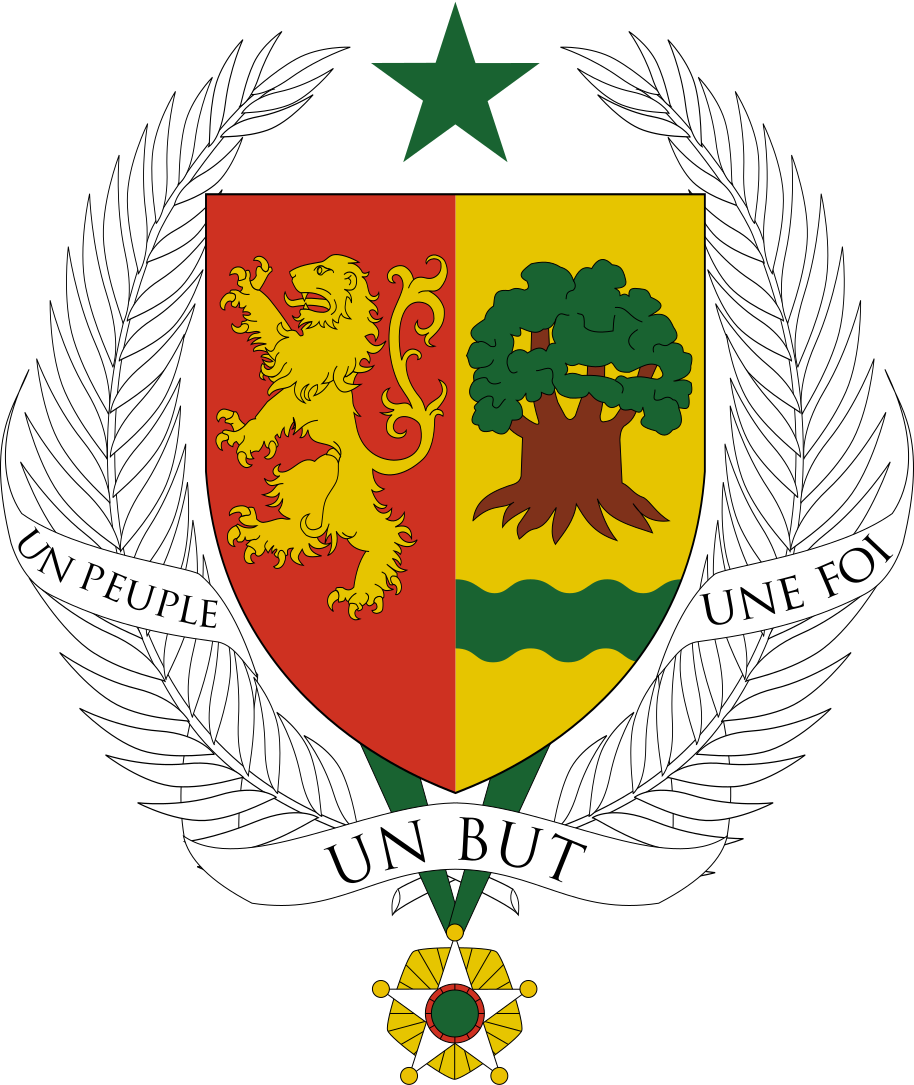
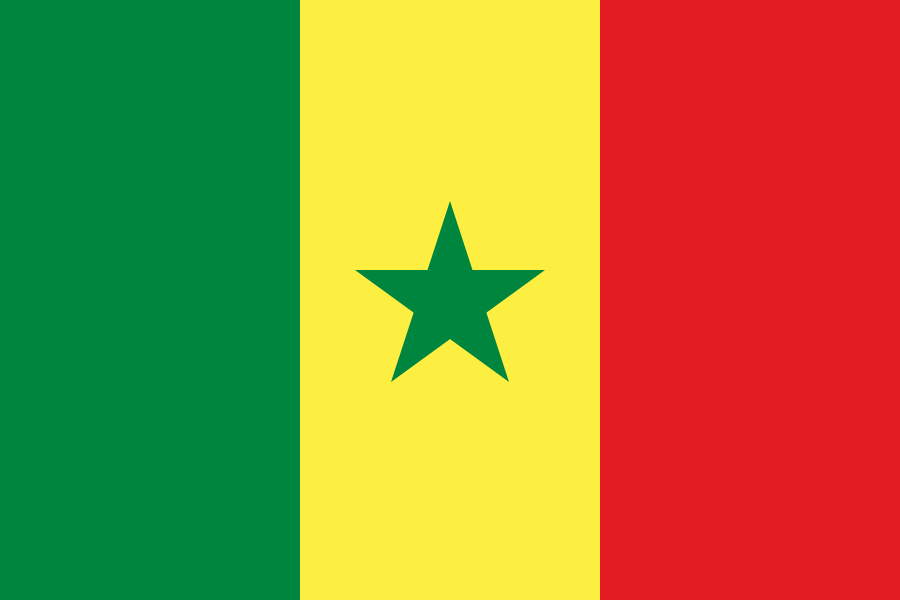
- Capital
- Dakar
- Population
- 18,593,258
- Region
- Africa · Western Africa
- Demonym
- Senegalese
- Currencies
- XOF (Fr)
- Languages
- French
- Calling code
- +221
- Drives on
- Right
- Gini
- 40.3 (2011)
- FIFA code
- SEN
- TLD
- .sn
- Timezones
- UTC
- Borders
- GMB, GIN, GNB, MLI, MRT
via REST Countries
Indicators · World Bank
- GDP
- $32.8B(2024)
- Population
- 18,501,984(2024)
- Life expectancy
- 68.9 yrs(2024)
- Unemployment
- 2.7 %(2025)
- Urban population
- 55.2 %(2024)
- Internet users
- 60.1 %(2024)
- Forest area
- 41.3 %(2023)
- Renewable energy
- 35.4 %(2021)
via World Bank Open Data · CC BY 4.0
Wikipedia views (30d)
114,760 totalvia Wikimedia Pageviews API
Key facts
- Country.area_rank
- 86th
- Country.conventional_long_name
- Republic of Senegal
- Country.common_name
- Senegal
- Country.image_flag
- Flag of Senegal.svg
- Country.image_coat
- Coat of arms of Senegal (official version).svg
- Country.image_map
- Senegal (orthographic projection).svg
- Country.national_motto
- ()
- Country.national_anthem
- ()
- Country.official_languages
- French
- Country.languages_type
- National languages
- Country.ethnic_groups_year
- 2019
- Country.religion_year
- 2019
- Country.demonym
- Senegalese
- Country.capital
- Dakar
- Country.largest_city
- capital
- Country.government_type
- Unitary presidential republic
- Country.leader_title1
- President
- Country.leader_name1
- Bassirou Diomaye Faye
via Wikipedia infobox
Research
16,291 papers- Senegal.Department of State publication. Background notes series · 1988United States. Department of State. Bureau of Public Affairs
- Senegal.Population policy compendium · 1980United Nations. Department of International Economic and Social Affairs, United Nations. Fund for Population Activities UNFPA
- Drivers of stunting reduction in Senegal: a country case study.The American journal of clinical nutrition · 2020Brar S, Akseer N, Sall M et al.DOI: 10.1093/ajcn/nqaa151
- Senegal.Department of State publication. Background notes series · 1991United States. Department of State. Bureau of Public Affairs
- Global Dialysis Perspective: Senegal.Kidney360 · 2020Niang A, Lemrabott ATDOI: 10.34067/KID.0000882020
- [Senegal].Jeune Afrique (Paris, France : 1980) · 1996
- Seoul Orthohantavirus in Wild Black Rats, Senegal, 2012-2013.Emerging infectious diseases · 2020Diagne MM, Dieng I, Granjon L et al.DOI: 10.3201/eid2610.201306
- Survey report: Senegal.Population today · 1988Kent MM
via PubMed
Wikidata facts
- Instance of
- country
- Named after
- Senegal River
- Official name
- Republic of Senegal
- Demonym
- Seineagálach
- Participant in
- Casamance conflict
- Country
- Senegal
- Contains
- Ziguinchor
- Continent
- Africa
- Capital
- Dakar
- Official language
- Balanta
- Currency
- West African CFA franc
- Population
- 16876720
- Area
- 196722
- Body of water
- Atlantic Ocean
- Head of government
- Bassirou Diomaye Faye
- Head of state
- Bassirou Diomaye Faye
- Form of government
- presidential system
- Legislature
- National Assembly
- Anthem
- Le Lion rouge
- Shares border with
- League of Arab States
- Official website
- www.sec.gouv.sn
- Image
- Flag map of Senegal.svg
- Life expectancy
- 67.146
- Nominal GDP
- 27684430244
Show 66 more facts
- Unemployment rate
- 10
- Calling code
- +221
- Licence plate code
- SN
- Mains voltage
- 230
- Motto
- Un bobl, un nod, un ffydd
- Flag
- flag of Senegal
- Coat of arms
- coat of arms of Senegal
- language used
- Bedik
- top-level Internet domain
- .sn
- Commons category
- Senegal
- member of
- African Continental Free Trade Area
- topic's main category
- Category:Senegal
- category for people who died here
- Category:Deaths in Senegal
- category for people born here
- Category:Births in Senegal
- category for films shot at this location
- Category:Films shot in Senegal
- category of associated people
- Category:Senegalese people
- diplomatic relation
- Poland
- Commons gallery
- Sénégal
- mobile country code
- 608
- lowest point
- Atlantic Ocean
- driving side
- right
- geography of topic
- Geography of Senegal
- age of majority
- 18
- marriageable age
- 16
- topic's main Wikimedia portal
- Portal:Senegal
- office held by head of government
- President of Senegal
- history of topic
- history of Senegal
- office held by head of state
- President of Senegal
- number of out-of-school children
- 1955454
- has characteristic
- free country
- located in/on physical feature
- West Africa
- different from
- Senegal River
- total fertility rate
- 5.09
- maritime identification digits
- 663
- on focus list of Wikimedia project
- Wikipedia:Vital articles/Level/4
- railway traffic side
- right
- inception
- 1960-01-01
- Unicode character
- 🇸🇳
- replaces
- French Community
- native label
- Senegaal
- described by source
- Brockhaus and Efron Encyclopedic Dictionary
- GS1 country code
- 604
- VAT rate
- 18
- BTI Status Index
- 5.97
- BTI Governance Index
- 6.71
- economy of topic
- economy of Senegal
- demographics of topic
- demographics of Senegal
- madhhab
- Malikism
- Democracy Index
- 5.67
- topic has template
- Template:Regions of Senegal
- Human Development Index
- 0.511
- P11012
- Star Wars
- central bank
- Central Bank of West African States
- hashtag
- Senegal
- Happy Planet Index score
- 51.2
- Gini coefficient
- 38.1
- Inequality-adjusted Human Development Index
- 0.354
- social media followers
- 13217
- P12749
- Montevideo
- birth rate
- 32.067
- male population
- 8516043
- death rate
- 5.548
- rural population
- 8816497
- female population
- 8800406
- urban population
- 8499952
- P8168
- Marc de Hemptinne
Sources (15)
via Wikidata · CC0
Travel guide
Get in
thumb|375px|A map showing the visa requirements of Senegal, with countries in green having visa-free access
Get around
thumb|Getting around in the rainy season can be challenging Taxi, taxi-brousse, taxi-clando, car-charette, and transport commun (cars rapides) Buslines in Dakar and around Dakar are maintained by SOTRAC (Société des Transports en commun de Cap Vert), now managed by a private company and called Dakar Demm Dikk. Car hire is available in Dakar (city and airport) and sometimes in MBour and Saly Portudal.
The main method of travel around the country is by sept places (from the French for "seven seats," literally questionable station wagons in which they will pack seven people so that you are basically sitting on the next person's lap throughout the journey). You can also come with a group and rent out an entire sept place, but this will be expensive. If you are obviously a tourist, they will try to rip you off, so make sure to set a price before you agree to a driver. If you want to travel more comfortably, buy 2 seats. There are set prices to often-travelled locations. The price per seat from Dakar to Ziguinchor, for example, is CFA9,500. Note that you also will have to negotiate a fee for luggage (CFA 500-1,000 per piece seems to be the going rate).
Little ride hailing app works in Senegal.
Keep in mind that if you wish to drive your own car, there are few street signs (mostly speed limits) and almost all of them are disregarded. Many streets are considered one way, but are never marked as such, and there are almost no stop signs. Heavy traffic areas such as Dakar are best l…
See
With arid desert and lush rainforests, Senegal boasts a stunning array of sights, sounds and flavours.
Lac Rose owes its name to its pink colouring for swimming and is also the terminus of the Dakar rally. Parc National du Niokolo-Noba is one of Senegal's major national parks and an international biosphere reserve.
Eat
thumb|Ceebu jen Be careful with food prepared by the road, as it could be cooked in unsanitary conditions. Western-style meals are available and can be found at restaurants in various parts of Dakar, Thies, Saint Louis and other towns and near the big hotels in the Petite Côte and in some other tourist regions of the country.
If you want to try genuine Senegalese food, you can buy it at many restaurants; or alternatively, you can make it yourself with the food gathered fresh from the markets or supermarkets.
The official dish of Senegal is ceebu jen (or thebou diene), which is rice and fish. It comes in two varieties (red and white, named after the respective sauces). The Senegalese love ceebu jen and will often ask if you've ever tried it, and it is definitely part of the experience. Even better if you get the chance to eat with your hands around the bowl with a Senegalese family. Keep your eyes out for the delicious, but elusive ceebu jen "diagga", which is served with extra sauce and fish balls.
Other common dishes are maafe, which is a rich, oily peanut-based sauce with meat that is served over white rice. Yassa is a delicious onion sauce that is often served over rice and chicken, yassa poulet or with deep fried fish yassa jen.
Drink
If you intend to explore the arid area of Senegal (Saint-Louis & Ferlo), you need to drink several litres of water a day. Even in Dakar, dehydration is possible during warmer months if you do not drink sufficient water.
Stay safe
Although highly exaggerated, there is still fighting going on in the Casamance region of Senegal.
The "struggle" goes on between the government and the Mouvement des forces démocratiques de la Casamance (MFDC). It would be wise to avoid travel to this area. If this is not possible, at least first check with the embassy for the latest situation. To find out how much the situation has improved look at this IRIN News report:
In Dakar, take care when walking the streets: petty theft and scams are abundant. You will be approached by aggressive street vendors who will follow you for several blocks. If refused, often accusations of 'racism" will be leveled at white non-local non-buyers. Also, pickpockets use the following two-person tactic: one (the distraction) will grab one of your legs while the other (the thief) goes into your pocket. If someone grabs your clothing, beware the person on the other side more. Wear trousers/shorts with secure (buttons or snaps) pockets and leave your shirt untucked to cover the pockets.
Be cautious of people claiming to have met you before or offering to guide you. Often, you will be led to a remote location and robbed. Women need to be particularly alert as they are frequently targeted at beaches or markets.
Finally, there have been instances of street stall vendors grabbing cash out of non-local shoppers' hands and quickly stuffing the money into their own pocket. After the money is in their pocket, they claim it is theirs and the victim is …
Stay healthy
Get necessary vaccines before arrival. Officially, certification of yellow fever vaccine is required upon arrival if coming from a country in a yellow fever zone, but it is not commonly checked.
Take anti-malarials.
Avoid tap water and all dishes prepared with it. Bottled water, such as Kirene which is most common and bottled in Senegal, is widely available and inexpensive.
To prevent serious effects of dehydration, it is wise to carry around packets of rehydration salts to mix with water, should you become dehydrated. These are widely available at pharmacies and are inexpensive. Alternatively, a proper mix of table salt and sugar can replace these.
Emergency numbers and contact details for health services:
Ambulance (SAMU): 15 15 SOS Médecins: +221 33 889 15 15 15 Hôpital Principal (Dakar): +221 33 839 50 50 (poste 5555) Clinique de la Madeleine (Dakar): +221 33 889 94 70 Clinique de l'Océan (Dakar): +221 33 825 69 37
Respect
The Senegalese in general are very friendly and hospitable.
Travel guide from Wikivoyage (CC BY-SA 4.0)
~40 min read
Encyclopedic overview
45 sectionsContents
- Etymology
- History
- Early and pre-colonial eras
- Colonial era
- Independence
- 1980 to present
- Government and politics
- Political culture
- Leadership in World governance initiatives
- Administrative divisions
- Foreign relations
- Military
- Law
- Geography
- Climate
- Wildlife
- Economy
- Industry and trade
- Agriculture
- Fishing
- Energy
- Demographics
- Gender
- Ethnic groups
- Languages
- Largest cities
- Religion
- Health
- Education
- Culture
- Cuisine
- Music
- Cinema
- Media
- Hospitality
- Sport
- See also
- Explanatory notes
- References
- Further reading
- External links
- Government
- History
- Tourism
- Maps
Senegal, officially the Republic of Senegal, is the westernmost country in West Africa, situated along the Atlantic Ocean coast. It borders Mauritania to the north, Mali to the east, Guinea to the southeast and Guinea-Bissau to the southwest. Senegal nearly surrounds the Gambia, a country occupying a narrow strip of land along the banks of the Gambia River, which separates Senegal's southern region of Casamance from the rest of the country. It also shares a maritime border with Cape Verde. The capital and largest city of Senegal is Dakar.
Senegal is the westernmost country in the mainland of the Old World, or Afro-Eurasia. It owes its name to the Senegal River, which borders it to the north and east. The climate is typically Sahelian, with a rainy season. Senegal covers a land area of almost 197,000 square kilometres (76,000 sq mi) and has a population of around 18 million. The state is a semi-presidential republic; since the country's foundation in 1960, it has been recognized as one of the most stable countries on the African continent. On the 2024 V-Dem Democracy Indices, Senegal is ranked 68th in electoral democracy worldwide and 10th in electoral democracy in Africa.
Excerpted from Wikipedia’s “Senegal” article, available under the CC BY-SA 4.0 licence.
Gallery (59)
On the map
6 mapped locations
Available in 255 languages
- Español
- Français
- Deutsch
- 中文
- 日本語
- Русский
- Português
- Italiano
- العربية
- हिन्दी
- Abkhazian
- Achinese
- Adyghe
- Afrikaans
- Akan
- Albanian
- Albanian
- Amharic
Show 236 more
- ami
- Angika
- Aragonese
- Armenian
- Arpitan
- Asturian
- azb
- Azerbaijani
- Bahasa Indonesia
- Balinese
- Bambara
- Bangla
- Banjar
- Bashkir
- Basque
- bat_smg
- Bavarian
- be_x_old
- Belarusian
- Betawi
- Bhojpuri
- Bikol
- Bishnupriya
- Bislama
- Bosnian
- Breton
- Bulgarian
- Buriat
- Burmese
- Catalan
- cbk_zam
- cdo
- Cebuano
- Central Kurdish
- Chechen
- Chuvash
- Cornish
- Corsican
- Crimean Tatar
- Croatian
- Czech
- dag
- Danish
- dga
- Divehi
- dty
- Egyptian Arabic
- Esperanto
- Estonian
- Ewe
- Extremaduran
- Faroese
- Fiji Hindi
- Filipino
- Finnish
- fiu_vro
- Fon
- Frafra
- Fula
- Gagauz
- Galician
- Ganda
- gcr
- Georgian
- Gilaki
- gpe
- Greek
- Guarani
- Haitian Creole
- Hakka Chinese
- Hausa
- Hebrew
- Hungarian
- Icelandic
- Ido
- Igbo
- Iloko
- Inari Sami
- Interlingua
- Interlingue
- Irish
- Jamaican Creole English
- Javanese
- Jju
- Kabyle
- kai
- Kannada
- Kanuri
- Kara-Kalpak
- Karachay-Balkar
- Kazakh
- kbp
- kge
- Khmer
- Kikuyu
- Kinyarwanda
- Kongo
- Kotava
- Kurdish
- Kyrgyz
- Ladino
- Lao
- Latin
- Latvian
- Ligurian
- Limburgish
- Lingala
- Lingua Franca Nova
- Lithuanian
- lld
- Lojban
- Lombard
- Low German
- Lower Sorbian
- Luxembourgish
- Macedonian
- Malagasy
- Malay
- Malayalam
- Maltese
- Manipuri
- Manx
- Māori
- Marathi
- Mari
- Mazanderani
- Minangkabau
- Mingrelian
- Mirandese
- Moksha
- Mongolian
- Moroccan Arabic
- N’Ko
- nds_nl
- Neapolitan
- Nederlands
- Nepali
- Newari
- Northern Frisian
- Northern Sami
- Northern Sotho
- Norwegian
- Norwegian Nynorsk
- Novial
- nup
- Obolo
- Occitan
- Old English
- olo
- Oromo
- Ossetic
- Pampanga
- Papiamento
- Pashto
- Piedmontese
- Polski
- Punjabi
- Quechua
- Romanian
- Rusyn
- Samoan
- Sango
- Sanskrit
- Santali
- Sardinian
- Saterland Frisian
- Scots
- Scottish Gaelic
- Serbian
- Serbian (Latin)
- Shan
- Shona
- Sicilian
- Silesian
- simple
- Sindhi
- Sinhala
- Slovak
- Slovenian
- Somali
- South Ndebele
- Southern Sotho
- Standard Moroccan Tamazight
- Sundanese
- Svenska
- Swahili
- szy
- Tachelhit
- Tajik
- Talysh
- Tamil
- Taroko
- Tatar
- tay
- Telugu
- Tibetan
- Tiếng Việt
- Tigrinya
- Tok Pisin
- Toki Pona
- Tsonga
- Tswana
- Tumbuka
- Türkçe
- Turkmen
- Tyap
- Udmurt
- Ukrainian
- Upper Sorbian
- Urdu
- Uyghur
- Uzbek
- Venetian
- Veps
- Volapük
- Walloon
- Waray
- Welsh
- Western Frisian
- Western Mari
- Western Panjabi
- Wolof
- Wu Chinese
- Yakut
- Yiddish
- Yoruba
- Zaza
- Zeelandic
- zh_classical
- zh_min_nan
- zh_yue
- Zhuang
- Zulu
- فارسی
- ไทย
- 한국어
via Wikidata sitelinks · CC0