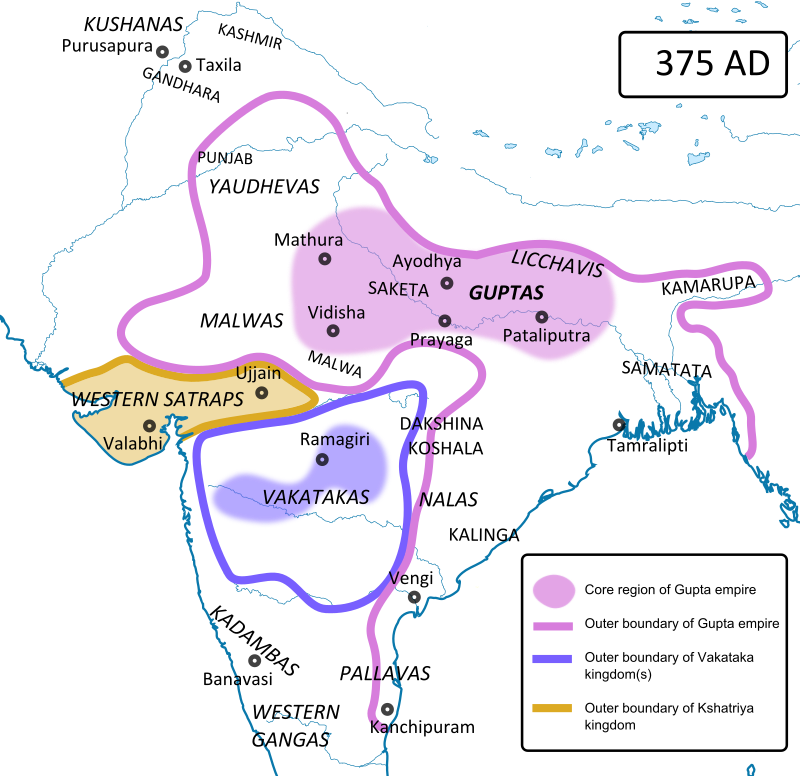
File:South_Asia_historical_AD375_EN.svg · Wikimedia Commons · See Wikimedia Commons
Gupta Empire
Sign in to saveAlso known as Gupta dynasty, Golden age of India
ancient Indian empire (c. 3rd century CE–575 CE)
The Gupta Empire was a powerful ancient Indian kingdom that ruled from around the 3rd century to 575 CE, during which time it became one of history's most influential civilizations. It matters because this period saw remarkable achievements in science, mathematics, literature, and art that shaped Indian culture and had lasting impacts on the wider world.
AI-generated from the Wikipedia summary — may contain errors.
Wikidata facts
- Instance of
- country
- Continent
- Asia
- Capital
- Pataliputra
- Official language
- Sanskrit
- Form of government
- monarchy
Show 10 more facts
- dissolved, abolished or demolished date
- 0550-01-01
- Commons category
- Gupta Empire
- topic's main category
- Category:Gupta Empire
- inception
- 0320-00-00
- replaces
- Western Satraps
- on focus list of Wikimedia project
- Wikipedia:Vital articles/Level/4
- described by source
- Encyclopædia Britannica 11th edition
- native label
- गुप्त राजवंश
- official religion
- Buddhism
- language used
- Sanskrit
via Wikidata · CC0
~35 min read
Encyclopedic overview
The Gupta Empire was an Indian empire during the classical period of the Indian subcontinent which existed from the mid 3rd century to mid 6th century CE. At its peak, the dynasty ruled over an empire that spanned much of the northern Indian subcontinent. This period has been considered as the Golden Age of India by some historians, although this characterisation has been disputed by others. The ruling dynasty of the empire was founded by Gupta.
The high points of the period are the great cultural developments which took place primarily during the reigns of Samudragupta, Chandragupta II and Kumaragupta I. Many Hindu epics and literary sources, such as the Mahabharata and Ramayana, were canonised during this period. The Gupta period produced scholars such as Kalidasa, Aryabhata, Varahamihira and Vatsyayana, who made significant advancements in many academic fields. Science and political administration reached new heights during the Gupta era. The period, sometimes described as Pax Gupta, gave rise to achievements in architecture, sculpture, and painting that "set standards of form and taste [that] determined the whole subsequent course of art, not only in India but far beyond her borders". Strong trade ties also made the region an important cultural centre and established the region as a base that would influence nearby kingdoms and regions in India and Southeast Asia. The Puranas, earlier long poems on a variety of subjects, are also thought to have been committed to written texts around this period. Hinduism was followed by the rulers and the Brahmins flourished in the Gupta empire but the Guptas were tolerant towards people of other faiths as well.
Excerpted from Wikipedia’s “Gupta Empire” article, available under the CC BY-SA 4.0 licence.
Gallery (12)
Available in 113 languages
- Español
- Français
- Deutsch
- 中文
- 日本語
- Русский
- Português
- Italiano
- العربية
- हिन्दी
- Afrikaans
- Albanian
- Albanian
- Angika
- Aragonese
- Armenian
- Assamese
- Asturian
Show 94 more
- azb
- Azerbaijani
- Bahasa Indonesia
- Bangla
- Bashkir
- Basque
- bat_smg
- be_x_old
- Belarusian
- Bhojpuri
- Bikol
- Bishnupriya
- Bosnian
- Breton
- Bulgarian
- Catalan
- Central Kurdish
- Chechen
- Cornish
- Crimean Tatar
- Croatian
- Czech
- Danish
- Egyptian Arabic
- Esperanto
- Estonian
- Faroese
- Fiji Hindi
- Filipino
- Finnish
- Galician
- Georgian
- Greek
- Gujarati
- Hebrew
- Hungarian
- Icelandic
- Iloko
- Kabardian
- Kannada
- Kazakh
- kbp
- Latin
- Latvian
- Lingua Franca Nova
- Lithuanian
- lld
- Low German
- Macedonian
- Malay
- Malayalam
- Marathi
- Nederlands
- Nepali
- Newari
- Northern Frisian
- Norwegian
- Norwegian Nynorsk
- Occitan
- Piedmontese
- Polski
- Punjabi
- Romanian
- Rusyn
- Sanskrit
- Serbian
- Serbian (Latin)
- simple
- Sindhi
- Sinhala
- Slovenian
- Svenska
- Swahili
- Tajik
- Tamil
- Telugu
- Tiếng Việt
- Türkçe
- Turkmen
- Ukrainian
- Urdu
- Uzbek
- Veps
- Waray
- Welsh
- Western Panjabi
- Wu Chinese
- Yiddish
- zh_min_nan
- zh_yue
- Zhuang
- فارسی
- ไทย
- 한국어
via Wikidata sitelinks · CC0