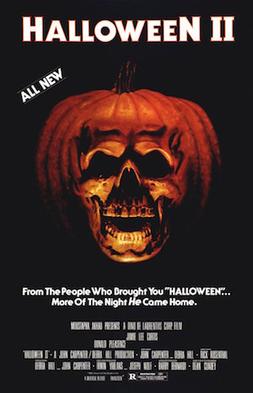
File:Halloween_II_(1981)_theatrical_poster.jpg · Wikimedia Commons · See Wikimedia Commons
Halloween II
Sign in to save1981 film by Rick Rosenthal
Film · TMDB
6.6After failing to kill stubborn survivor Laurie and taking a bullet or six from former psychiatrist Dr. Sam Loomis, Michael Myers has followed Laurie to the Haddonfield Memorial Hospital, where she's been admitted for Myers' attempt on her life. The institution proves to be particularly suited to serial killers, however, as Myers cuts, stabs and slashes his way through hospital staff to reach his favorite victim.
Cast
- Jamie Lee Curtis as Laurie Strode
- Donald Pleasence as Dr. Sam Loomis
- Charles Cyphers as Sheriff Leigh Brackett
- Jeffrey Kramer as Graham
- Lance Guest as Jimmy Lloyd
- Pamela Susan Shoop as Karen
Themes
- mask
- sheriff
- halloween
- sequel
- serial killer
- hospital
- killing spree
- holiday horror
This product uses the TMDB API but is not endorsed or certified by TMDB.
Ratings
IMDb
6.5/10
111,200 votes
Rotten Tomatoes
34%
Metacritic
40/100
- Year
- 1981
- Runtime
- 92 min
- Genres
- Horror
- Rated
- R
- Awards
- 1 win & 3 nominations total
via OMDb · IMDb
Key facts
- Directed by
- Rick Rosenthal
- Written by
- John Carpenter Debra Hill
- Produced by
- Debra Hill John Carpenter
- Starring
- Jamie Lee Curtis Donald Pleasence
- Cinematography
- Dean Cundey
- Edited by
- Mark Goldblatt Skip Schoolnik
- Music by
- John Carpenter Alan Howarth
- Production company
- Dino De Laurentiis Corporation
- Distributed by
- Universal Pictures
- Release date
- October 30, 1981 ( 1981-10-30 )
- Running time
- 92 minutes
- Country
- United States
- Language
- English
- Budget
- $2.5 million
- Box office
- $25.5 million (North America)
via Wikipedia infobox
Wikidata facts
- Instance of
- film
- Genre
- slasher film
- Country of origin
- United States
- Original language
- English language
- Series
- Halloween (franchise)
- Followed by
- Halloween H20: 20 Years Later
- Follows
- Halloween (1978 film)
- Director
- Rick Rosenthal
- Screenwriter
- Debra Hill
- Cast member
- Kyle Richards
- Composer
- John Carpenter
- Producer
- Debra Hill
- Production company
- Universal Pictures
- Cinematographer
- Dean Cundey
- Duration
- 90
- FilmAffinity ID
- 609722
- Distribution format
- video on demand
- Official website
- www.halloweenmovies.com
- Image
- Halloween2bann.jpg
Show 9 more facts
- publication date
- 1981-10-30
- film editor
- Mark Goldblatt
- title
- Halloween II
- distributed by
- Netflix
- set during recurring event
- Halloween
- assessment
- Bechdel test
- set in environment
- hospital
- review score
- 36%
- capital cost
- 2500000
Sources (15)
via Wikidata · CC0
~38 min read
Encyclopedic overview
Halloween II is a 1981 American slasher film directed by Rick Rosenthal, in his directorial debut, written and produced by John Carpenter and Debra Hill, and starring Jamie Lee Curtis and Donald Pleasence, who reprise their respective roles as Laurie Strode and Dr. Sam Loomis. It is the second installment in the Halloween film series and serves as a direct sequel to Halloween (1978). The story picks up immediately after the cliffhanger ending of the first film, with Michael Myers (Dick Warlock) following survivor Laurie Strode to the local hospital, while his psychiatrist Dr. Loomis continues his pursuit of him.
Though Carpenter and Hill co-wrote the screenplay to the sequel, Carpenter was reluctant to extend his involvement and declined to direct, instead appointing the direction to Rosenthal. Filming took place in the spring of 1981, primarily at Morningside Hospital in Los Angeles, California, on a budget of $2.5 million. Stylistically, Halloween II reproduces certain key elements that made the original Halloween a success, such as first-person camera perspectives, and was intended to finish the story of Michael Myers and Laurie Strode. It also introduces the plot twist of Laurie Strode being the sister of Michael Myers, an element that would form the narrative arc of the series in subsequent films after Halloween II—including Rob Zombie's remake and its sequel—but was dropped from the current series' canon from the 2018 film onwards.
Excerpted from Wikipedia’s “Halloween II” article, available under the CC BY-SA 4.0 licence.