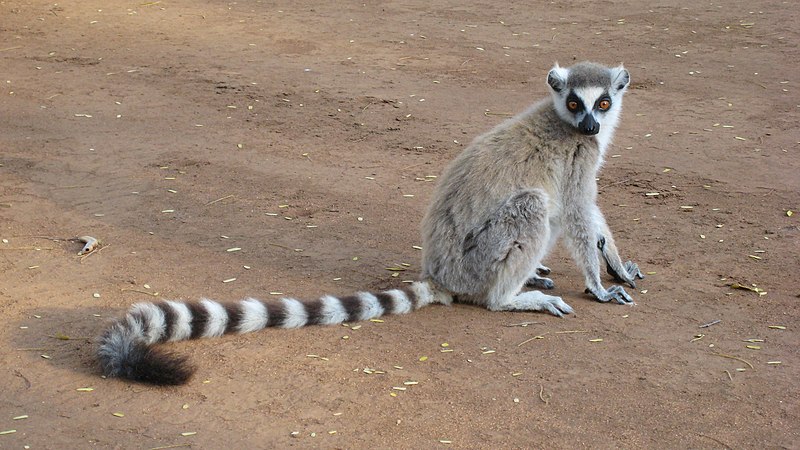
File:Lemur_catta_001.jpg · Wikimedia Commons · See Wikimedia Commons
primate
Sign in to saveAlso known as the primate order, primates
Primates is an order of mammals, which is further divided into the strepsirrhines, which include lemurs, galagos, and lorisids; and the haplorhines, which include tarsiers and simians (monkeys and apes). Primates arose 74–63 million years ago first from small terrestrial mammals, which adapted for life in tropical forests: many primate characteristics represent adaptations to the challenging environment among tree tops, including large brain sizes, binocular vision, color vision, vocalizations, shoulder girdles allowing a large degree of movement in the upper limbs, and opposable thumbs (
OverviewAI-generated
Primates is an order of mammals within the class Mammalia, phylum Chordata, and subclass Placentalia. The taxon was established by Linnaeus in 1758 and belongs to the parent taxa Primatomorpha and mammal. It is an accepted order in the World Register of Marine Species. The group has been studied by the field of primatology.
The temporal range of the order begins in the Paleocene, with start times cited as about 55 million years ago or about 80 million years ago. Records of the organism are held by institutions including WSU and UWSP in the United States. A list of primates is available, and the topic is maintained by WikiProject Primates, WikiProject Mammals, and WikiProject Tree of Life.
Synthesized by Vinony from 33 facts across 5 sources: Wikidata, PubMed, WoRMS, iDigBio, Vinony graph. Generated from structured data (not the Wikipedia text) and checked against those facts — may still contain errors.
Species
Order
- PhylumChordata
- ClassMammalia
- OrderPrimates
灵长目(学名:Primates)是哺乳纲的一个目,在生物分类学上,可以再細分原猴及簡鼻亞目(包括人)[1]。灵长目的始祖住在熱帶雨林的樹上,許多灵长目的特徵表現了其適應三維立體環境的能力,大部份的灵长目至少有部份樹棲(英语:arboreal)的能力。 大部份人以外的灵长目住在美洲、亞洲及非洲的熱帶或是亞熱帶區域[2],只有人類可以住在南極洲以外的任何地區[3]。灵长目的體型變化很大,像伯特夫人狐猴(英语:Madame Berthe's mouse lemur)體重只有30克,而東部大猩猩體重達200公斤。依照化石的證據,最早已知的灵长目是德氏猴,其年代可以追溯到5580萬年以前[4]。分子鐘認為灵长目的分支可能起源於白堊紀-古近紀界線,約六七千萬年前[5][6][7][8]。 灵长目过去一般會分為二類:原猴及類人猿。原猴的特徵接近最早期的灵长目,包括馬達加斯加的狐猴、懶猴下目(英语:Lorisoidea)及跗猴。類人猿包括猴、猿及人族。最近的生物分類學會將灵长目分為原猴亞目(Strepsirrhini)及簡鼻亞目(Haplorhini)。原猴亞目是指鼻部濕潤的灵长目,包括跗猴以外的原猴,簡鼻亞目是指鼻部乾燥的灵长目,包括跗猴型下目(Tarsiiformes)及類人猿下目(Simiiformes)。 類人猿下目也可以分為狹鼻小目(非洲及東南亞的猿及猴)及闊鼻小目(中美及南美的新世界猴)。狹鼻小目包括舊世界猴(像狒狒屬及獼猴)、长臂猿及人科。新世界猴包括卷尾猴、吼猴及松鼠猴屬。人類是其中唯一成功在非洲、南亞及東亞以外地區繁衍的狹鼻小目動物,不過有化石證據指出其他狹鼻小目動物也曾出現在歐洲。現在仍有發現新的灵长目物種,在2000年代找到了超過25個物種,在2010年代也已找到了11個物種。 灵长目是適應性良好的哺乳類動物,有許多不同的特點。有些灵长目(包括一些大猿和狒狒)主要是陆栖動物,不是树栖動物。但其他的灵长目都可以爬樹。行動方式包括從一棵树跳到另一棵树、用二隻或四隻腳行走,指關節行走(英语:knuckle-walking)或是在樹枝上擺盪(握枝现象(英语:[brachiation]]))。 相對於其他的哺乳類,灵长目的大腦大了許多,灵长目也比較依賴立体视觉,而其嗅覺就不如大多數動物。在猿及猴身上這類的特徵更加明顯,但在懶猴及狐猴身上就不太明顯。有些灵长目有三色視覺(英语:Trichromacy),大部份也有对生拇指,甚至有些會有适于抓取的尾巴。許多灵长目會有 两性异形,差異包括體重、犬齒大小及顏色。灵长目的發育比其他體型相當的動物要晚,也較晚成熟,但其壽命也較長。依物種的不同,成年的灵长目可能是獨自生活、成對生活,或是成群生活。 目录 1 歷史和現代術語 2 特征 2.1 比较解剖学 2.2 生物化学 3 分类 3.1 内部分类 4 社会行为 5 起源 6
via
Museum specimens
- Specimen records
- 3
- With media
- 1
- Collections
- WSU, UWSP
- Recorded in
- United States, Unknown Or Unspecified
Research
23,629,451 papers- Primate genomes.ReviewGenome dynamics · 2006Herlyn H, Zischler HDOI: 10.1159/000095090
- Nonhuman primate dentistry.ReviewThe veterinary clinics of North America. Exotic animal practice · 2003Wiggs RB, Hall BDOI: 10.1016/s1094-9194(03)00039-2
- Primate cognition.ReviewTopics in cognitive science · 2010Seed A, Tomasello MDOI: 10.1111/j.1756-8765.2010.01099.x
- Why primate models matter.ReviewAmerican journal of primatology · 2014Phillips KA, Bales KL, Capitanio JP et al.DOI: 10.1002/ajp.22281
- Eye-tracking as a window into primate social cognition.ReviewAmerican journal of primatology · 2022Lewis LS, Krupenye CDOI: 10.1002/ajp.23393
- Comparative morphology of the primate tongue.ReviewAnnals of anatomy = Anatomischer Anzeiger : official organ of the Anatomische Gesellschaft · 2019Iwasaki SI, Yoshimura K, Shindo J et al.DOI: 10.1016/j.aanat.2019.01.008
- Integrating culture into primate conservation.ReviewPhilosophical transactions of the Royal Society of London. Series B, Biological sciences · 2025Izar P, van de Waal E, Robbins MMDOI: 10.1098/rstb.2024.0135
- 'Emptying Forests?' Conservation Implications of Past Human-Primate Interactions.ReviewTrends in ecology & evolution · 2021Amano N, Wang YV, Boivin N et al.DOI: 10.1016/j.tree.2020.12.004
via PubMed
Wikidata facts
Show 16 more facts
- taxon rank
- order
- taxon name
- Primates
- Commons category
- Primates
- topic's main category
- Category:Primates
- MCN code
- 0106.11.00
- Commons gallery
- Primates
- equivalent class
- kbpedia.org/kko/rc/Primate
- start time
- 79600000-0
- topic has template
- Template:Primate-stub
- on focus list of Wikimedia project
- Wikipedia:Vital articles/Level/4
- described by source
- Encyclopædia Britannica 11th edition
- topic's main Wikimedia portal
- Portal:Primates
- has list
- list of primates
- taxon common name
- primater
- maintained by WikiProject
- WikiProject Tree of Life
- temporal range start
- Paleocene
Sources (6)
via Wikidata · CC0
~58 min read
Encyclopedic overview
37 sectionsContents
- Etymology and classification
- Common names
- Classification
- Phylogeny and genetics
- Evolutionary history
- Hybrids
- Clones
- Anatomy and physiology
- Head
- Body
- Sexual dimorphism
- Locomotion
- Vision
- Behavior
- Social systems
- Interspecific associations
- Mating systems
- Sexual behavior
- Life history
- Diet and feeding
- Hunting
- As prey
- Communication
- Intelligence and cognition
- Tool use and manufacture
- Ecology
- Interactions between humans and other primates
- Disease transmission
- Legal and social status
- Role in scientific research
- Extinction threats
- See also
- Footnotes
- References
- Literature cited
- Further reading
- External links
Primates is an order of mammals, which is further divided into the strepsirrhines, which include lemurs, galagos, and lorisids; and the haplorhines, which include tarsiers and simians (monkeys and apes). Primates arose 74–63 million years ago first from small terrestrial mammals, which adapted for life in tropical forests: many primate characteristics represent adaptations to the challenging environment among tree tops, including large brain sizes, binocular vision, color vision, vocalizations, shoulder girdles allowing a large degree of movement in the upper limbs, and opposable thumbs (in most but not all) that enable better grasping and dexterity. Primates range in size from Madame Berthe's mouse lemur, which weighs , to the eastern gorilla, weighing over . There are 376–524 species of living primates, depending on which classification is used. New primate species continue to be discovered: over 25 species were described in the 2000s, 36 in the 2010s, and six in the 2020s.
Primates have large brains (relative to body size) compared to other mammals, as well as an increased reliance on visual acuity at the expense of the sense of smell, which is the dominant sensory system in most mammals. These features are more developed in monkeys and apes, and noticeably less so in lorises and lemurs. Some primates, including gorillas, humans and baboons, are primarily ground-dwelling rather than arboreal, but all species have adaptations for climbing trees. Arboreal locomotion techniques used include leaping from tree to tree and swinging between branches of trees (brachiation); terrestrial locomotion techniques include walking on two hindlimbs (bipedalism) and modified walking on four limbs (quadrupedalism) via knuckle-walking.
Excerpted from Wikipedia’s “primate” article, available under the CC BY-SA 4.0 licence.
Gallery (56)
Available in 146 languages
- Español
- Français
- Deutsch
- 中文
- 日本語
- Русский
- Português
- Italiano
- العربية
- हिन्दी
- abstract
- Achinese
- Afrikaans
- Albanian
- Albanian
- Amharic
- Aragonese
- Armenian
Show 127 more
- Assamese
- Asturian
- azb
- Azerbaijani
- Bahasa Indonesia
- Balinese
- Bangla
- Bashkir
- Basque
- bat_smg
- be_x_old
- Belarusian
- Bosnian
- Breton
- Bulgarian
- Burmese
- Catalan
- Cebuano
- Central Kurdish
- Chuvash
- Cornish
- Croatian
- Czech
- Danish
- Egyptian Arabic
- Esperanto
- Estonian
- Extremaduran
- Fiji Hindi
- Filipino
- Finnish
- Galician
- Georgian
- Gorontalo
- Greek
- Guarani
- Haitian Creole
- Hebrew
- Hungarian
- Icelandic
- Interlingua
- Irish
- Javanese
- Kannada
- Kashmiri
- Kazakh
- Komi-Permyak
- Kotava
- Kurdish
- Kyrgyz
- Latin
- Latvian
- Lezghian
- Ligurian
- Limburgish
- Lingua Franca Nova
- Lithuanian
- Lombard
- Low German
- Luxembourgish
- Macedonian
- Madurese
- Malagasy
- Malay
- Malayalam
- Minangkabau
- Mingrelian
- Moroccan Arabic
- Navajo
- Nederlands
- Nepali
- Newari
- Northern Frisian
- Norwegian
- Norwegian Nynorsk
- Novial
- nrm
- Occitan
- Oromo
- Ossetic
- Papiamento
- Pashto
- Piedmontese
- Polski
- Punjabi
- Quechua
- Romanian
- Rusyn
- Scots
- Serbian
- Serbian (Latin)
- Sicilian
- simple
- Sindhi
- Slovak
- Slovenian
- Standard Moroccan Tamazight
- Sundanese
- Svenska
- Swahili
- Tamil
- Tatar
- Telugu
- Tiếng Việt
- Toki Pona
- Türkçe
- Udmurt
- Ukrainian
- Urdu
- Uzbek
- Veps
- Waray
- Welsh
- West Flemish
- Western Frisian
- Western Panjabi
- Wu Chinese
- Yakut
- Yiddish
- Yoruba
- Zaza
- zh_min_nan
- zh_yue
- Zulu
- فارسی
- ไทย
- 한국어
via Wikidata sitelinks · CC0