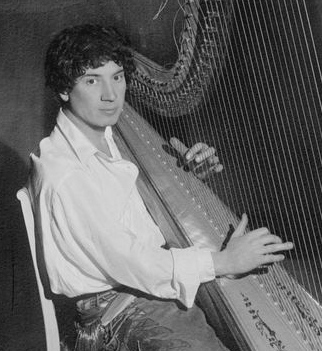
File:Harpo_Marx_playing_the_harp_(cropped).jpeg · Wikimedia Commons · See Wikimedia Commons
Person · Open Library
- Born
- 1888
- Died
- 1964
- Works
- 4
Top works
- Harpo speaks!
- Harpo speaks!
- Harpo speaks-- about New York
via Open Library + Wikidata
Film & TV
New York City, New York, USA
Arthur Adolph "Harpo" Marx (November 23, 1888 – September 28, 1964) was an American comedian and film star. He was the second oldest of the Marx Brothers. His comic style was influenced by clown and pantomime traditions. He wore a curly reddish wig, and never spoke during performances (he blew a horn or whistled to communicate). Marx frequently used props such as a walking stick with a built-in…
Known for
- The Marx Brothers: Hollywood's Kings of Chaos — Self (archive footage)2016
- Dalí & Disney: A Date with Destino — Self (archive footage)2010
- Inside the Marx Brothers — Self (archive footage)2003
- The Our Gang Story — Self (archive footage)1994
- The Unknown Marx Brothers — Self (archive footage)1993
- The Ten-Year Lunch — Himself (archive footage)1987
- Classic Comedy Teams — Self (archive footage)1986
- Going Hollywood: The '30s — (archive footage)1984
- Hollywood Out-takes and Rare Footage — Self (archive footage) (uncredited)1983
- Showbiz Goes to War — (archive footage)1982
via TMDB
Key facts
- Born
- Adolph Marx , ( 1888-11-23 ) November 23, 1888, New York City, New York, U.S.
- Died
- September 28, 1964 (1964-09-28) (aged 75), Los Angeles, California, U.S.
- Occupations
- Comedian actor mime artist harpist
- Years active
- 1910–1964
- Spouse
- Susan Fleming ( married</span>"}]]}'>m. 1936 )
- Children
- 4, including Bill Marx
- Parents
- Sam "Frenchie" Marx (father) Minnie Schönberg (mother)
- Relatives
- Chico Marx (older brother) Groucho Marx (younger brother) Gummo Marx (younger brother) Zeppo Marx (younger brother) Al Shean (maternal uncle) Arthur Marx (nephew) Miriam Marx (niece) Melinda Marx (niece)
via Wikipedia infobox
Wikidata facts
- Instance of
- human
- Given name
- Arthur
- Family name
- Marx
- Gender
- male
- Citizenship
- United States
- Place of birth
- New York City
- Place of death
- Los Angeles
- Spouse
- Susan Fleming
- Mother
- Minnie Marx
- Sibling
- Groucho Marx
- Occupation
- film actor
- Languages spoken
- English language
- Student of
- Henriette Renié
- Instrument
- harp
- Record label
- RCA Victor
- Image
- Harpo Marx playing the harp (cropped).jpeg
- Number of children
- 4
Show 11 more facts
- member of
- Marx Brothers
- Commons category
- Harpo Marx
- date of birth
- 1888-11-23
- date of death
- 1974-09-28
- birth name
- Adolph Marx
- pseudonym
- Harpo Marx
- cause of death
- myocardial infarction
- manner of death
- natural causes
- start of work period
- 1910-00-00
- name in native language
- Harpo Marx
- end of work period
- 1964-00-00
Sources (3)
via Wikidata · CC0
~23 min read
Encyclopedic overview
Lobby card for Monkey Business (1931) with Chico (left) and Harpo (right) Arthur "Harpo" Marx (born Adolph Marx; November 23, 1888 – September 28, 1964) was an American comedian and harpist, and the second-oldest of the Marx Brothers. In contrast to the mainly verbal comedy of his brothers Groucho and Chico, Harpo's comic style was visual, being an example of vaudeville, clown and pantomime traditions. In all of his movie appearances, he wore a curly reddish blonde wig and did not speak, instead blowing a horn or whistling to communicate. Marx frequently employed props such as a horn cane constructed from a lead pipe, tape, and a bulbhorn.
Most of the Marx Brothers' stage and film appearances included a song performed by Harpo on the harp in his unique style, for example "When My Dreams Come True" in The Cocoanuts (1929) and "Alone" in A Night at the Opera (1935).
Excerpted from Wikipedia’s “Harpo Marx” article, available under the CC BY-SA 4.0 licence.