Encyclopedia of Life · EOL (see source)
Hericiaceae
Sign in to saveThe Hericiaceae are a family of fungi in the order Russulales. The best known genus is Hericium, species of which are valued for their medicinal properties in Oriental medicine. Taxa are mainly known from north temperate regions, and are saprobic on rotting wood. Phylogenetic analysis suggests that Hericiaceae belongs to the russuloid clade of homobasidiomycetes, and morphological and molecular evidence links it with the families Auriscalpiaceae, Bondarzewiaceae and Echinodontiaceae. Originally proposed in 1961 by Taisiya Lvovna Nikolayeva as a subfamily of Hydnaceae, Hericiaceae was formally
Species
FAMILY
- KingdomFungi
- PhylumBasidiomycota
- ClassAgaricomycetes
- OrderRussulales
- FamilyHericiaceae
Die Stachelbartverwandten (Hericiaceae) sind parasitische oder saprotrophe Weißfäulepilze aus der Ordnung der Täublingsartigen (Russulales). Sie haben ein monomitisches Hyphensystem, sulfoaldehyd-negative Gloeozystiden sowie relativ kleine, fast kugelige bis ellipsoide und amyloide Sporen. Es sind also in erster Linie mikromorphologische Merkmale, die die Familie vereinen und zusammenhalten. Die Familie enthält vier Gattungen: Die Stachelbärte (Hericium) mit großen korallig-verzweigten Fruchtkörpern und einem hydnoiden Hymenophor aus fleischigen, herabhängenden Stacheln, die Gattungen Dentipellis und Dentipellicula mit resupinaten Fruchtkörpern und einem hydnoiden Hymenophor und die Krustenschichtpilze (Laxitextum) mit einem resupinaten bis stereoiden Fruchtkörper und einem glatten Hymenophor. Die Typusgattung ist Hericium.
via GBIF
Museum specimens
- Specimen records
- 4
- With media
- 2
- Family
- Hericiaceae
- Collections
- LSUM, TENN-F, CORT, GB
- Recorded in
- United States, Costa Rica, Austria
Wikidata facts
- Instance of
- taxon
- Parent taxon
- Russulales
- Image
- Igelstachelbart Nov 06.jpg
Show 4 more facts
- taxon name
- Hericiaceae
- Commons category
- Hericiaceae
- taxon rank
- family
- topic's main category
- Category:Hericiaceae
Sources (2)
via Wikidata · CC0
~1 min read
Encyclopedic overview
2 sectionsContents
- Description
- References
The Hericiaceae are a family of fungi in the order Russulales. The best known genus is Hericium, species of which are valued for their medicinal properties in Oriental medicine. Taxa are mainly known from north temperate regions, and are saprobic on rotting wood. Phylogenetic analysis suggests that Hericiaceae belongs to the russuloid clade of homobasidiomycetes, and morphological and molecular evidence links it with the families Auriscalpiaceae, Bondarzewiaceae and Echinodontiaceae. Originally proposed in 1961 by Taisiya Lvovna Nikolayeva as a subfamily of Hydnaceae, Hericiaceae was formally published as a family by Marinus Anton Donk in 1964.
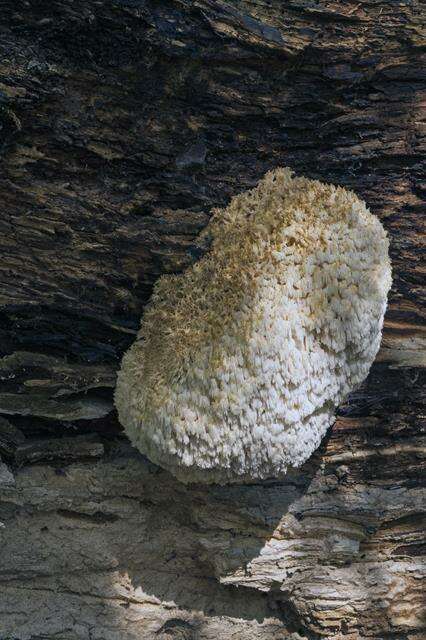
==Description== Species of this family commonly have fruitbodies with pegs, spines, or teeth hanging from the hymenium.
Excerpted from Wikipedia’s “Hericiaceae” article, available under the CC BY-SA 4.0 licence.