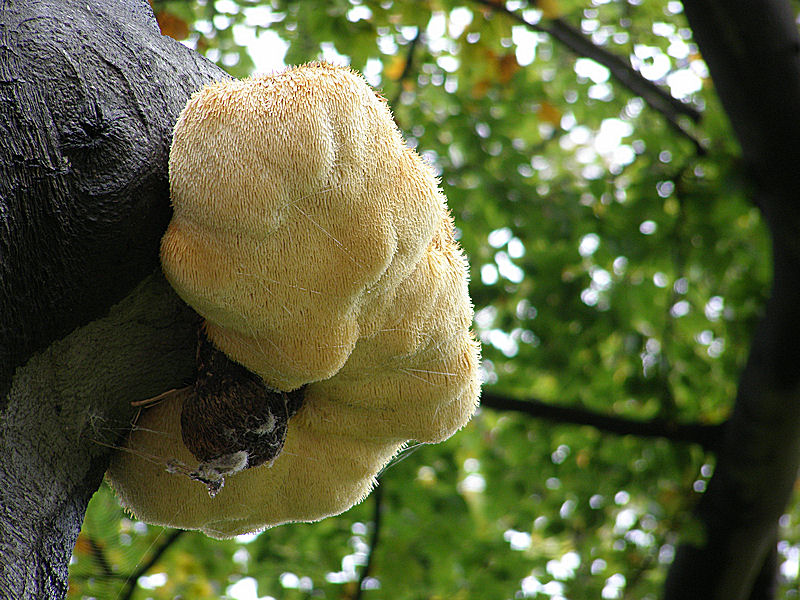
Image from GBIF · CC BY
Hericium erinaceus
Sign in to saveAlso known as Lion's Mane, Yamabushitake, lion's mane mushroom, Bearded tooth
edible mushroom
OverviewAI-generated
Hericium erinaceus is a species of fungus in the family Hericiaceae. It belongs to the kingdom Fungi, phylum Basidiomycota, class Agaricomycetes, and order Russulales. The organism is classified as a taxon with a parent taxon of Hericium. Its ecological type is parasitism, and it produces a white spore print. The species is listed as a medicinal mushroom. Common names include pigau barfog, Pruikzwam, ヤマブシタケ, and korálovec ježatý.
The taxon author citation is (Bull.) Pers. According to the IUCN Red List, the conservation status is Least Concern, with a status year of 2019. A regional conservation status of Endangered is also noted. Records from iDigBio indicate the presence of the species in Mexico and the United States, with 460 records and 311 media items held by institutions including CESUES, IB-CUCBA-UDG, MO, LSUM, and CINC. GBIF data shows an occurrence count of 12180.
Synthesized by Vinony from 30 facts across 6 sources: Wikidata, GBIF, Gbif Occ, IUCN Red List, iDigBio, Vinony graph. Generated from structured data (not the Wikipedia text) and checked against those facts — may still contain errors.
Species
Least ConcernSPECIES
- KingdomFungi
- PhylumBasidiomycota
- ClassAgaricomycetes
- OrderRussulales
- FamilyHericiaceae
Der Igel-Stachelbart (Hericium erinaceus), auch Affenkopfpilz, Löwenmähne, jap. Yamabushitake, frz. Pompon blanc genannt, ist eine Pilzart aus der Ordnung der Täublingsartigen. Inhaltsverzeichnis 1 Merkmale 1.1 Makroskopische Merkmale 1.2 Mikroskopische Merkmale 1.3 Genetische Merkmale 2 Ökologie 3 Verbreitung 4 Bedeutung 4.1 Speisewert 4.1.1 Nährwert 4.2 Kultivierung 4.3 Traditionelle Medizin 5 Quellen 5.1 Literatur 5.2 Einzelnachweise 6 Weblinks Merkmale Junge Fruchtkörper des Igel-Stachelbarts Blick in das Innere eines jungen Igel-Stachelbarts Ausschnittsvergrößerung der Stacheln Makroskopische Merkmale Der Fruchtkörper ist beigefarben, manchmal auch leicht rötlich und kann Größen von bis zu 30 cm erreichen. Die Pilze sind meist kurz gestielt und werden 10–25 cm dick. Die Oberseite ist faserig aufgerissen. An der Unterseite befinden sich weiche, dicht stehende Stacheln. Sie werden 2–5 cm lang und 1,5–2 mm dick; deren Oberfläche ist bereift. Das Fleisch ist weißlich und besitzt eine zähe, etwas faserige Konsistenz. Das Sporenpulver ist weiß. Mikroskopische Merkmale Die Sporen sind farblos, rundlich und besitzen eine glatte oder leicht warzige Oberfläche. Sie messen 5–7 × 4–6 Mikr
via GBIF · IUCN
Museum specimens
- Specimen records
- 460
- With media
- 311
- Family
- Hericiaceae
- Collections
- CESUES, IB-CUCBA-UDG, MO, LSUM, CINC, MSC
- Recorded in
- Mexico, United States
Wikidata facts
- Parent taxon
- Hericium
- Image
- Igelstachelbart Nov 06.jpg
Show 12 more facts
- Commons gallery
- Hericium erinaceus
- Commons category
- Hericium erinaceus
- taxon rank
- species
- mushroom ecological type
- parasitism
- spore print color
- white
- edibility
- medicinal mushrooms
- taxon common name
- Bearded tooth
- IUCN conservation status
- Least Concern
- taxon author citation
- (Bull.) Pers.
- taxon name
- Hericium erinaceus
- short name
- H. erinaceus
- regional conservation status
- Endangered status
Sources (6)
via Wikidata · CC0
~11 min read
Encyclopedic overview
Hericium erinaceus, commonly known as lion's mane, yamabushitake, bearded tooth fungus, or bearded hedgehog, is a species of tooth fungus. It tends to grow in a single clump with dangling spines longer than 1 centimetre (1⁄2 inch). It can be mistaken for other Hericium species that grow in the same areas.
Native to North America and Eurasia, the mushrooms are common during late summer and autumn on hardwoods, particularly American beech and maple. It is typically considered saprophytic, as it mostly feeds on dead trees. It can also be found on living trees, usually in association with a wound.
Excerpted from Wikipedia’s “Hericium erinaceus” article, available under the CC BY-SA 4.0 licence.