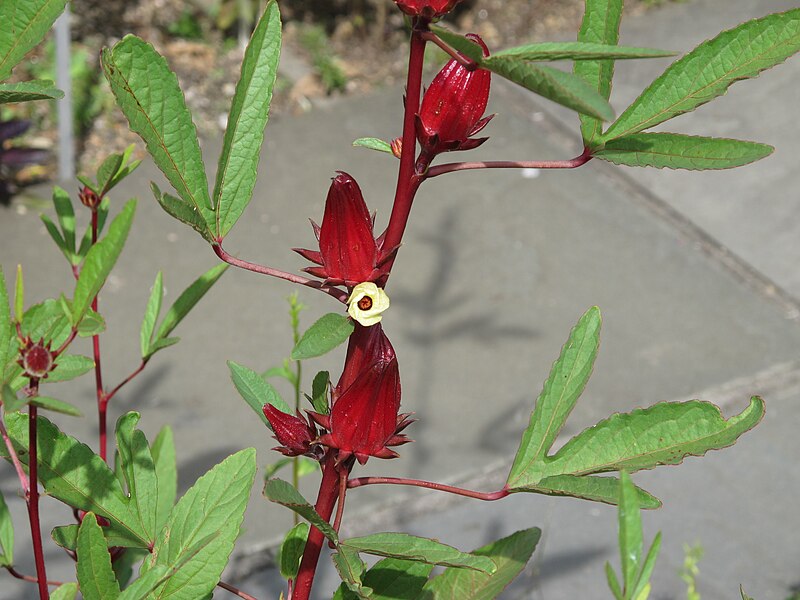
File:Roselle,_Hibiscus_sabdariffa,_2014_01.JPG · Wikimedia Commons · See Wikimedia Commons
OverviewAI-generated
*Hibiscus sabdariffa*, commonly known as roselle or Jamaica sorrel, is a species of plant in the family Malvaceae. It belongs to the genus *Hibiscus* and is classified within the order Malvales, class Magnoliopsida, and phylum Tracheophyta. The scientific name is cited as *Hibiscus sabdariffa* L. This taxon has uses as a medicinal plant and for fiber.
Records of this species have been documented in various locations, including Guangdong, Coelho Neto, Bom Jardim, and Myanmar. Additional occurrence data is associated with Honduras and Mexico, with specimens held by institutions such as ECOSUR, ENCB-IPN, INECOL, CICY, and UACH. The species has been the subject of numerous observations and records across different biological databases.
Synthesized by Vinony from 38 facts across 7 sources: Wikidata, GBIF, iNaturalist, Gbif Occ, Plants of the World, iDigBio, Vinony graph. Generated from structured data (not the Wikipedia text) and checked against those facts — may still contain errors.
Species
Roselle
Hibiscus sabdariffa
SPECIES
- KingdomPlantae
- PhylumTracheophyta
- ClassMagnoliopsida
- OrderMalvales
- FamilyMalvaceae
玫瑰茄(学名:Hibiscus sabdariffa)[1]又称洛神花、洛神葵、洛神果、山茄、洛济葵,是锦葵科木槿属一年生草本植物或多年生灌木,生長於热带和亚热带地区,最高可有2-2.5米高。葉片裂成三塊或五塊,8-15厘米長,互生。 玫瑰茄原产于西非、印度,在中国的广东、广西、福建、云南均有分布。其盛产在4月或在8月下旬,成长期大约是4 个月。其花果中富含花青素、果胶、果酸等,其味更是天然芳香、微酸,色泽鲜艳、红润细嫩。 玫瑰茄的花含有丰富的维生素C、β-胡萝卜素、维他命B1、B2等,不但可以促進新陳代謝、缓解身体疲倦、开胃消滞、振奮精神、清凉降火、生津止渴、利尿的功效,对治疗陽痿、心脏病、高血压、调节血脂,降低血液浓度等更是达到一定的效果[2],是一种保健食品。可以用来冲泡茶和制作饮料,其味酸。洛神花汁在西北非很流行,但在西歐的市場還是剛起步[3]。玫瑰茄也可以提取玫瑰茄色素[4],用作食品行业的食品添加剂,亦可製成果醋。 中山醫學大學生化暨生物科技研究所教授王朝鐘研究發現,玫瑰茄能抑制癌細胞生長、防癌、及輔助治療的效果,特別是血癌和胃癌。中山醫學大學前校長、台灣營養學會榮譽理事長王進崑教授團隊發現能降膽固醇,以實驗找來平均48歲、患有高血脂的40名男女,讓受測者每天喝200cc玫瑰茄熱飲,連續一個月後,血液膽固醇濃度從平均每100cc血液200毫克膽固醇,降至150毫克。[5] 一種在馬來西亞流行的玫瑰茄種植品種 洛神花花萼也可以加工成甜鹹的食品 洛神花的花 萼片 使用簡單的手持小工具去除種子膠囊以獲得它的花萼 洛神花植株 收成沙地上種植的玫瑰茄 乾燥的玫瑰茄萼片 洛神花茶飲 參見 蜜餞 參考文獻 《台灣蔬果實用百科第三輯》,薛聰賢 著,薛聰賢出版社,2003年 ^ Hibiscus sabdariffa L.. In: The Plant List (2013). Version 1.1. Published on the Internet; http://www.theplantlist.org/ [2018-1-13]. ^ 【四季養生帖】夏-惟德堂藥房 ^ 《全球飲勝》第一集,高清翡翠台,2012-9-23 17:30~18:30 ^ 玫瑰茄红 CAS:71149-61-6 ^ 洛神花清血管!洛神花茶喝進防癌降血脂多重功效.
via GBIF · Kew POWO
Museum specimens
- Specimen records
- 1,237
- With media
- 896
- Family
- Malvaceae
- Collections
- ECOSUR, ENCB-IPN, INECOL, CICY, UACH, IEA-UAT
- Recorded in
- Honduras, Mexico
Wikidata facts
Show 10 more facts
- Commons category
- Hibiscus sabdariffa
- taxon name
- Hibiscus sabdariffa
- taxon rank
- species
- Commons gallery
- Hibiscus sabdariffa
- taxon common name
- vinagreira
- short name
- H. sabdariffa
- taxon author citation
- L.
- taxon range
- Gabon
- external data available at URL
- www.gbif.org/dataset/31dc1507-a6e1-4233-a8df-c7a78596a7e4
Sources (8)
via Wikidata · CC0
~25 min read
Encyclopedic overview
Roselle (Hibiscus sabdariffa) is a species of flowering plant in the genus Hibiscus that is native to Africa, most likely West Africa. In the 16th and early 17th centuries it was spread to Asia and the West Indies, where it has since become naturalized in many places. The stems are used for the production of bast fibre and the dried cranberry-tasting calyces are commonly steeped to make a popular infusion known by many names, including zobo and carcade.
Description
Excerpted from Wikipedia’s “Hibiscus sabdariffa” article, available under the CC BY-SA 4.0 licence.