
Angola
Sign in to saveAlso known as Republic of Angola, ao, Ngola
Angola, officially the Republic of Angola, is a country on the western coast of Southern Africa. It is the second-largest Portuguese-speaking (Lusophone) country after Brazil in both total area and population and is the seventh-largest country in Africa. It is bordered by Namibia to the south, the Democratic Republic of the Congo to the north, Zambia to the east, and the Atlantic Ocean to the west. Angola has an exclave province, the province of Cabinda, that borders the Republic of the Congo and the Democratic Republic of the Congo. The capital and most populous city is Luanda.
OverviewAI-generated
Angola, officially the Republic of Angola, is a country located in Africa, specifically within the Middle Africa subregion. Its capital is Luanda. The nation has a land area of 1246700 and observes the UTC+01:00 timezone. It shares diplomatic relations with Brazil, Germany, Cape Verde, and Australia. The country was formerly part of the Portuguese Empire.
The population figures vary across sources, listing 36749906, 36170961, and 37885849. The official language is Portuguese, and the primary ethnic groups include the Ovimbundu, Mbundu, Kongo, and Mestiço peoples. The currency is the kwanza, though the Angolan escudo, Angolan real, and Angolan angolar are also listed. The head of state is João Lourenço, and the legislative body is the National Assembly of Angola.
Economic and social indicators include a GDP of 100998916781.079 USD and an urban population percentage of 70.6551379036435. The forest area covers 52.0912696719339 percent of the land, with renewable energy accounting for 52.9 percent. Life expectancy is 64.805 years, and the unemployment rate is 14.108 percent. Internet users comprise 40.70479965 percent of the population.
Synthesized by Vinony from 67 facts across 9 sources: Wikidata, REST Countries, Openweathermap, Open Meteo, World Bank, OpenStreetMap, PubMed, Vinony graph, Geo. Generated from structured data (not the Wikipedia text) and checked against those facts — may still contain errors.
In the Vinony graph
Angola appears in Vinony's Countries collection — one of 215 entries.
Within Vinony's link graph, Angola is referenced by 16,456 other articles, and connects out to Kongo, African Union and government of Angola.
The entry is geolocated on the map in city, across 60 mapped points.
It is catalogued under topics including 1975 establishments in Angola, Angola and Countries and territories where Portuguese is an official language.
Weather now
cached 1h ago7-day forecast
via Open-Meteo
Country

- Capital
- Luanda
- Population
- 36,170,961
- Region
- Africa · Middle Africa
- Demonym
- Angolan
- Currencies
- AOA (Kz)
- Languages
- Portuguese
- Calling code
- +244
- Drives on
- Right
- Gini
- 51.3 (2018)
- FIFA code
- ANG
- TLD
- .ao
- Timezones
- UTC+01:00
- Borders
- COG, COD, ZMB, NAM
via REST Countries
Indicators · World Bank
- GDP
- $101B(2024)
- Population
- 37,885,849(2024)
- Life expectancy
- 64.8 yrs(2024)
- Unemployment
- 14.1 %(2025)
- Urban population
- 70.7 %(2024)
- Internet users
- 40.7 %(2024)
- Forest area
- 52.1 %(2023)
- Renewable energy
- 52.9 %(2021)
via World Bank Open Data · CC BY 4.0
Wikipedia views (30d)
101,406 totalvia Wikimedia Pageviews API
Key facts
- Country.conventional_long_name
- Republic of Angola
- Country.common_name
- Angola
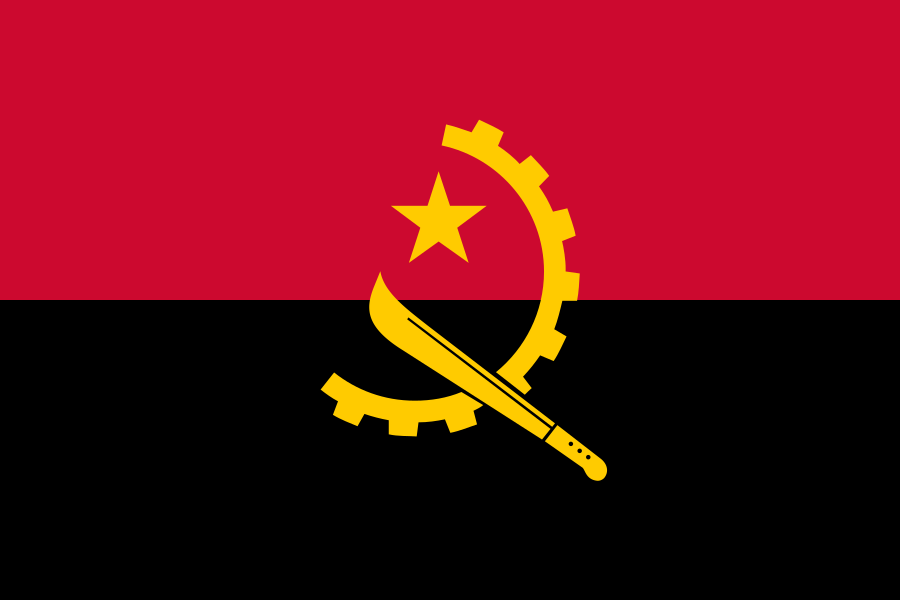
- Country.image_flag
- Flag of Angola.svg
- Country.image_coat
- Emblem of Angola.svg
- Country.symbol_type
- Emblem
- Country.national_anthem
- ()File:Angolan-National-Anthem-_US-Navy-Band.ogg
- Country.map_caption
- Major cities of Angola
- Country.capital
- Luanda
- Country.religion_year
- 2024
- Country.largest_city
- capital
- Country.official_languages
- Portuguese
- Country.languages2_type
- National languages
- Country.languages2
- Chokwe, Kimbundu, Kikongo, Oshiwambo, Luchazi, Umbundu
- Country.ethnic_groups_year
- 2021
- Country.demonym
- Angolan
- Country.government_type
- Unitary presidential republic
- Country.leader_title1
- President
- Country.leader_name1
- João Lourenço
via Wikipedia infobox
Research
3,069 papers- Malaria in Angola: recent progress, challenges and future opportunities using parasite demography studies.ReviewMalaria journal · 2022Tavares W, Morais J, Martins JF et al.DOI: 10.1186/s12936-022-04424-y
- Angola.Department of State publication. Background notes series · 1987United States. Department of State. Bureau of Public Affairs
- Plasmodium falciparum drug resistance in Angola.ReviewMalaria journal · 2016Fançony C, Brito M, Gil JPDOI: 10.1186/s12936-016-1122-z
- [Angola].Jeune Afrique (Paris, France : 1980) · 1996
- Oncology Education in Angola: Current Status and Recommendations for Improvement.Journal of cancer education : the official journal of the American Association for Cancer Education · 2024da Rocha JW, Silva FDCD, Lara Santos LDOI: 10.1007/s13187-024-02444-7
- Cholera, Angola--update.Releve epidemiologique hebdomadaire · 2006
- Rethinking malaria elimination: a perspective on challenges and solutions in Angola.ReviewMalaria journal · 2025Domingos ESDOI: 10.1186/s12936-025-05398-3
- Zika in Angola and India.Journal of travel medicine · 2019Hamer DH, Chen LHDOI: 10.1093/jtm/taz012
via PubMed
Wikidata facts
- Instance of
- overseas province of Portugal
- Official name
- Angolská republika
- Demonym
- Angolanerinnen
- Participant in
- Kivu conflict
- Country
- Portuguese Empire
- Contains
- Zaire Province
- Continent
- Africa
- Capital
- Luanda
- Official language
- Portuguese
- Currency
- Angolan angolar
- Population
- 36749906
- Area
- 1246700
- Body of water
- Atlantic Ocean
- Head of government
- João Lourenço
- Head of state
- João Lourenço
- Form of government
- presidential system
- Legislature
- National Assembly of Angola
- Anthem
- Angola Avante
- Shares border with
- Gabon
- Highest point
- Mount Moco
- Official website
- www.governo.gov.ao
- Image
- Angola - Location Map (2013) - AGO - UNOCHA.svg
- Life expectancy
- 61.547
Show 63 more facts
- Nominal GDP
- 84824654481
- Unemployment rate
- 7
- Calling code
- +244
- Licence plate code
- ANG
- Electrical plug type
- Europlug
- Mains voltage
- 220
- Motto
- Virtus Unita Fortior
- Flag
- flag of Angola
- Coat of arms
- Emblem of Angola
- topic's main Wikimedia portal
- Portal:Angola
- Unicode character
- 🇦🇴
- category of associated people
- Category:Angolan people
- ethnic group
- European people
- geography of topic
- Geography of Angola
- office held by head of government
- Prime Minister of Angola
- number of out-of-school children
- 2146000
- diplomatic relation
- North Korea
- Commons gallery
- Angola
- history of topic
- history of Angola
- marriageable age
- 18
- on focus list of Wikimedia project
- Wikipedia:Vital articles/Level/4
- mobile country code
- 631
- total fertility rate
- 6.08
- maritime identification digits
- 603
- topic's main category
- Category:Angola
- central bank
- National Bank of Angola
- age of majority
- 18
- category for films shot at this location
- Category:Films shot in Angola
- category for people who died here
- Category:Deaths in Angola
- office held by head of state
- President of Angola
- Commons category
- Angola
- top-level Internet domain
- .ao
- category for people born here
- Category:Births in Angola
- driving side
- right
- lowest point
- Atlantic Ocean
- maximum temperature record
- 43.5
- literacy rate
- 66
- suicide rate
- 7.9
- native label
- Angola
- culture
- culture of Angola
- replaces
- People's Republic of Angola
- BTI Status Index
- 4.21
- BTI Governance Index
- 4.46
- inception
- 1992-08-25
- economy of topic
- economy of Angola
- demographics of topic
- demographics of Angola
- Democracy Index
- 3.66
- Human Development Index
- 0.586
- P11012
- lead
- hashtag
- Angola
- Gini coefficient
- 51.3
- Inequality-adjusted Human Development Index
- 0.407
- P12749
- Sandro Pertini
- birth rate
- 38.2
- male population
- 17590767
- death rate
- 7.863
- rural population
- 11359649
- female population
- 17998220
- urban population
- 24229338
- P8168
- German nationality
- member of
- African Continental Free Trade Area
- most populous urban area
- Luanda
- located in/on physical feature
- Central Africa
Sources (15)
via Wikidata · CC0
Travel guide
Understand
The people of Angola are stoics. They have a deep understanding of patience, and avoid blaming the difficulties the country faces on the fact that there was war. In fact, Angolans behave as if there was no war although it is deeply rooted in every Angolan. Music is the heart and soul of Angolans, it can be heard anywhere and they use anything as an excuse to party. The country has a wide range of music, mainly Kuduro, Kizomba, Semba, and Tarrachinha, the latter being more sensual than all the others. In all, it is safe to say that Angolans are fun and loving people with a thirst for more of what life has to give.
Since the end of the brutal, horrific Angolan Civil War in 2002, the Angolan government is keen on improving the country's international image and opening up Angola to the world. Tourism is still in its nascent stages and it will take some time for things to get back to normal. The country's national park system was devastated during the war, with rampant poaching leaving Angola with relatively scant megafauna compared to its African peers.
The country's tourism industry has been steadily growing and attracts 500,000–600,000 people each year. Angola shares borders with Namibia, Zambia, and the two Congos.
Get in
thumb|375px|A map showing the visa requirements of Angola, with countries in green having visa-free access. The ones in light green - visa-free for up to 30 days per entry and 90 days per year
See
thumb|Ruacana Falls In Luanda: the Mussulo island for clean tropical beaches and water sports, the Benfica Market for Kwanza River.
Eco Tur Angola do various bespoke no tours Angola including Kissama with specialist game viewing vehicles.
In Benguela: Baia Azul for beautiful desert beaches. Art deco architecture in Benguela. Lobito City for the Restinga Peninsula and ice cold draught Cuca beer, the Benguela Rail road, and fantastic scenery.
In Kwanza Sul - Cubal Canyon, Conde Hot springs and Cachoeiras and Binga Waterfalls, with the Cambambe Dam on River Kwanza. Waku Kungo plains has fantastic scenery.
In Malange - Kalandula Waterfalls and Pungo n'Dongo Black Stones.
In Huila - Serra de Leba, Tunbda Vala Gorge, Mumuila tribespeople, fantastic scenery.
In Namibe - Arco Lagoon, beaches and a desert, and Mucubais tribespeople.
In Huambo - City Tours, Alto Hama hot springs, and fantastic scenery.
In Cunene - Himba tribes people, Ruacana Falls, and fantastic scenery.
Eat
thumb|Muamba Generally, dining out is not very easy in Angola, since even in Luanda restaurant food is expensive and many of the less well equipped restaurants have poor hygiene. Nonetheless, Angolan cuisine is varied and tasty, with local dishes based mainly on fish, cassava products and spicy stews.
Angolan seafood is abundant and very good, and the Angolan coast is a special place to eat fresh lobster right off the fisherman's boat.
Tropical fruit in Angola is also a treat because artisan production has maintained organic methods so that rich fruit flavours, unusual to the Western palate accustomed to industrially produced tropical fruits, predominate. If, however, you are situated in Luanda and need to dine, it is recommended that you get to Ilha de Luanda, where beach-restaurants (of varying price-classes from very exclusive to rather informal) can serve most foreign needs. Restaurants in Luanda grew in numbers and quality after the 2002 ceasefire brought stability and significant investment to the country.
Be careful: when eating out, do not drink tap water, ask for bottled mineral water instead.
Not all restaurants accept US dollars in cash; ask before ordering. Credit cards will not be accepted at most restaurants, although that is rapidly changing.
Sleep
World class hotels include the Tropico Hotel, the Alvalade Hotel, Le President Meridien Hotel, the Continental Hotel, the Skyna Hotel, the Epic Sana hotel, and the Palm Beach Hotel, among others.
Stay safe
thumb|Angolan police — reputedly not OK to photograph You should consider hiring a trusted and knowledgeable local guide for travel within Angola, although if you follow some basic rules then travelling in Angola isn't dangerous. Travelling after dark and alone is never a good idea. If possible, join with several cars of the same make and model because of the possible need of spare parts.
Never step beyond the red and white HALO Trust posts. These denote mine fields. In fact, beware of anything surrounded by any kind of red stones or similar markers.
In Angola, it is mandatory to have a form of identification on you at all times. What this means: carrying a certified copy of your passport or your national identification card.
Stay healthy
State-of-the-art medical care is virtually non-existent in Angola; the country has one of the lowest average life expectancies in the world, the country is ideal for many tropical diseases, and a significant portion of Angolans are too poor to afford healthcare.
Malaria is a leading cause of death in the country. Regularly use insect repellent to lower your chances of contracting malaria, and consider draping a mosquito net (if you have one) over your bed. It's strongly recommended to take malaria prophylaxis when travelling to Angola.
Do not drink tap water. There is no working water purification system in Angola. Stick to bottled water.
Yellow fever is prevalent in the country. You are normally required to get vaccinated against the disease before applying for an Angolan visa and/or travelling to the country.
Dengue fever is another major health threat.
The country's HIV/AIDS prevalence rate among adults is 1.80%. Although it is low compared to other African nations, you should always be aware of your surroundings.
Respect
Since Angola is rarely visited by tourists, you may attract unwanted attention from the locals. This indicates curiosity rather than hostility.
As is the case throughout Africa, it is obligatory to show respect for elders (including authority figures) as they're generally viewed as wiser and more experienced. When visiting an Angolan home, it is customary to greet the oldest person first. If you're waiting to enter a building, allow someone older to go in first. If you're on public transportation, give up your seat for someone older than you.
Angolans are extremely hospitable and they consider it impolite to not give someone a good welcome. Therefore, you can expect to be treated with immense respect as a visitor. If you've been invited for a meal at an Angolan person's home, bear in mind that the oldest person in the house starts eating first.
Angolans are attentive listeners. They consider it extremely rude to interrupt someone's conversation.
If travelling to rural areas, take some time to greet the local soba (chief with government-backed authority). Words of kindness will allow you to enjoy your journey in peace.
Angolans are generally amiable, and it is important to greet everyone respectfully and immediately upon seeing them. A simple hello ("Bom dia") will do.
Connect
The phone country code of Angola is +244. Telephone connections, cellular and landline, are heavily overloaded, making communication difficult at times. International lines are, however, often better.
Carry a satellite telephone in the case of a breakdown or other emergency. Be aware, that while Iridium satellite phones have global coverage, Thuraya satellite phones have coverage in most of Angola, but may not have coverage in the southern parts of the country.
Travel guide from Wikivoyage (CC BY-SA 4.0)
~40 min read
Encyclopedic overview
40 sectionsContents
- Etymology
- History
- Early migrations and political units
- Portuguese colonisation
- Angolan War of Independence
- Angolan Civil War
- 21st century
- Geography
- Climate
- Wildlife
- Government and politics
- Constitution
- Justice
- Administrative divisions
- Exclave of Cabinda
- Foreign relations
- Military
- Police
- Human rights
- Economy
- Natural resources
- Agriculture
- Transport
- Telecommunications
- Technology
- Demographics
- Urbanisation
- Languages
- Religion
- Health
- Education
- Culture
- Media
- Cinema
- Sports
- See also
- Notes
- References
- Further reading
- External links
Angola, officially the Republic of Angola, is a country on the western coast of Southern Africa. It is the second-largest Portuguese-speaking (Lusophone) country after Brazil in both total area and population and is the seventh-largest country in Africa. It is bordered by Namibia to the south, the Democratic Republic of the Congo to the north, Zambia to the east, and the Atlantic Ocean to the west. Angola has an exclave province, the province of Cabinda, that borders the Republic of the Congo and the Democratic Republic of the Congo. The capital and most populous city is Luanda.
Angola has been inhabited since the Palaeolithic Age. After the Bantu expansion reached the region, states were formed by the 13th century and organised into confederations. The Kingdom of Kongo ascended to achieve hegemony among the other kingdoms from the 14th century. Portuguese explorers established relations with Kongo in 1483. To the south were the kingdoms of Ndongo and Matamba, with the Ovimbundu kingdoms further south, and the Mbunda Kingdom in the east.
Excerpted from Wikipedia’s “Angola” article, available under the CC BY-SA 4.0 licence.
Gallery (639)
On the map
60 mapped locations
Available in 271 languages
- Español
- Français
- Deutsch
- 中文
- 日本語
- Русский
- Português
- Italiano
- العربية
- हिन्दी
- Abkhazian
- abstract
- Afrikaans
- Akan
- Albanian
- Albanian
- Amharic
- ami
Show 252 more
- Angika
- Aragonese
- Armenian
- Arpitan
- Asturian
- Aymara
- azb
- Azerbaijani
- Bahasa Indonesia
- Balinese
- Bambara
- Bangla
- Banjar
- Bashkir
- Basque
- bat_smg
- Bavarian
- be_x_old
- Belarusian
- Betawi
- Bhojpuri
- Bikol
- Bishnupriya
- Bislama
- Bosnian
- Breton
- Bulgarian
- Buriat
- Burmese
- Catalan
- cbk_zam
- cdo
- Cebuano
- Central Kurdish
- Chechen
- Cherokee
- Chuvash
- Colognian
- Cornish
- Corsican
- Crimean Tatar
- Croatian
- Czech
- dag
- Danish
- Dinka
- Divehi
- dty
- Dzongkha
- Egyptian Arabic
- Esperanto
- Estonian
- Ewe
- Extremaduran
- Faroese
- Fiji Hindi
- Filipino
- Finnish
- fiu_vro
- Frafra
- Fula
- Gagauz
- Galician
- Ganda
- gcr
- Georgian
- Gilaki
- Goan Konkani
- gpe
- Greek
- Guarani
- Gujarati
- guw
- Haitian Creole
- Hakka Chinese
- Hausa
- Hawaiian
- Hebrew
- Hungarian
- hyw
- Icelandic
- Ido
- Igbo
- Iloko
- Inari Sami
- Interlingua
- Interlingue
- Inupiaq
- Irish
- Jamaican Creole English
- Javanese
- Jju
- Kabyle
- kai
- Kannada
- Kanuri
- Kara-Kalpak
- Karachay-Balkar
- Kashmiri
- Kashubian
- Kazakh
- kbp
- Khmer
- Kikuyu
- Kinyarwanda
- Kongo
- Kotava
- Kurdish
- Kyrgyz
- Ladino
- Lao
- Latgalian
- Latin
- Latvian
- Ligurian
- Limburgish
- Lingala
- Lingua Franca Nova
- Lithuanian
- lld
- Lojban
- Lombard
- Low German
- Lower Sorbian
- Luxembourgish
- Macedonian
- Malagasy
- Malay
- Malayalam
- Maltese
- Manipuri
- Manx
- Māori
- map_bms
- Marathi
- Mazanderani
- Minangkabau
- Mingrelian
- Mirandese
- Moksha
- Mongolian
- Moroccan Arabic
- nds_nl
- Nederlands
- Nepali
- Newari
- Nigerian Pidgin
- Northern Frisian
- Northern Sami
- Northern Sotho
- Norwegian
- Norwegian Nynorsk
- Novial
- nup
- Nyanja
- Obolo
- Occitan
- Odia
- Old English
- olo
- Oromo
- Ossetic
- Pampanga
- Papiamento
- Pashto
- Pennsylvania German
- Piedmontese
- Polski
- Punjabi
- Quechua
- roa_rup
- Romanian
- Romansh
- Rusyn
- Samoan
- Sango
- Sanskrit
- Santali
- Sardinian
- Saterland Frisian
- Scots
- Scottish Gaelic
- Serbian
- Serbian (Latin)
- Shan
- Shona
- Sicilian
- Silesian
- simple
- Sindhi
- Sinhala
- Slovak
- Slovenian
- Somali
- South Ndebele
- Southern Sotho
- Standard Moroccan Tamazight
- Sundanese
- Svenska
- Swahili
- Swati
- szy
- Tachelhit
- Tajik
- Talysh
- Tamil
- Taroko
- Tatar
- tay
- Telugu
- Tetum
- Tibetan
- Tiếng Việt
- Tigrinya
- Toki Pona
- Tsonga
- Tswana
- Tumbuka
- Türkçe
- Turkmen
- Tyap
- Udmurt
- Ukrainian
- Upper Sorbian
- Urdu
- Uyghur
- Uzbek
- Venetian
- Veps
- Volapük
- Waray
- Welsh
- West Flemish
- Western Frisian
- Western Mari
- Western Panjabi
- Wolof
- Wu Chinese
- Xhosa
- Yakut
- Yiddish
- Yoruba
- Zaza
- Zeelandic
- zh_classical
- zh_min_nan
- zh_yue
- Zhuang
- Zulu
- فارسی
- ไทย
- 한국어
via Wikidata sitelinks · CC0