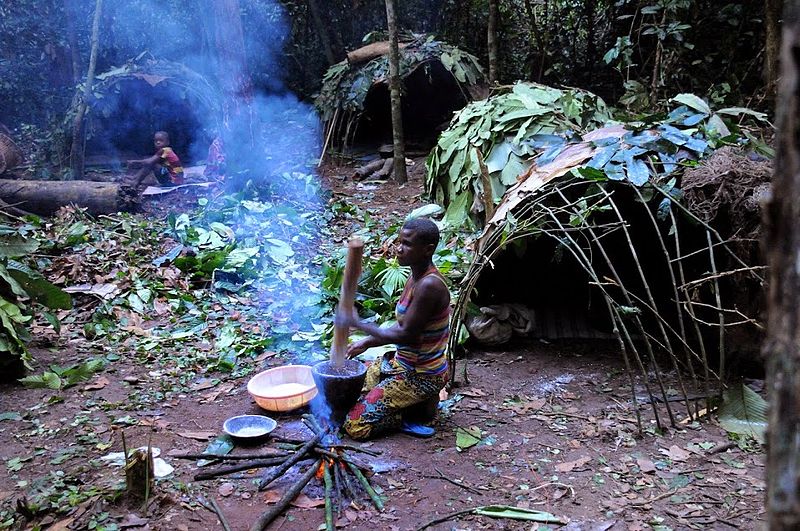
File:Living_on_the_rainforest.jpg · Wikimedia Commons · See Wikimedia Commons
hunter-gatherer
Sign in to saveAlso known as forager, hunter-gatherers, hunter gatherer, hunters gatherers, hunters and gatherers
thumb|upright=1.1|African Pygmies|Central African foragers in the [[Congo Basin in August 2014]] A hunter-gatherer, or forager, is a human living in a community, or according to an ancestrally derived lifestyle, in which most or all food is obtained by foraging, that is, by gathering food from local naturally occurring sources or by hunting game. This is a common practice among most vertebrates that are omnivores. Hunter-gatherer groups, usually a few dozen people, were and are nomadic or semi-nomadic. Hunter-gatherer societies are contrasted with more sedentary agricultural societies, which r
A hunter-gatherer, or forager, is a person living in a community where most or all food comes from gathering naturally occurring sources or hunting game rather than farming. Understanding hunter-gatherers matters because these societies, which were typically small and nomadic or semi-nomadic groups, represent a fundamentally different way of organizing human life compared to agricultural societies.
AI-generated from the Wikipedia summary — may contain errors.
Wikidata facts
- Part of
- primitive tribal community
- Field of work
- gathering
- Image
- Living on the rainforest.jpg
Show 3 more facts
- topic's main category
- Category:Hunter-gatherers
- Commons category
- Hunter-gatherers
- female form of label
- lovka-nabiralka
Sources (3)
via Wikidata · CC0
~26 min read
Encyclopedic overview
14 sectionsContents
- Archaeological evidence
- Common characteristics
- Habitat and population
- Social and economic structure
- Diet
- Variability
- Modern and revisionist perspectives
- Americas
- See also
- Modern hunter-gatherer groups
- Social movements
- References
- Further reading
- External links
thumb|upright=1.1|African Pygmies|Central African foragers in the [[Congo Basin in August 2014]] A hunter-gatherer, or forager, is a human living in a community, or according to an ancestrally derived lifestyle, in which most or all food is obtained by foraging, that is, by gathering food from local naturally occurring sources or by hunting game. This is a common practice among most vertebrates that are omnivores. Hunter-gatherer groups, usually a few dozen people, were and are nomadic or semi-nomadic. Hunter-gatherer societies are contrasted with more sedentary agricultural societies, which rely mainly on cultivating crops and raising domesticated animals for food production.
Hunting and gathering emerged with Homo erectus about 1.8 million years ago and was humanity's original and most enduring successful competitive adaptation in the natural world, occupying at least 90 percent of human (pre)history. Following the invention of agriculture, hunter-gatherers who did not change were displaced or conquered by farming or pastoralist groups in most parts of the world. In Western Eurasia, farming and metallurgical societies gradually replaced hunter-gatherers, but dense forests remained their last refuge until Bronze and Iron Age societies fully overcame them.
Excerpted from Wikipedia’s “hunter-gatherer” article, available under the CC BY-SA 4.0 licence.
Gallery (52)
Available in 65 languages
- Español
- Français
- Deutsch
- 中文
- 日本語
- Русский
- Português
- Italiano
- العربية
- हिन्दी
- Afrikaans
- Albanian
- Bahasa Indonesia
- Basque
- Bulgarian
- Catalan
- Croatian
- Czech
Show 46 more
- Danish
- Esperanto
- Estonian
- Finnish
- Galician
- Greek
- Hebrew
- Hungarian
- Icelandic
- Interlingua
- Irish
- Javanese
- Kinyarwanda
- Kurdish
- Latin
- Lingua Franca Nova
- Lithuanian
- Macedonian
- Malay
- Malayalam
- Marathi
- Mongolian
- nds_nl
- Nederlands
- Norwegian
- Norwegian Nynorsk
- Occitan
- Polski
- Romanian
- Serbian
- Serbian (Latin)
- simple
- Sinhala
- Somali
- Svenska
- Swahili
- Tiếng Việt
- Türkçe
- Ukrainian
- Urdu
- Uzbek
- Western Frisian
- Wu Chinese
- فارسی
- ไทย
- 한국어
via Wikidata sitelinks · CC0