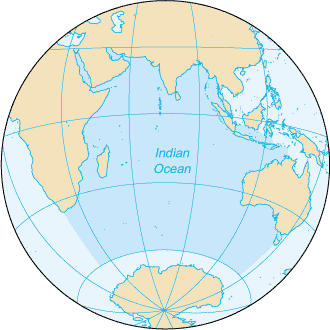
File:Indian_Ocean-CIA_WFB_Map.png · Wikimedia Commons · See Wikimedia Commons
Indian Ocean
Sign in to saveAlso known as Eastern Ocean, Eastern Sea, Indian Sea, Oriental Sea, Oriental Ocean
ocean bounded by Africa, Asia, Australia, and Antarctica
The Indian Ocean is a large body of water bounded by the continents of Africa, Asia, Australia, and Antarctica. It is one of the world's major oceans and serves as an important route for global shipping and trade between these continents.
AI-generated from the Wikipedia summary — may contain errors.
Research
9,037 papers- Microbial Diversity in the Indian Ocean Sediments: An Insight into the Distribution and Associated Factors.ReviewCurrent microbiology · 2022Ambati M, Kumar MSDOI: 10.1007/s00284-022-02801-z
- The Incidence of Tetrodotoxin and Its Analogs in the Indian Ocean and the Red Sea.ReviewMarine drugs · 2019Tamele IJ, Silva M, Vasconcelos VDOI: 10.3390/md17010028
- The Indian Ocean 'garbage patch': Empirical evidence from floating macro-litter.Marine pollution bulletin · 2021Connan M, Perold V, Dilley BJ et al.DOI: 10.1016/j.marpolbul.2021.112559
- New species and records of Heterospio (Annelida, Longosomatidae) from continental shelf, slope and abyssal depths of the Atlantic Ocean, Pacific Ocean, Indian Ocean and adjacent seas.ReviewZootaxa · 2023Blake JA, Maciolek NJDOI: 10.11646/zootaxa.5260.1.1
- Microplastics in the Indian Ocean: a review of the ingestion and trophic transfer in commercial pelagic fish.ReviewEnvironmental monitoring and assessment · 2025Beeharry MJ, Duflos G, Dufossé LDOI: 10.1007/s10661-025-14455-y
- Overview of monitoring methods and environmental distribution: Microplastics in the Indian Ocean.ReviewMarine pollution bulletin · 2025Zhou L, Li J, Zhao C et al.DOI: 10.1016/j.marpolbul.2025.117715
- Coccolithophores: an environmentally significant and understudied phytoplankton group in the Indian Ocean.ReviewEnvironmental monitoring and assessment · 2021Arundhathy M, Jyothibabu R, Santhikrishnan S et al.DOI: 10.1007/s10661-020-08794-1
- A meta-analytic review of microplastic pollution in the Indian Ocean: Ecological health and seafood safety risk implications.ReviewMarine pollution bulletin · 2023Nugawela NPPS, Mahaliyana AS, Abhiram G et al.DOI: 10.1016/j.marpolbul.2023.115213
via PubMed
Wikidata facts
- Instance of
- region
- Part of
- World Ocean
- Named after
- India
- Area
- 76174000
- Elevation
- 0
- Shares border with
- Southern Ocean
- Image
- Indian Ocean-CIA WFB Map.png
- Width
- 10000
Show 14 more facts
- inflows
- Ci Mandiri
- coordinates of westernmost point
- -34.833237,20.0091
- Commons gallery
- Indian Ocean
- Commons category
- Indian Ocean
- topic's main category
- Category:Indian Ocean
- described by source
- Pauly–Wissowa
- volume as quantity
- 282650000
- vertical depth
- 3711
- on focus list of Wikimedia project
- Wikipedia:Vital articles/Level/4
- has characteristic
- Indian Ocean garbage patch
- topic has template
- Q10557006
- different from
- list of islands in the Indian Ocean
- P12749
- Monika Kaserer
- has boundary
- New Guinea
Sources (10)
via Wikidata · CC0
~40 min read
Encyclopedic overview
The Indian Ocean is the third-largest of the world's five oceanic divisions, covering 70,560,000 km (27,240,000 sq mi) or approximately 20% of the water area of Earth's surface. It is bounded by Asia to the north, Africa to the west and Australia to the east. To the south it is bounded by the Southern Ocean or Antarctica, depending on the definition in use. The Indian Ocean has large marginal or regional seas, including the Andaman Sea, the Arabian Sea, the Bay of Bengal, and the Laccadive Sea.
Geologically, the Indian Ocean is the youngest of the oceans (being directly preceded by the Tethys Ocean, which fragmented into the Mediterranean Sea and the Indian Ocean only 20 million years ago), and it has distinct features such as narrow continental shelves. Its average depth is 3,741 m. It is the warmest ocean, with a significant impact on global climate due to its interaction with the atmosphere. Its waters are affected by the Indian Ocean Walker circulation, resulting in unique oceanic currents and upwelling patterns. The Indian Ocean is ecologically diverse, with important ecosystems such as coral reefs, mangroves, and seagrass beds. It hosts a significant portion of the world's tuna catch and is home to endangered marine species. The climate around the Indian Ocean is characterized by monsoons.
Excerpted from Wikipedia’s “Indian Ocean” article, available under the CC BY-SA 4.0 licence.
Gallery (12)
On the map
Available in 234 languages
- Español
- Français
- Deutsch
- 中文
- 日本語
- Русский
- Português
- Italiano
- العربية
- हिन्दी
- abstract
- Achinese
- Adyghe
- Afrikaans
- Albanian
- Albanian
- Amharic
- Angika
Show 215 more
- Aragonese
- Aramaic
- Armenian
- Assamese
- Asturian
- Avaric
- Awadhi
- azb
- Azerbaijani
- Bahasa Indonesia
- Balinese
- Bangla
- Banjar
- Bashkir
- Basque
- bat_smg
- Bavarian
- be_x_old
- Belarusian
- Betawi
- Bhojpuri
- Bikol
- blk
- Bosnian
- Breton
- Bulgarian
- Buriat
- Burmese
- Catalan
- cdo
- Cebuano
- Central Kurdish
- Chechen
- Chuvash
- Cornish
- Corsican
- Crimean Tatar
- Croatian
- Czech
- Danish
- Divehi
- dty
- Egyptian Arabic
- Esperanto
- Estonian
- Extremaduran
- Faroese
- Fiji Hindi
- Filipino
- Finnish
- fiu_vro
- Galician
- Gan Chinese
- gcr
- Georgian
- Gorontalo
- Greek
- Guarani
- Gujarati
- Haitian Creole
- Hakka Chinese
- Hausa
- Hawaiian
- Hebrew
- Hungarian
- hyw
- Iban
- Icelandic
- Ido
- Igbo
- Iloko
- Inari Sami
- Ingush
- Interlingua
- Interlingue
- Irish
- Jamaican Creole English
- Javanese
- Kabardian
- Kabyle
- Kannada
- Kanuri
- Kara-Kalpak
- Karachay-Balkar
- Kashmiri
- Kazakh
- kbp
- kge
- Khmer
- Kikuyu
- Komi-Permyak
- Kotava
- Kurdish
- Kyrgyz
- Ladino
- Lao
- Latin
- Latvian
- Lezghian
- Limburgish
- Lingala
- Lingua Franca Nova
- Lithuanian
- lld
- Lojban
- Lombard
- Low German
- Lower Sorbian
- Luxembourgish
- Macedonian
- Maithili
- Malagasy
- Malay
- Malayalam
- Maltese
- Manx
- Māori
- map_bms
- Marathi
- Mazanderani
- Minangkabau
- Mingrelian
- Mirandese
- Moksha
- Mongolian
- Moroccan Arabic
- nds_nl
- Neapolitan
- Nederlands
- Nepali
- Newari
- Northern Frisian
- Northern Sotho
- Norwegian
- Norwegian Nynorsk
- Occitan
- Old English
- olo
- Oromo
- Ossetic
- Pampanga
- Papiamento
- Pashto
- Picard
- Piedmontese
- Polski
- Punjabi
- Quechua
- roa_tara
- Romanian
- Romansh
- Rusyn
- Samoan
- Sanskrit
- Santali
- Sardinian
- Scots
- Scottish Gaelic
- Serbian
- Serbian (Latin)
- Shona
- Sicilian
- Silesian
- simple
- Sindhi
- Sinhala
- Slovak
- Slovenian
- Somali
- Southern Sotho
- Standard Moroccan Tamazight
- Sundanese
- Svenska
- Swahili
- Tahitian
- Tajik
- Tamil
- Tatar
- Telugu
- Tiếng Việt
- Toki Pona
- Türkçe
- Turkmen
- Tuvinian
- Tyap
- Udmurt
- Ukrainian
- Upper Sorbian
- Urdu
- Uyghur
- Uzbek
- Venetian
- Veps
- Volapük
- Walloon
- Waray
- Welsh
- West Flemish
- Western Frisian
- Western Mari
- Western Panjabi
- Wolof
- Wu Chinese
- Yakut
- Yiddish
- Yoruba
- Zaza
- Zeelandic
- zh_classical
- zh_min_nan
- zh_yue
- Zhuang
- فارسی
- ไทย
- 한국어
via Wikidata sitelinks · CC0