Encyclopedia of Life · EOL (see source)
OverviewAI-generated
The Indo-Pacific sailfish, scientifically known as *Istiophorus platypterus*, is a species of marine fish. It belongs to the family Istiophoridae within the order Carangiformes, class Teleostei, and phylum Chordata. The taxon name was established by Shaw in 1792, and the species is currently accepted in taxonomic records. Other common names for this organism include Aguja de Abanico, Pez Velo, and Picudo Banderón.
The Indo-Pacific sailfish has a recorded range that includes Brazil and Chile Central. Its habitat is marine. According to the IUCN Red List, the species was assessed as Vulnerable in 2022.
Synthesized by Vinony from 22 facts across 5 sources: Wikidata, WoRMS, IUCN Red List, Encyclopedia of Life, Vinony graph. Generated from structured data (not the Wikipedia text) and checked against those facts — may still contain errors.
Species
VulnerableIndo-Pacific sailfish
Species
- PhylumChordata
- ClassTeleostei
- OrderCarangiformes
- FamilyIstiophoridae
Chile Central
via IUCN
Wikidata facts
Show 7 more facts
- taxon name
- Istiophorus platypterus
- Commons category
- Istiophorus platypterus
- taxon rank
- species
- IUCN conservation status
- Vulnerable
- Commons gallery
- Istiophorus platypterus
- taxon common name
- 雨笠仔
- taxon range
- Brazil
Sources (2)
via Wikidata · CC0
~2 min read
Encyclopedic overview
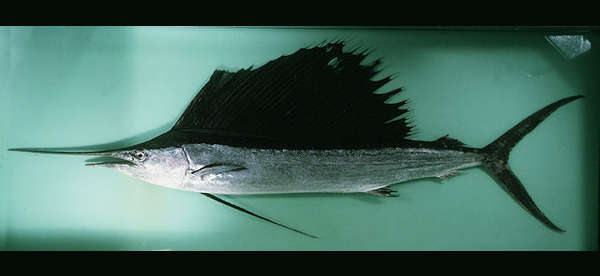
Exhibiting sail-raising behavior The Indo-Pacific sailfish (Istiophorus platypterus) is a sailfish native to the Indian and Pacific Oceans and is naturalized in the Atlantic where it has entered the Mediterranean Sea via the Suez Canal as a Lessepsian migrant. It is dark blue on top, brown-blue laterally, silvery white underbelly; upper jaw elongated in the form of a spear; first dorsal fin greatly enlarged in the form of a sail, with many black cones, its front squared off, highest at its midpoint; pelvic fins very narrow, reaching almost to the anus; body covered with embedded scales, blunt at end; lateral line curved above pectoral fin, then straight to base of tail. They have a large and sharp bill, which they use for hunting. They feed on tuna and mackerel, some of the fastest fish in the ocean. Most authorities only recognise a single species of sailfish, I. platypterus.
It is theorized by marine biologists that the 'sail' (dorsal fin array) of the sailfish may serve the purpose of a cooling and heating system for this fish; this due to a network of a large number of blood vessels found in the sail and because of "sail-raising" behaviour exhibited by the sailfish at or near the surface waters after or before high-speed bursts.
Excerpted from Wikipedia’s “Indo-Pacific sailfish” article, available under the CC BY-SA 4.0 licence.