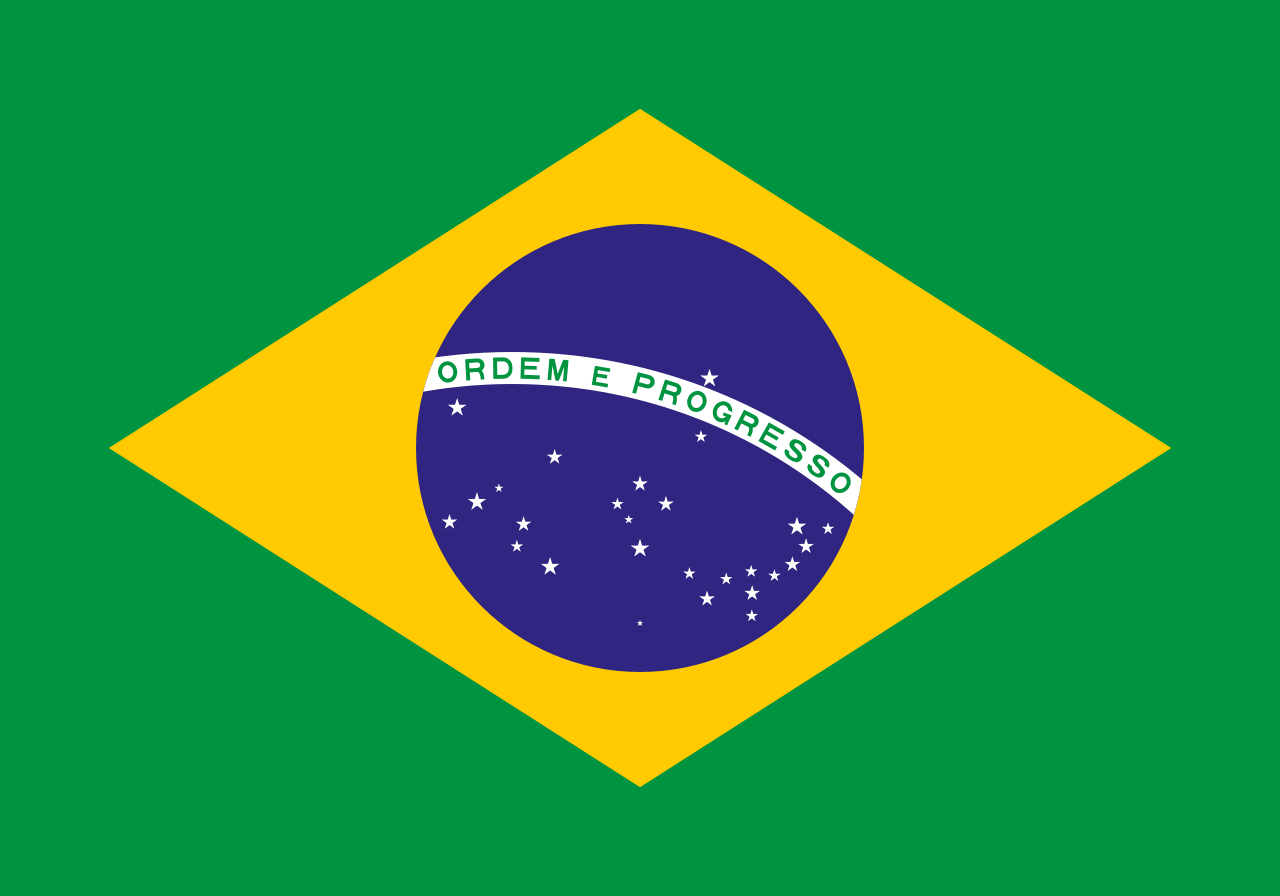
Brazil
Sign in to saveAlso known as Federative Republic of Brazil, Brasil
Brazil, officially the Federative Republic of Brazil, is the largest country in South America. It is also the world's fifth-largest country by area and the seventh-largest by population, with over 213 million people. The country is a federation composed of 26 states and a Federal District, which hosts the capital, Brasília. Its most populous city is São Paulo, followed by Rio de Janeiro. Brazil has the most Portuguese speakers in the world and is the only country in the Americas where Portuguese is an official language.
OverviewAI-generated
Brazil, officially the Federative Republic of Brazil, is a country in South America. Its capital is Brasília. The nation has a population of 213,421,037 and covers an area of 8,515,767 square kilometers. It is characterized as a free country with a federal republic government that operates as a representative democracy and presidential system. The official motto is "Order and Progress."
The country uses the Brazilian real as currency and has the license plate code BR. Its flag is represented by the Unicode character 🇧🇷. Brazil is home to White Brazilians, Pardo Brazilians, African Brazilians, and Asian Brazilians. Public holidays include International Workers' Day, Independence Day, All Souls' Day, and Christmas. The patron saint is Our Lady of Aparecida. The country maintains diplomatic relations with Argentina, South Africa, Germany, and Angola.
Synthesized by Vinony from 73 facts across 10 sources: Wikidata, Openweathermap, Open Meteo, REST Countries, World Bank, OpenStreetMap, Firecrawl, PubMed, Vinony graph, Geo. Generated from structured data (not the Wikipedia text) and checked against those facts — may still contain errors.
Weather now
cached 7h ago7-day forecast
via Open-Meteo
Country

- Capital
- Brasília
- Population
- 213,421,037
- Region
- Americas · South America
- Demonym
- Brazilian
- Currencies
- BRL (R$)
- Languages
- Portuguese
- Calling code
- +55
- Drives on
- Right
- Gini
- 53.4 (2019)
- FIFA code
- BRA
- TLD
- .br
- Timezones
- UTC-05:00 · +3 more
- Borders
- ARG, BOL, COL, GUF, GUY, PRY, PER, SUR, URY, VEN
via REST Countries
Indicators · World Bank
- GDP
- $2.2T(2024)
- Population
- 211,998,573(2024)
- Life expectancy
- 76 yrs(2024)
- Unemployment
- 6 %(2025)
- Urban population
- 87.9 %(2024)
- Internet users
- 84.5 %(2024)
- Forest area
- 59 %(2023)
- Renewable energy
- 46.5 %(2021)
via World Bank Open Data · CC BY 4.0
Wikipedia views (30d)
403,321 totalvia Wikimedia Pageviews API
Key facts
- Country.conventional_long_name
- Federative Republic of Brazil
- Country.common_name
- Brazil
- Country.image_flag
- Flag of Brazil.svg
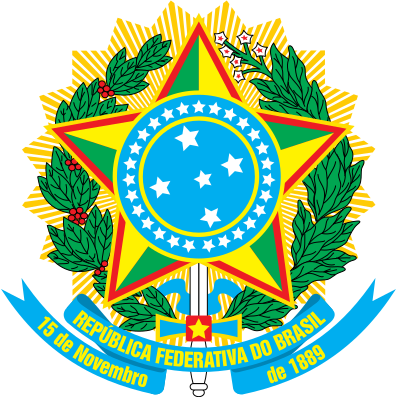
- Country.image_coat
- Coat of arms of Brazil (dark blue).svg
- Country.symbol_type
- Coat of arms
- Country.coa_size
- 90px
- Country.other_symbol_type
- National Seal
- Country.national_motto
- "Order and Progress"
- Country.national_anthem
- "Brazilian National Anthem"File:Hino-Nacional-Brasil-instrumental-mec.ogg
- Country.flag_anthem
- "National Flag Anthem"File:Brazilian Flag Anthem (Ministry of Education).ogg
- Country.image_map
- File:BRA orthographic.svg
- Country.map_width
- 220px
- Country.capital
- Brasília
- Country.largest_city
- São Paulo
- Country.languages_type
- Official language
- Country.languages
- Portuguese
- Country.languages2_type
- Recognized regional languages
- Country.languages2
- See regional official languages
via Wikipedia infobox
Research
724,280 papers- Brazil's family health strategy--delivering community-based primary care in a universal health system.The New England journal of medicine · 2015Macinko J, Harris MJDOI: 10.1056/NEJMp1501140
- Immunization Agenda 2030 and Brazil's challenges.Epidemiologia e servicos de saude : revista do Sistema Unico de Saude do Brasil · 2023Braga C, Reis-Santos BDOI: 10.1590/S2237-962220230003000018.EN
- Brazil's COVID-19 response.Lancet (London, England) · 2020Rizzo LV, Wolosker NDOI: 10.1016/S0140-6736(20)31915-2
- Brazil's dengue vaccine campaign falters.The Lancet. Infectious diseases · 2024Triunfol MDOI: 10.1016/S1473-3099(24)00310-4
- Brazil's mangroves: Natural carbon storage.Science (New York, N.Y.) · 2022da S Bezerra D, de Lima Santos A, Bezerra JS et al.DOI: 10.1126/science.abo4578
- Brazil's COVID-19 response.Lancet (London, England) · 2020da Silva Bastos MHDOI: 10.1016/S0140-6736(20)31914-0
- Brazil's COVID-19 response.Lancet (London, England) · 2020de Andreazzi CS, Brandão ML, Bueno MG et al.DOI: 10.1016/S0140-6736(20)31920-6
- Brazil's COVID-19 response.Lancet (London, England) · 2020Pontes MRN, Lima JPDOI: 10.1016/S0140-6736(20)31919-X
via PubMed
Official website

GOV.BR
O gov.br reúne, em um só lugar, serviços para o cidadão e informações sobre a atuação de todas as áreas do governo.
gov.br →Link to the official site · 35,323 chars · not written by Vinony
Travel guide
Understand
Brazil is the largest country in South America. The country has a soul of history and culture and includes nightlife, scenic beauty, white sandy beaches, inland waterways and lush green forests that are among the largest in the world.
Get in
thumb|375px|A map showing the visa requirements of Brazil, with countries in green and light blue having visa-free access
Get around
Travelling between major cities in Brazil can take a lot of time.
Sleep
thumb|Night in [[Campinas]] High season in Brazil follows the school holidays calendar, December and January (summer) being the busiest months. New Year, Carnival (movable between February and March, see Understand above) and Holy week are the peak periods, and prices can skyrocket, especially in coastal cities like Rio and Salvador. Also, during those holidays, many hotels restrict bookings to a 3 or 4-day minimum and charge in advance.
Hotels are plentiful in just about all areas of Brazil and can range from luxury beach resorts to very modest and inexpensive choices. The Brazilian tourism regulation board imposes specific minimum attributes for each type of facility, but as the 1-5 star rating is no longer enforced, check in advance if your hotel provides the kind of services you expect.
Pousada means guesthouse (the local equivalent of a French auberge or a British boarding house), and are usually simpler than hotels, and will offer fewer services (room service, laundry etc.). Pousadas are even more widespread than hotels.
In wilderness areas like the Pantanal, travelers usually stay in fazendas, which are ranches with guest facilities. In small towns of Minas Gerais people are fond of hotéis-fazenda (farm hotels) where you can swim, ride, walk, play football, and camp as well as sleep in picturesque barracks.
Also there is great fun in going on a boat hotel which will take you to inaccessible places on the rivers and lakes for great fishing trips or for simply relaxi…
Stay healthy
When visiting the Midwestern states of Brazil, the relative humidity can be below 30% during the dry season from June to September. It is important to drink plenty of water to avoid the unpleasant effects of dehydration.
Food from street and beach vendors has a bad hygienic reputation in Brazil. The later in the day, the worse it gets. Bottled and canned drinks are safe, although some people will insist on using a straw to avoid contact with the exterior of the container. Bear in mind the heat and humidity when storing perishable foods.
Tap water varies from place to place, (from contaminated, saline or soaked with chlorine to plain drinkable) and Brazilians themselves usually prefer to have it filtered.
In airports, bus stations, as well as many of the cheaper hotels and malls, it is common to find drinking fountains (bebedouro), although not always safe. In hostel kitchens, look for the tap with the cylindrical filter attached. In more expensive hotels, there is often no publicly accessible fountain, and bedrooms contain minibars, selling you mineral water at extremely inflated prices — buying bottled water from the store is always the best alternative. thumb|View of the Amazon rainforest Vaccination against yellow fever and taking anti-malaria medication may be necessary if you are travelling to the Midwestern state of Mato Grosso or the northern (Amazon) regions. If you're arriving from Peru, Colombia or Bolivia, proof of yellow fever vaccination is required befo…
Stay safe
By law, everyone must carry a photo ID at all times. For a foreigner, this means your passport. However, the police will mostly be pragmatic and accept a plastified color photocopy. Not carrying a photo ID can lead to problems and delays if stopped by police or in case of a medical emergency.
Respect
Generally speaking, Brazilians are passionate, curious, welcoming conversationalists.
Go next
Crossing the land border is possible to Uruguay, Argentina, Colombia, French Guiana, Paraguay, Bolivia, Peru, Guyana and Venezuela. There is no road to Suriname.
Argentina and Paraguay: Directly at the border crossing to both countries is the Brazilian airport of Foz do Iguaçu. The airport has flights from several Brazilian destinations. Bolivia: The bigger Brazilian airports nearby are in Campo Grande, Cuiabá and Porto Velho. Directly at a border crossing is the airport of Corumba with flights for example from São Paulo. Uruguay: Fly to nearby Pelotas or Porto Alegre. Colombia and Peru: Take a flight or a boat on the Amazon to Tabatinga. To the Peruvian border you could also fly to Rio Branco or Porto Velho. French Guyana: Take a flight to Macapa or Belém. Guyana and Venezuela: Fly to Boa Vista or Manaus.
Travel guide from Wikivoyage (CC BY-SA 4.0)
~40 min read
Encyclopedic overview
48 sectionsContents
- Etymology
- History
- Pre-Cabraline era
- European colonization and Colonial Brazil
- Kingdom of Brazil
- Empire of Brazil
- Early Republic
- Military dictatorship
- Contemporary era
- Geography
- Climate
- Topography and hydrography
- Biodiversity and conservation
- Government and politics
- Law
- Political subdivisions
- Foreign relations
- Military
- Law enforcement and crime
- Human rights
- Economy
- Tourism
- Science and technology
- Energy
- Transportation
- Demographics
- Urbanization
- Race and ethnicity
- Language
- Religion
- Education
- Health
- Culture
- Architecture
- Visual arts
- Music
- Literature
- Theatre
- Cinema
- Media
- Cuisine
- Sports
- See also
- Notes
- References
- Bibliography
- Further reading
- External links
Brazil, officially the Federative Republic of Brazil, is the largest country in South America. It is also the world's fifth-largest country by area and the seventh-largest by population, with over 213 million people. Brazil is a federation composed of 26 states and a Federal District, which hosts the capital, Brasília. Its most populous city is São Paulo, followed by Rio de Janeiro. Brazil has the most Portuguese speakers in the world and is the only country in the Americas where Portuguese is an official language.
Bounded by the Atlantic Ocean on the east, Brazil has a coastline of 7,491 kilometers (4,655 mi), among the longest in the world. Covering roughly half of South America's land area, it borders all other countries and territories on the continent except Ecuador and Chile. Brazil encompasses a wide range of tropical and subtropical landscapes, as well as wetlands, savannas, plateaus, and low mountains. It contains most of the Amazon basin, including the world's largest river system and most extensive virgin tropical forest. Brazil has diverse wildlife, a variety of ecological systems, and extensive natural resources spanning numerous protected habitats. It ranks first among 17 megadiverse countries, with its natural heritage being the subject of significant global interest, as environmental degradation (through processes such as deforestation) directly affect global issues such as climate change and biodiversity loss.
Excerpted from Wikipedia’s “Brazil” article, available under the CC BY-SA 4.0 licence.
Gallery (639)
On the map
60 mapped locations
Available in 304 languages
- Español
- Français
- Deutsch
- 中文
- 日本語
- Русский
- Português
- Italiano
- العربية
- हिन्दी
- Abkhazian
- abstract
- Achinese
- Adyghe
- Afrikaans
- Akan
- Albanian
- Albanian
Show 285 more
- Amharic
- ami
- Angika
- Aragonese
- Aramaic
- Armenian
- Arpitan
- Assamese
- Asturian
- Awadhi
- Aymara
- azb
- Azerbaijani
- Bahasa Indonesia
- Balinese
- Bambara
- Bangla
- Bashkir
- Basque
- bat_smg
- Batak Toba
- Bavarian
- be_x_old
- Belarusian
- Betawi
- Bhojpuri
- Bikol
- Bishnupriya
- Bislama
- blk
- Bosnian
- Breton
- btm
- Bulgarian
- Buriat
- Burmese
- Catalan
- cbk_zam
- cdo
- Cebuano
- Central Dusun
- Central Kurdish
- Chamorro
- Chechen
- Cherokee
- Cheyenne
- Church Slavic
- Chuvash
- Cornish
- Corsican
- Crimean Tatar
- Croatian
- Czech
- dag
- Danish
- Divehi
- dty
- Dzongkha
- Egyptian Arabic
- eml
- Erzya
- Esperanto
- Estonian
- Ewe
- Extremaduran
- Faroese
- Fiji Hindi
- Fijian
- Filipino
- Finnish
- fiu_vro
- Fon
- Friulian
- Fula
- Gagauz
- Galician
- Gan Chinese
- Ganda
- gcr
- Georgian
- Gilaki
- Goan Konkani
- Gothic
- gpe
- Greek
- Guarani
- Gujarati
- Haitian Creole
- Hakka Chinese
- Hausa
- Hawaiian
- Hebrew
- Hungarian
- hyw
- Iban
- Icelandic
- Ido
- Igbo
- Iloko
- Inari Sami
- Ingush
- Interlingua
- Interlingue
- Inupiaq
- Irish
- Jamaican Creole English
- Javanese
- Kabardian
- Kabyle
- kai
- Kannada
- Kanuri
- Kara-Kalpak
- Karachay-Balkar
- Kashmiri
- Kashubian
- Kazakh
- kbp
- kge
- Khmer
- Kikuyu
- Kinyarwanda
- Komi
- Kongo
- Kotava
- Kurdish
- Kyrgyz
- Ladino
- Lao
- Latgalian
- Latin
- Latvian
- Lezghian
- Ligurian
- Limburgish
- Lingala
- Lingua Franca Nova
- Lithuanian
- lld
- Lojban
- Lombard
- Low German
- Lower Sorbian
- Luxembourgish
- Macedonian
- Maithili
- Malagasy
- Malay
- Malayalam
- Maltese
- Manipuri
- Manx
- Māori
- map_bms
- Marathi
- Mari
- Mazanderani
- Minangkabau
- Mingrelian
- Mirandese
- mnw
- Moksha
- Mongolian
- Moroccan Arabic
- N’Ko
- Navajo
- nds_nl
- Neapolitan
- Nederlands
- Nepali
- Newari
- Northern Frisian
- Northern Sami
- Northern Sotho
- Norwegian
- Norwegian Nynorsk
- Novial
- nrm
- Obolo
- Occitan
- Old English
- olo
- Oromo
- Ossetic
- Palatine German
- Pampanga
- Pangasinan
- Papiamento
- Pashto
- Pennsylvania German
- Picard
- Piedmontese
- Polski
- Punjabi
- Quechua
- roa_tara
- Romanian
- Romansh
- Romany
- Rundi
- Rusyn
- Samoan
- Sango
- Sanskrit
- Santali
- Sardinian
- Saterland Frisian
- Scots
- Scottish Gaelic
- Serbian
- Serbian (Latin)
- Shan
- Shona
- Sicilian
- Silesian
- simple
- Sindhi
- Sinhala
- Slovak
- Slovenian
- Somali
- Southern Sotho
- Sranan Tongo
- Standard Moroccan Tamazight
- Sundanese
- Svenska
- Swahili
- Swati
- syl
- szy
- Tachelhit
- Tahitian
- Tajik
- Talysh
- Tamil
- Taroko
- Tatar
- tay
- Telugu
- Tetum
- Tibetan
- Tiếng Việt
- Tigrinya
- Tok Pisin
- Toki Pona
- Tongan
- Tswana
- Tumbuka
- Türkçe
- Turkmen
- Tuvinian
- Tyap
- Udmurt
- Ukrainian
- Upper Sorbian
- Urdu
- Uyghur
- Uzbek
- Venda
- Venetian
- Veps
- Volapük
- Walloon
- Waray
- Welsh
- West Flemish
- Western Frisian
- Western Mari
- Western Panjabi
- Wolof
- Wu Chinese
- Xhosa
- Yakut
- Yiddish
- Yoruba
- Zaza
- Zeelandic
- zh_classical
- zh_min_nan
- zh_yue
- Zhuang
- Zulu
- فارسی
- ไทย
- 한국어
via Wikidata sitelinks · CC0