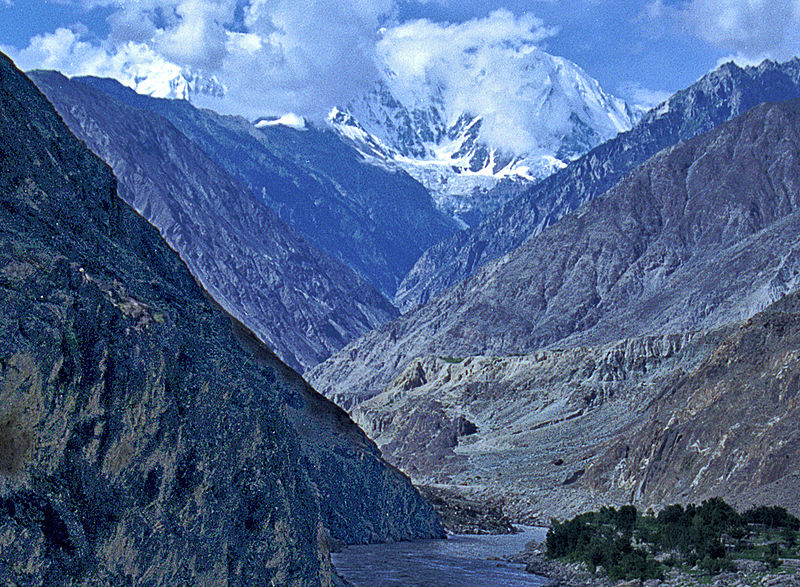
File:Nanga_Parbat_Indus_Gorge.jpg · Wikimedia Commons · See Wikimedia Commons
Indus River
Sign in to saveAlso known as Sindhu River, Sindh River, Mehran River, River Indus, Indus R., R. Indus, Indus
river in Asia
The Indus River is a major river located in Asia that flows through several countries in South Asia. It is one of the world's most important rivers, supporting millions of people through agriculture, water supply, and transportation.
AI-generated from the Wikipedia summary — may contain errors.
Wikidata facts
- Instance of
- river
- Country
- India
- Located in
- Tibet Autonomous Region
- Continent
- Asia
- Image
- Indus near Skardu.jpg
- Length
- 3180
Show 13 more facts
- Commons category
- Indus River
- mouth of the watercourse
- Arabian Sea
- topic's main category
- Category:Indus River
- category for the water basin
- Category:Indus basin
- Commons gallery
- River Indus
- watershed area
- 1165000
- discharge
- 6600
- native label
- نیلاب
- on focus list of Wikimedia project
- Wikipedia:Vital articles/Level/4
- impounded by
- Tarbela Dam
- basin country
- Pakistan
- different from
- Dalaman Brook
- origin of the watercourse
- Tibetan Plateau
via Wikidata · CC0
~35 min read
Encyclopedic overview
The Indus (/ˈɪndəs/ IN-dəs) is a transboundary river of Asia and a trans-Himalayan river of South and Central Asia. The 3,180 km (1,980 mi) river rises in the Tibet Autonomous Region of China where it is known as Sengge Zangbo, flows northwest through the disputed Kashmir region, first through the Indian-administered Ladakh, and then the Pakistani-administered Gilgit-Baltistan, bends sharply to the left after the Nanga Parbat massif, and flows south-by-southwest through Sindh province of Pakistan, before bifurcating and emptying into the Arabian Sea, its main stem located near the port city of Karachi.
The Indus River has a total drainage area of circa 1,120,000 km (430,000 mi). Its estimated annual flow is around 175 km/a (5,500 m/s), making it one of the 50 largest rivers in the world in terms of average annual flow. Its left-bank tributary in Ladakh is the Zanskar River, and its left-bank tributary in the plains is the Panjnad River which is formed by the successive confluences of the five Punjab rivers, namely the Chenab, Jhelum, Ravi, Beas, and Sutlej rivers. Its principal right-bank tributaries are the Shyok, Gilgit, Kabul, Kurram, and Gomal rivers. Beginning in a mountain spring and fed with glaciers and rivers in the Himalayan, Karakoram, and Hindu Kush ranges, the river supports the ecosystems of temperate forests, plains, and arid countryside.
Excerpted from Wikipedia’s “Indus River” article, available under the CC BY-SA 4.0 licence.
Gallery (12)
On the map
4 mapped locations
Available in 152 languages
- Español
- Français
- Deutsch
- 中文
- 日本語
- Русский
- Português
- Italiano
- العربية
- हिन्दी
- Afrikaans
- Albanian
- Albanian
- Amharic
- Aragonese
- Armenian
- Assamese
- Asturian
Show 133 more
- azb
- Azerbaijani
- Bahasa Indonesia
- Balinese
- Bangla
- Bashkir
- Basque
- bat_smg
- Bavarian
- be_x_old
- Belarusian
- Bhojpuri
- Bikol
- Bosnian
- Breton
- Bulgarian
- Buriat
- Burmese
- Catalan
- Cebuano
- Central Kurdish
- Chechen
- Chuvash
- Cornish
- Crimean Tatar
- Croatian
- Czech
- Danish
- Divehi
- Egyptian Arabic
- Esperanto
- Estonian
- Extremaduran
- Fiji Hindi
- Filipino
- Finnish
- fiu_vro
- Galician
- Georgian
- Gorontalo
- Greek
- Guarani
- Gujarati
- Hausa
- Hebrew
- Hungarian
- Icelandic
- Ido
- Iloko
- Interlingua
- Irish
- Javanese
- Kannada
- Kanuri
- Kara-Kalpak
- Karachay-Balkar
- Kashmiri
- Kazakh
- kbp
- kge
- Kurdish
- Kyrgyz
- Latin
- Latvian
- Lezghian
- Lingua Franca Nova
- Lithuanian
- Low German
- Macedonian
- Maithili
- Malagasy
- Malay
- Malayalam
- Marathi
- Mingrelian
- Mongolian
- Moroccan Arabic
- Nederlands
- Nepali
- Newari
- Northern Frisian
- Norwegian
- Norwegian Nynorsk
- Nyanja
- Occitan
- Odia
- Old English
- Ossetic
- Pashto
- Piedmontese
- Polski
- Punjabi
- roa_tara
- Romanian
- Rusyn
- Sanskrit
- Santali
- Serbian
- Serbian (Latin)
- Sicilian
- simple
- Sindhi
- skr
- Slovak
- Slovenian
- Svenska
- Swahili
- Tajik
- Talysh
- Tamil
- Tatar
- Telugu
- Tibetan
- Tiếng Việt
- Türkçe
- Turkmen
- Ukrainian
- Upper Sorbian
- Urdu
- Uzbek
- Venetian
- Veps
- Waray
- Welsh
- Western Panjabi
- Wu Chinese
- Yakut
- Yiddish
- zh_min_nan
- zh_yue
- فارسی
- ไทย
- 한국어
via Wikidata sitelinks · CC0