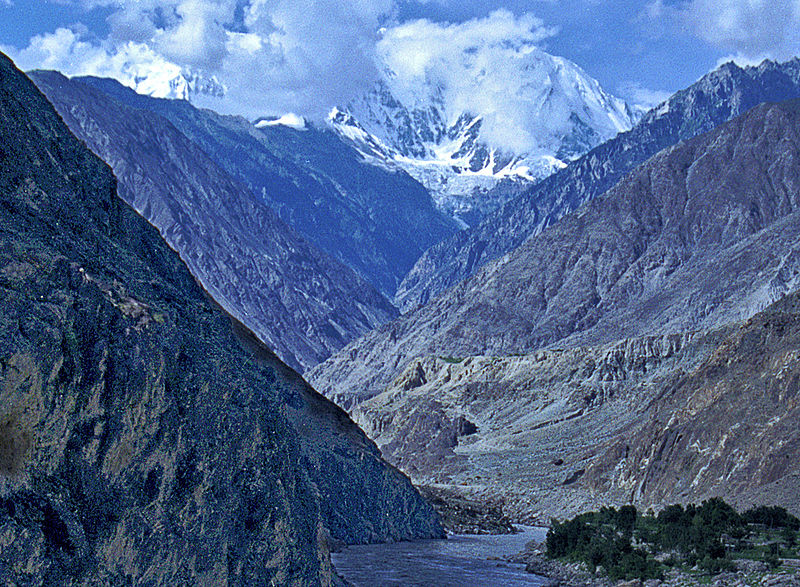
File:Nanga_Parbat_Indus_Gorge.jpg · Wikimedia Commons · See Wikimedia Commons
Indo
Sign in to saveAlso known as Sindhu River, Sindh River, Mehran River, River Indus, Indus R., R. Indus, Indus
río de Asia
The Indus River is a major river located in Asia that flows through several countries in South Asia. It is one of the world's most important rivers, supporting millions of people through agriculture, water supply, and transportation.
AI-generated from the Wikipedia summary — may contain errors.
Wikidata facts
- Instance of
- river
- Country
- India
- Located in
- Tibet Autonomous Region
- Continent
- Asia
- Image
- Indus near Skardu.jpg
- Length
- 3180
Show 13 more facts
- Commons category
- Indus River
- mouth of the watercourse
- Arabian Sea
- topic's main category
- Category:Indus River
- category for the water basin
- Category:Indus basin
- Commons gallery
- River Indus
- watershed area
- 1165000
- discharge
- 6600
- native label
- نیلاب
- on focus list of Wikimedia project
- Wikipedia:Vital articles/Level/4
- impounded by
- Tarbela Dam
- basin country
- Pakistan
- different from
- Dalaman Brook
- origin of the watercourse
- Tibetan Plateau
via Wikidata · CC0
Article · Español
El Indo es un río asiático que discurre por el subcontinente indio, uno de los más largos del continente, el más importante de Pakistán y de los principales de la India (y que también recorre en su curso alto China). Originario de la meseta tibetana del oeste de China, en la Región Autónoma del Tíbet, el curso de agua discurre a través del distrito de Ladakh de Jammu y Cachemira y luego entra en Pakistán a través de Gilgit-Baltistán; sigue después desde el norte del país en dirección sur cruzando a lo largo todo Pakistán, hasta desembocar en el mar Arábigo, cerca de la ciudad portuaria de Karachi en Sind. La longitud total del río es de 3.180 km, siendo el río más largo de Pakistán. Drena una gran cuenca de más de 1.165.000 km² y tiene un caudal anual estimado en unos 207 km³, lo que lo convierten en el 21.º más caudaloso del mundo. Comenzando en las alturas del mundo con glaciares, el río alimenta el ecosistema de los bosques templados, llanuras y paisajes áridos. Junto con los ríos Jhelum, Chenab, Ravi, Sutlej, Beas y dos afluentes desde la Jaiber Pastunjuá y Afganistán, el Indo forma el delta del Indo de Pakistán, mencionado en el Rig-veda (el texto más antiguo de la India, de mediados del II milenio a. C.) como Sapta Sindhu y en el texto iranio Zend Avesta como Hapta Hindu (significando ambos términos, ‘siete ríos’). El Indo proporciona los recursos hídricos clave para la economía de Pakistán —especialmente el granero de la provincia de Punyab, que representa la mayor parte de la producción agrícola de la nación, y de Sind. El curso de agua también soporta muchas industrias pesadas y constituye el principal suministro de agua potable en Pakistán. Los cinco ríos que dan nombre al Panyab son el Jhelum, Chenab, el Ravi, el Beas y el Sutlej. Antes de la división en 1947 de la antigua India en los modernos estados de la India y Pakistán, el Indo era el segundo río en importancia de la región, después del río Ganges, tanto en términos culturales como comerciales. En la actualidad el río también da nombre a la provincia pakistaní de Sind. El río ha sido una fuente de asombro durante el periodo clásico. El rey Darío I de Persia envió a Escílax de Carianda a explorar el Indo entre los años 519 y 512 a. C., descendiéndolo hasta llegar al mar. Llamado Hindós o Indós por los griegos y luego Indus por los autores latinos, fue siempre conocido en Occidente por su nombre latinizado que también dio nombre a la India (Bharat).
Abstract from DBpedia / Wikipedia · CC BY-SA
Gallery (12)
On the map
4 mapped locations
Available in 152 languages
- Español
- Français
- Deutsch
- 中文
- 日本語
- Русский
- Português
- Italiano
- العربية
- हिन्दी
- Afrikaans
- Albanian
- Albanian
- Amharic
- Aragonese
- Armenian
- Assamese
- Asturian
Show 133 more
- azb
- Azerbaijani
- Bahasa Indonesia
- Balinese
- Bangla
- Bashkir
- Basque
- bat_smg
- Bavarian
- be_x_old
- Belarusian
- Bhojpuri
- Bikol
- Bosnian
- Breton
- Bulgarian
- Buriat
- Burmese
- Catalan
- Cebuano
- Central Kurdish
- Chechen
- Chuvash
- Cornish
- Crimean Tatar
- Croatian
- Czech
- Danish
- Divehi
- Egyptian Arabic
- Esperanto
- Estonian
- Extremaduran
- Fiji Hindi
- Filipino
- Finnish
- fiu_vro
- Galician
- Georgian
- Gorontalo
- Greek
- Guarani
- Gujarati
- Hausa
- Hebrew
- Hungarian
- Icelandic
- Ido
- Iloko
- Interlingua
- Irish
- Javanese
- Kannada
- Kanuri
- Kara-Kalpak
- Karachay-Balkar
- Kashmiri
- Kazakh
- kbp
- kge
- Kurdish
- Kyrgyz
- Latin
- Latvian
- Lezghian
- Lingua Franca Nova
- Lithuanian
- Low German
- Macedonian
- Maithili
- Malagasy
- Malay
- Malayalam
- Marathi
- Mingrelian
- Mongolian
- Moroccan Arabic
- Nederlands
- Nepali
- Newari
- Northern Frisian
- Norwegian
- Norwegian Nynorsk
- Nyanja
- Occitan
- Odia
- Old English
- Ossetic
- Pashto
- Piedmontese
- Polski
- Punjabi
- roa_tara
- Romanian
- Rusyn
- Sanskrit
- Santali
- Serbian
- Serbian (Latin)
- Sicilian
- simple
- Sindhi
- skr
- Slovak
- Slovenian
- Svenska
- Swahili
- Tajik
- Talysh
- Tamil
- Tatar
- Telugu
- Tibetan
- Tiếng Việt
- Türkçe
- Turkmen
- Ukrainian
- Upper Sorbian
- Urdu
- Uzbek
- Venetian
- Veps
- Waray
- Welsh
- Western Panjabi
- Wu Chinese
- Yakut
- Yiddish
- zh_min_nan
- zh_yue
- فارسی
- ไทย
- 한국어
via Wikidata sitelinks · CC0