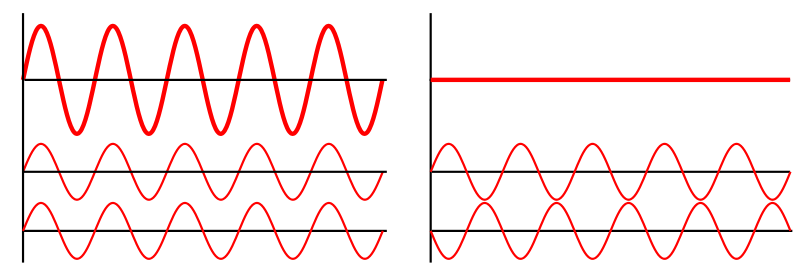
File:Interference_of_two_waves.svg · Wikimedia Commons · See Wikimedia Commons
Also known as phase interference, wave interference
phenomenon in which two coherent waves combine into a resultant wave with greater intensity or lower amplitude
Interference happens when two waves overlap and combine to create a new wave that can be either stronger or weaker than the original waves. It matters because it explains many everyday phenomena, from the colors in soap bubbles to how noise-canceling headphones work, and is fundamental to how light and sound behave.
AI-generated from the Wikipedia summary — may contain errors.
Wikidata facts
- Instance of
- phenomenon
- Subclass of
- physical law
- Part of
- physics
- Image
- Interference of two waves.svg
Show 6 more facts
- Stack Exchange tag
- physics.stackexchange.com/tags/interference
- on focus list of Wikimedia project
- Wikipedia:Vital articles/Level/4
- Commons category
- Interference
- Commons gallery
- Interference
- topic's main category
- Category:Interference
- described at URL
- www.youtube.com/watch?v=ugZBrWlHETQ
Sources (2)
via Wikidata · CC0
Article · 中文
干涉(英語:Interference)在物理学中,指的是兩列或两列以上的波在空间中重疊時发生叠加,从而形成新波形的現象。 例如采用分束器将一束单色光束分成两束后,再让它们在空间中的某个区域内重叠,将会发现在重叠区域内的光强并不是均匀分布的:其明暗程度随其在空间中位置的不同而变化,最亮的地方超过了原先两束光的光强之和,而最暗的地方光强有可能为零,这种光强的重新分布被称作“干涉条纹”。在历史上,干涉现象及其相关实验是证明光的波动性的重要依据,但光的这种干涉性质直到十九世纪初才逐渐被人们发现,主要原因是相干光源的不易获得。 为了获得可以观测到可见光干涉的相干光源,人们发明制造了各种产生相干光的光学器件以及干涉仪,这些干涉仪在当时都具有非常高的测量精度:阿尔伯特·迈克耳孙就借助迈克耳孙干涉仪完成了著名的迈克耳孙-莫雷实验,得到了以太风观测的零结果。迈克耳孙也利用此干涉仪測得的精確長度,並因此獲得了1907年的諾貝爾物理學獎。而在二十世纪六十年代之后,激光这一高强度相干光源的发明使光学干涉测量技术得到了前所未有的广泛应用,在各种精密测量中都能见到激光干涉仪的身影。现在人们知道,两束电磁波的干涉是彼此振动的电场强度矢量叠加的结果,而由于光的波粒二象性,光的干涉也是光子自身的几率幅叠加的结果。
Abstract from DBpedia / Wikipedia · CC BY-SA
Gallery (12)
Available in 72 languages
- Español
- Français
- Deutsch
- 中文
- 日本語
- Русский
- Português
- Italiano
- العربية
- हिन्दी
- Amharic
- Armenian
- Asturian
- Azerbaijani
- Bahasa Indonesia
- Bangla
- Basque
- Belarusian
Show 53 more
- Bosnian
- Bulgarian
- Catalan
- Chuvash
- Croatian
- Czech
- Danish
- Esperanto
- Estonian
- Filipino
- Finnish
- Galician
- Greek
- Haitian Creole
- Hebrew
- Hungarian
- Ido
- Interlingua
- Irish
- Kannada
- Latvian
- Lithuanian
- Luxembourgish
- Macedonian
- Malay
- Malayalam
- Mongolian
- Nederlands
- Norwegian
- Norwegian Nynorsk
- Polski
- Punjabi
- Romanian
- Serbian
- Serbian (Latin)
- simple
- Slovak
- Slovenian
- Svenska
- Tamil
- Tatar
- Tiếng Việt
- Türkçe
- Ukrainian
- Urdu
- Uzbek
- Welsh
- Wu Chinese
- zh_min_nan
- zh_yue
- فارسی
- ไทย
- 한국어
via Wikidata sitelinks · CC0