File:Double-alaskan-rainbow.jpg · Wikimedia Commons · See Wikimedia Commons
rainbow
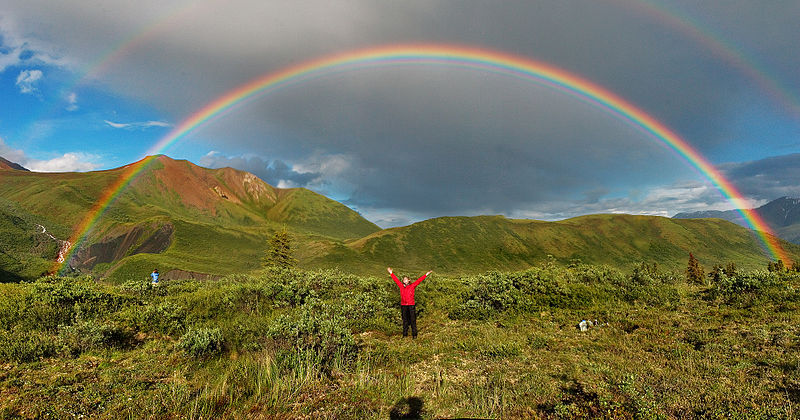
Sign in to savethumb|upright=1.35|Double rainbow and supernumerary rainbows on the inside of the primary arc. The shadow of the photographer's head at the bottom of the photograph marks the centre of the rainbow circle (the antisolar point).
A rainbow is an optical phenomenon consisting of a spectrum of light that appears in the sky when sunlight and rain occur simultaneously, with the observer positioned between the sun and the rain. Rainbows matter because they are striking natural displays that have fascinated people throughout history and provide visible evidence of how light behaves when it interacts with water droplets.
AI-generated from the Wikipedia summary — may contain errors.
Wikidata facts
- Instance of
- phenomenon
- Subclass of
- photometeor
- Image
- WhereRainbowRises.jpg
Show 7 more facts
- Unicode character
- 🌈
- Commons category
- Rainbows
- topic's main category
- Category:Rainbow
- Commons gallery
- Rainbow
- color
- red
- on focus list of Wikimedia project
- Wikipedia:Vital articles/Level/4
Sources (9)
via Wikidata · CC0
~43 min read
Encyclopedic overview
26 sectionsContents
- Visibility
- Number of colours in a spectrum or a rainbow <span class="anchor" id="The seven colours of the rainbow"></span>
- Explanation
- Mathematical derivation
- Variations
- Double rainbows
- Twinned rainbow
- Full-circle rainbow
- Supernumerary rainbows {{anchor|Supernumerary}}
- Reflected rainbow, reflection rainbow
- Monochrome rainbow
- Higher-order rainbows
- Rainbows under moonlight
- Fogbow
- Sleetbow
- Circumhorizontal and circumzenithal arcs
- Extraterrestrial rainbows
- Rainbows with different materials
- Scientific history
- Experiments
- Religion, culture and mythology
- See also
- Notes
- References
- Further reading
- External links
thumb|upright=1.35|Double rainbow and supernumerary rainbows on the inside of the primary arc. The shadow of the photographer's head at the bottom of the photograph marks the centre of the rainbow circle (the antisolar point).
A rainbow is an optical phenomenon caused by refraction, internal reflection and dispersion of light in water droplets resulting in a continuous spectrum of light appearing in the sky. The rainbow takes the form of a multicoloured circular arc. Rainbows caused by sunlight always appear in the section of sky directly opposite the sun. Rainbows can be caused by many forms of airborne water. These include not only rain, but also mist, spray, and airborne dew.
Excerpted from Wikipedia’s “rainbow” article, available under the CC BY-SA 4.0 licence.
Gallery (29)
Available in 179 languages
- Español
- Français
- Deutsch
- 中文
- 日本語
- Русский
- Português
- Italiano
- العربية
- हिन्दी
- Afrikaans
- Albanian
- Amharic
- ami
- Aragonese
- Aramaic
- Armenian
- Assamese
Show 160 more
- Asturian
- Aymara
- Azerbaijani
- Bahasa Indonesia
- Balinese
- Bangla
- Banjar
- Bashkir
- Basque
- bat_smg
- bdr
- be_x_old
- Belarusian
- Betawi
- Bikol
- Bosnian
- Breton
- Bulgarian
- Burmese
- Catalan
- cdo
- Central Kurdish
- Chechen
- Cherokee
- Chuvash
- Croatian
- Czech
- Danish
- Erzya
- Esperanto
- Estonian
- Fijian
- Filipino
- Finnish
- fiu_vro
- Friulian
- Galician
- Georgian
- Gorontalo
- Greek
- Guarani
- Gujarati
- Haitian Creole
- Hakka Chinese
- Hausa
- Hebrew
- Hungarian
- Iban
- Icelandic
- Ido
- Ingush
- Interlingua
- Inupiaq
- Irish
- Javanese
- Kabyle
- Kannada
- Kara-Kalpak
- Kashmiri
- Kazakh
- kbp
- kge
- Khmer
- Komi
- Komi-Permyak
- Kurdish
- Kyrgyz
- Lao
- Latin
- Latvian
- Ligurian
- Limburgish
- Lithuanian
- lld
- Lombard
- Lower Sorbian
- Macedonian
- Maithili
- Malagasy
- Malay
- Malayalam
- Manx
- Māori
- Marathi
- Mari
- mnw
- Mongolian
- Moroccan Arabic
- nah
- Nederlands
- Nepali
- Newari
- Norwegian
- Norwegian Nynorsk
- Occitan
- Oromo
- Pampanga
- Pashto
- Pennsylvania German
- Polski
- ppl
- Punjabi
- pwn
- Quechua
- roa_rup
- Romanian
- Santali
- Saterland Frisian
- Scottish Gaelic
- Serbian
- Serbian (Latin)
- Shona
- Sicilian
- Silesian
- simple
- Sindhi
- Sinhala
- Slovak
- Slovenian
- Somali
- Sundanese
- Svenska
- Swahili
- szy
- Tachelhit
- Tajik
- Tamil
- Taroko
- Tatar
- tay
- Telugu
- Tibetan
- Tiếng Việt
- Tsonga
- Tulu
- Türkçe
- Ukrainian
- Upper Sorbian
- Urdu
- Uzbek
- Venetian
- Veps
- Walloon
- Waray
- Wayuu
- Welsh
- Western Frisian
- Western Mari
- Western Panjabi
- Wu Chinese
- Yakut
- Yiddish
- Zaza
- zh_classical
- zh_min_nan
- zh_yue
- Zhuang
- فارسی
- ไทย
- 한국어
via Wikidata sitelinks · CC0