File:IntertropicalConvergenceZone-EO.jpg · Wikimedia Commons · See Wikimedia Commons
Intertropical Convergence Zone
Sign in to saveAlso known as ITCZ, Belt of Calms, The Calms
Meteorological phenomenon
Wikidata facts
Show 1 more fact
- Commons category
- Intertropical Convergence Zone
Sources (2)
via Wikidata · CC0
~12 min read
Encyclopedic overview
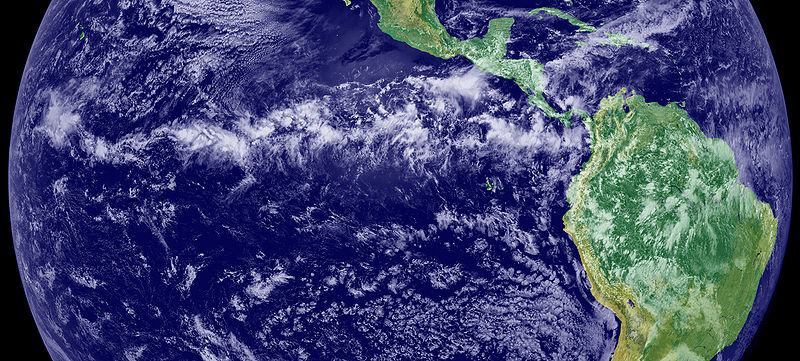
The ITCZ is visible as a band of clouds encircling Earth near the Equator. Average vertical air velocity at 500 hPa in July. Ascent (negative values) is concentrated close to the solar equator; descent (positive values) is more diffuse Seasonal variability of the Intertropical Convergence Zone (ITCZ), Congo air boundary (CAB), tropical rainbelt, and surface winds over Africa (adapted from Dezfuli 2017 with modification). This schematic shows that the ITCZ and the region of maximum rainfall can be decoupled over the continents.
The Intertropical Convergence Zone (ITCZ /ɪtʃ/ ITCH, or ICZ), known by sailors as the doldrums or the calms because of its monotonous windless weather, is the area where the northeast and the southeast trade winds converge. It encircles Earth near the thermal equator, though its specific position varies seasonally. When it lies near the geographic equator, it is called the near-equatorial trough. Where the ITCZ is drawn into and merges with a monsoonal circulation, it is sometimes referred to as a monsoon trough (a usage that is more common in Australia and parts of Asia).
Excerpted from Wikipedia’s “Intertropical Convergence Zone” article, available under the CC BY-SA 4.0 licence.