File:Earth_Global_Circulation_-_en.svg · Wikimedia Commons · See Wikimedia Commons
Hadley cell
Sign in to savetropical atmospheric circulation feature
Wikidata facts
- Part of
- atmospheric circulation
- Named after
- George Hadley
- Image
- HadleyCross-sec.jpg
Show 3 more facts
- facet of
- atmospheric circulation
- on focus list of Wikimedia project
- Wikipedia:Vital articles/Level/4
- Commons category
- Hadley cells
Sources (3)
via Wikidata · CC0
~40 min read
Encyclopedic overview
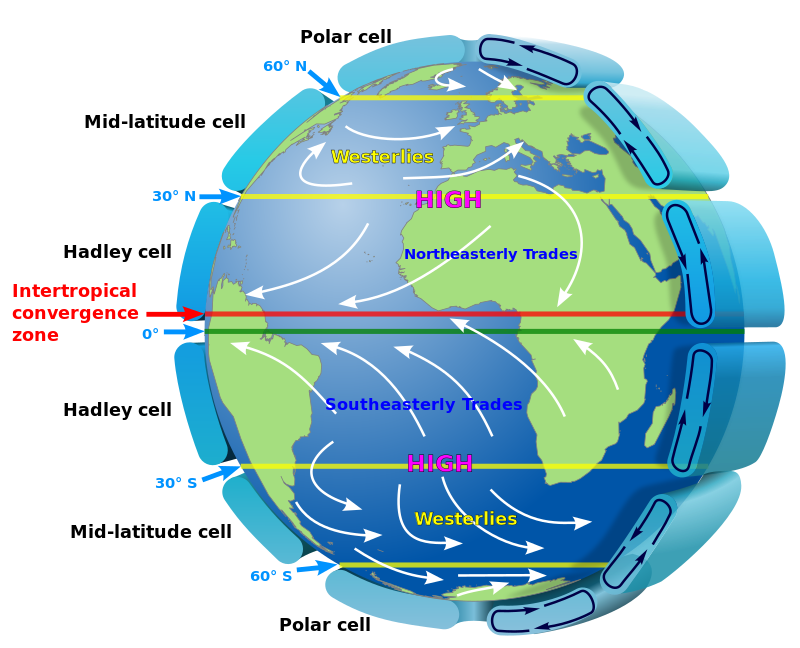
Diagram of global circulation patterns with Hadley cells, Polar cells, mid-latitude Ferrel cells, Westerlies, Trade winds and the median position of the Intertropical convergence zone Average vertical velocity (in pascals per second) at the 500 hPa pressure height in July from 1979 to 2001. Ascent (negative values) is concentrated close to the solar equator while descent (positive values) is more diffuse; their distribution is an imprint of the ascending and descending branches of the Hadley circulation.
The Hadley cell, also known as the Hadley circulation, is a global-scale tropical atmospheric circulation that features air rising near the equator, flowing poleward near the tropopause at a height of 12–15 km (7.5–9.3 mi) above the Earth's surface, cooling and descending in the subtropics at around 30 degrees latitude, and then returning equatorward near the surface. It is a thermally direct circulation within the troposphere that emerges due to differences in insolation and heating between the tropics and the subtropics. On a yearly average, the circulation is characterized by a circulation cell on each side of the equator. The Southern Hemisphere Hadley cell is slightly stronger on average than its northern counterpart, extending slightly beyond the equator into the Northern Hemisphere. During the summer and winter months, the Hadley circulation is dominated by a single, cross-equatorial cell with air rising in the summer hemisphere and sinking in the winter hemisphere. Analogous circulations may occur in extraterrestrial atmospheres, such as on Venus and Mars.
Excerpted from Wikipedia’s “Hadley cell” article, available under the CC BY-SA 4.0 licence.