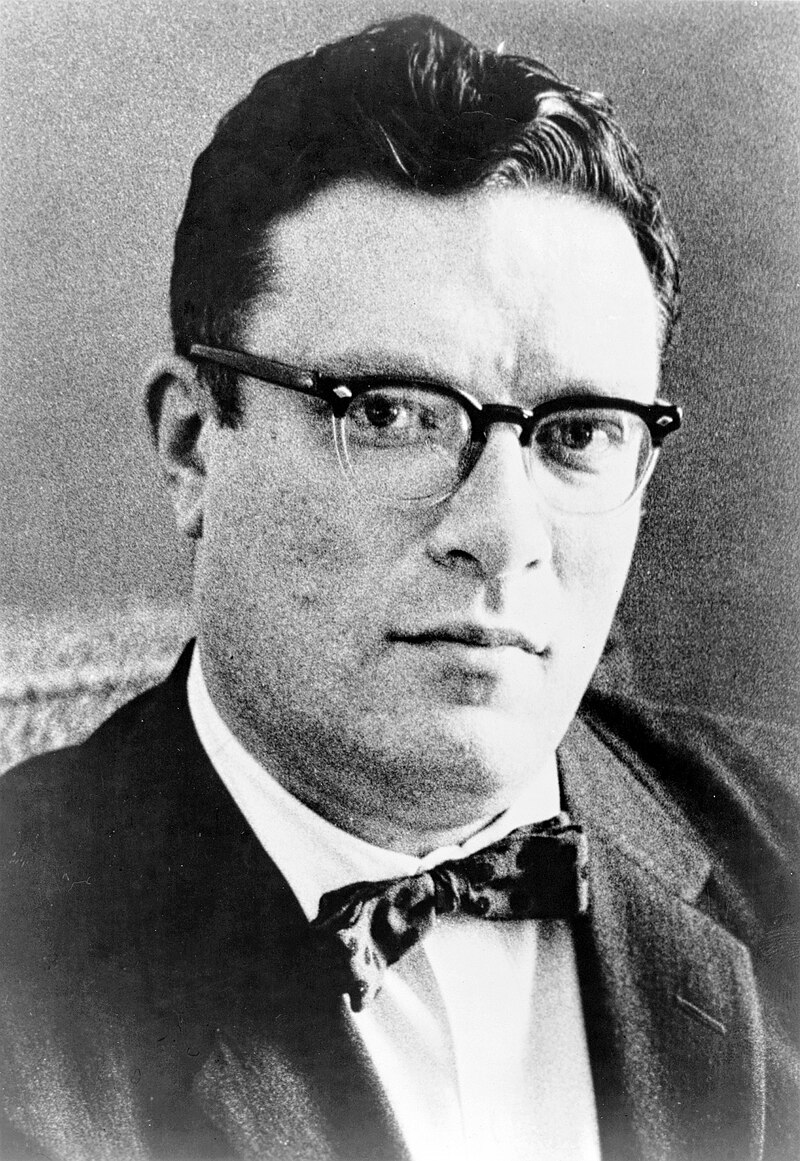
File:Isaac.Asimov01.jpg · Wikimedia Commons · See Wikimedia Commons
Isaac Asimov
Sign in to saveAlso known as Isaak Osimov, Paul French, Asimov, Isaak Ozimov, Itzhak Ozimov
American writer and biochemist (1920–1992)
OverviewAI-generated
Isaac Asimov, born Исаáк Ази́мов on 2 January 1920 in Petrovichi, was a biochemist, novelist, prose writer, and autobiographer. He held citizenship in the Russian Socialist Federative Soviet Republic and the United States. Asimov was a member of the Democratic Party and the American Academy of Arts and Sciences. He served in the United States Army during World War II and was employed by Boston University. He spoke English and Yiddish.
His notable works include the Foundation series, Robot series, Nightfall, and The Intelligent Man's Guide to Science. He received the Hugo Award, Edward E. Smith Memorial Award, Nebula Award for Best Novel, and Locus Award for Best Novel. Asimov was educated at Columbia University and Columbia University School of General Studies. He used the pseudonyms Paul French and H. B. Ogden. He was married to Janet Asimov.
Asimov died of natural causes due to kidney and heart failure on 6 April 1992 in Manhattan. He was of the Jewish ethnic group. His writing fields included short stories, science fiction, technical writing, science popular works, and novels.
Synthesized by Vinony from 42 facts across 5 sources: Wikidata, Open Library, TMDb, VIAF, Vinony collections. Generated from structured data (not the Wikipedia text) and checked against those facts — may still contain errors.
Person · Open Library
- Born
- 2 January 1920
- Died
- 6 April 1992
- Works
- 1447
Top works
- Great Tales of Crime and Detection
- Eu, Robô
- Eu, Robô
- Box Fundação
- The Foundation Novels 7-Book Bundle
via Open Library + Wikidata
Film & TV
Petrovichi, Russia
Isaac Asimov (born Isaak Yudovich Ozimov, January 2, 1920 – April 6, 1992) was an American author and professor of biochemistry at Boston University, best known for his works of science fiction and for his popular science books. Asimov was one of the most prolific writers of all time, having written or edited more than 500 books and an estimated 9,000 letters and postcards. His works have been…
Known for
- Isaac Asimov: A Message to the Future — Self (archive footage)2022
- Rendezvous with the Future — Self (archive footage)2022
- History 101 — Self (archive footage)2020
- The Real History of Science Fiction — Himself (archive footage)2014
- This Fantastic World 12 — (archive)1987
- Isaac Asimov: Voyage to the Outer Planets & Beyond — Self - Host1986
- Who's Who1986
- Doctor Who's Who's Who1985
- Target... Earth? — Self1980
- Since '45 — Self1979
via TMDB
Authority record · VIAF
- Lifespan
- 1920–1992
- Nationality
- US, RU, USA
- Role / Field
- Authors, Science writers, Romanciers, Medical teaching personnel, Humanists, Short stories
- Language
- eng
- Gender
- Male
Recorded by 42 libraries
via VIAF · OCLC
Wikidata facts
- Instance of
- human
- Gender
- male
- Citizenship
- United States
- Place of birth
- Petrovichi
- Place of death
- Manhattan
- Occupation
- crime fiction writer
- Employer
- Boston University
- Political party
- Democratic Party (United States)
- Languages spoken
- Yiddish
- Notable work
- Youth
- Field of work
- biochemistry
- Genre
- science fiction
- Conflict
- World War II
- Military branch
- United States Army
- Official website
- www.asimovonline.com
- Image
- Isaac.Asimov01.jpg
- Residence
- Manhattan
Show 19 more facts
- Commons category
- Isaac Asimov
- date of birth
- 1920-01-02
- date of death
- 1992-04-06
- topic's main category
- Category:Isaac Asimov
- pseudonym
- H. B. Ogden
- cause of death
- heart failure
- birth name
- Исаáк Ази́мов
- manner of death
- natural causes
- Commons gallery
- Isaac Asimov
- ethnic group
- Jewish people
- list of works
- Isaac Asimov bibliography
- start of work period
- 1934-00-00
- end of work period
- 1992-00-00
- name in native language
- Isaac Asimov
- writing language
- English language
- Commons Creator page
- Isaac Asimov
- topic has template
- Template:Isaac Asimov novels
- on focus list of Wikimedia project
- Wikipedia:Vital articles/Level/4
Sources (15)
via Wikidata · CC0
~40 min read
Encyclopedic overview
Isaac Asimov (/ˈæzɪmɒv/ AZ-im-ov; c. January 2, 1920 – April 6, 1992) was an American writer and professor of biochemistry at Boston University. During his lifetime, Asimov was considered one of the "Big Three" science fiction writers, along with Robert A. Heinlein and Arthur C. Clarke. He wrote or edited more than 500 books. He also wrote an estimated 90,000 letters and postcards. Best known for his hard science fiction, Asimov also wrote mysteries and fantasy, as well as popular science and other non-fiction, including guides to the Bible and William Shakespeare.
Asimov's most famous work is the Foundation series about a fallen space empire, the first three books of which won the one-time Hugo Award for "Best All-Time Series" in 1966. His other major series are the Galactic Empire series and the Robot series, which include major works such as The Caves of Steel and The Naked Sun, both written in the mid-1950s. The Galactic Empire novels are set in the much earlier history of the same fictional universe as the Foundation series. Later, with Foundation and Earth (1986), he linked this distant future to the Robot series, creating a unified "future history" for his works. He also wrote more than 380 short stories, including the social science fiction novelette "Nightfall", which in 1964 was voted the best short science fiction story of all time by the Science Fiction Writers of America. Asimov wrote the Lucky Starr series of juvenile science-fiction novels using the pen name Paul French.
Excerpted from Wikipedia’s “Isaac Asimov” article, available under the CC BY-SA 4.0 licence.
Gallery (8)
Available in 120 languages
- Español
- Français
- Deutsch
- 中文
- 日本語
- Русский
- Português
- Italiano
- العربية
- हिन्दी
- Afrikaans
- Albanian
- Aragonese
- Armenian
- Asturian
- Aymara
- azb
- Azerbaijani
Show 101 more
- Bahasa Indonesia
- Bangla
- Bashkir
- Basque
- be_x_old
- Belarusian
- Bikol
- Bosnian
- Breton
- Bulgarian
- Catalan
- Central Kurdish
- Cornish
- Corsican
- Croatian
- Czech
- Danish
- Egyptian Arabic
- Esperanto
- Estonian
- Fiji Hindi
- Filipino
- Finnish
- Galician
- Georgian
- Greek
- Haitian Creole
- Hausa
- Hebrew
- Hungarian
- Icelandic
- Ido
- Iloko
- Interlingua
- Irish
- Javanese
- Kannada
- Kazakh
- Kyrgyz
- Lao
- Latin
- Latvian
- Lingua Franca Nova
- Lithuanian
- Macedonian
- Malagasy
- Malay
- Malayalam
- map_bms
- Marathi
- Mazanderani
- Mingrelian
- Mirandese
- nah
- Nederlands
- Norwegian
- Norwegian Nynorsk
- Occitan
- Pashto
- Piedmontese
- Polski
- Punjabi
- Quechua
- roa_rup
- Romanian
- Rusyn
- Scots
- Serbian
- Serbian (Latin)
- Silesian
- simple
- Slovak
- Slovenian
- Southern Altai
- Svenska
- Swahili
- Tajik
- Tamil
- Tatar
- Telugu
- Tiếng Việt
- Toki Pona
- Türkçe
- Turkmen
- Ukrainian
- Urdu
- Uyghur
- Uzbek
- Venetian
- Waray
- Welsh
- Western Frisian
- Western Panjabi
- Wu Chinese
- Yiddish
- Yoruba
- zh_min_nan
- zh_yue
- فارسی
- ไทย
- 한국어
via Wikidata sitelinks · CC0