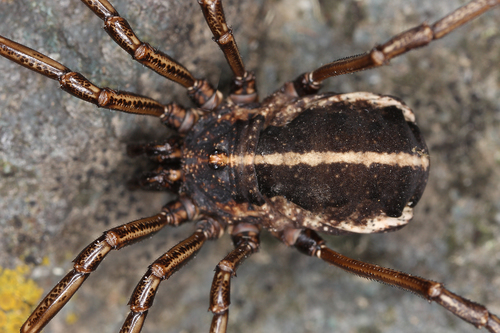
(c) gernotkunz, all rights reserved, uploaded by gernotkunz
Ischyropsalis
Sign in to saveIschyropsalis is a genus of harvestmen that belongs to the family Ischyropsalididae. They are found in the mountainous regions of Europe such as the Alps and the Carpathian mountains. Ischyropsalis is one of the most charismatic genus of harvestman with relatively large body sizes and massively enlarged chelicerae which can be twice the length of the body. Members of this genus often understudied because they are often rare and inhabit difficult to access habitats such as mountains or sometimes caves.
Species
GENUS
- KingdomAnimalia
- PhylumArthropoda
- ClassArachnida
- OrderOpiliones
- FamilyIschyropsalididae
via GBIF
Museum specimens
- Specimen records
- 3
- Family
- Ischyropsalididae
- Collections
- SAM, MZLU
- Recorded in
- Slovenia
~7 min read
Encyclopedic overview
10 sectionsContents
- Etymology
- Distribution
- Description
- Ecology
- Taxonomy
- Species
- Taxonomic synonyms
- References
- Further reading
- External links
Ischyropsalis is a genus of harvestmen that belongs to the family Ischyropsalididae. They are found in the mountainous regions of Europe such as the Alps and the Carpathian mountains. Ischyropsalis is one of the most charismatic genus of harvestman with relatively large body sizes and massively enlarged chelicerae which can be twice the length of the body. Members of this genus often understudied because they are often rare and inhabit difficult to access habitats such as mountains or sometimes caves.
The genus was first described in 1839 by C.L. Koch, a German entomologist and arachnologist, with the type species being Ischyropsalis kollari. Then over time, dozens of species, many described by Rover, were described creating a confusing and chaotic taxonomy with many having unutilizable descriptions. However Martens in 1969 cleared much of the confusion by reducing the dozens of species into only 15. Now this genus contains around 24 described species. Charles Piochard de La Brûlerie, an entomologist, discovered the first strictly cave-dwelling species, I. dispar, in Albia Cave in Burgos of northern Spain. ==Etymology== The genus is feminine. The genus name is a combination of Ancient Greek ischyros "strong" and psalis "shears", referring to the greatly enlarged chelicerae.
Excerpted from Wikipedia’s “Ischyropsalis” article, available under the CC BY-SA 4.0 licence.