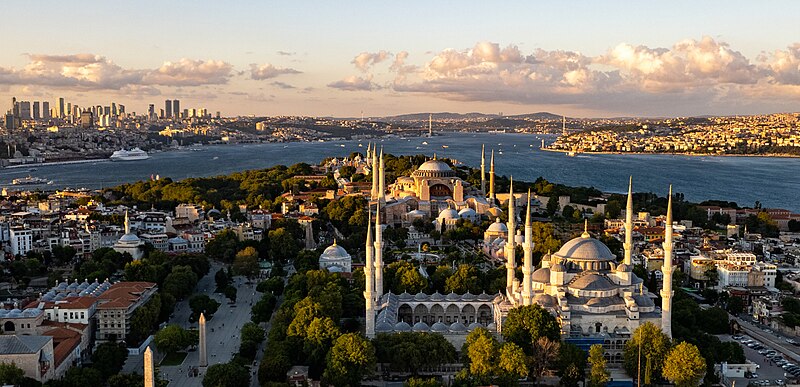
File:Historical_peninsula_and_modern_skyline_of_Istanbul.jpg · Wikimedia Commons · See Wikimedia Commons
Istanbul Province
Sign in to saveAlso known as İstanbul Province, Istanbul, İstanbul
province in northwestern Turkey
Istanbul Province is a region in northwestern Turkey that contains the city of Istanbul, one of the world's largest and most historically significant cities. It matters because Istanbul serves as Turkey's cultural and economic center, bridging Europe and Asia, and has been a major hub of human civilization for thousands of years.
AI-generated from the Wikipedia summary — may contain errors.
Wikidata facts
- Instance of
- province of Turkey
- Part of
- Istanbul Subregion
- Official name
- İstanbul
- Country
- Turkey
- Located in
- Turkey
- Continent
- Europe
- Capital
- Istanbul
- Official language
- Turkish
- Population
- 15655924
- Area
- 5461
- Elevation
- 120
- Time zone
- UTC+03:00
- Body of water
- Sea of Marmara
- Head of government
- Davut Gül
- Shares border with
- Tekirdağ Province
- Official website
- www.istanbul.gov.tr
- Image
- Map of the Districts of Istanbul.png
- Households
- 4855719
- Life expectancy
- 77.80
- GDP per capita
- 21.741
- Dialing code
- 216
- Licence plate code
- 34
Show 22 more facts
- located in the statistical territorial entity
- Istanbul Subregion
- category of associated people
- Category:People from Istanbul Province
- category for people who died here
- Q27681401
- Commons category
- Istanbul Province
- topic's main category
- Category:Istanbul Province
- category for people born here
- Category:Births in Istanbul Province
- native label
- İstanbul ili
- postal code
- 34000–34999
- language used
- Turkish
- coextensive with
- Istanbul
- P11012
- Lampona taroom
- male population
- 7281064
- female population
- 7286854
- annual number of weddings
- 104126
- suicide rate
- 3.57
- total fertility rate
- 1.38
- mean age
- 34.52
- minimum temperature record
- -9
- maximum temperature record
- 40.6
- present in work
- Civilization V
- name in kana
- イスタンブール
- water as percent of area
- 2.62
Sources (15)
via Wikidata · CC0
~40 min read
Encyclopedic overview
Istanbul is the largest city in Turkey, constituting the country's economic, cultural, and historical center. With a population of over 15 million, it is home to 18% of the population of Turkey. Istanbul is among the largest cities in Europe and in the world by population. It is a city on two continents; about two-thirds of its population live in Europe and the rest in Asia. Istanbul straddles the Bosphorus – one of the world's busiest waterways – in northwestern Turkey, between the Sea of Marmara and the Black Sea. Its area of 5,461 square kilometers (2,109 mi) is coterminous with Istanbul Province.
The city now known as Istanbul developed to become one of the most significant cities in history. Byzantium was founded on the Sarayburnu promontory by Greek colonists, potentially in the seventh century BC. Over nearly 16 centuries following its reestablishment as Constantinople in 330 AD, it served as the capital of four empires: the Roman Empire (330–395), the Eastern Roman (Byzantine) Empire (395–1204 and 1261–1453), the Latin Empire (1204–1261), and the Ottoman Empire (1453–1922). It was instrumental in the advancement of Christianity during Roman and Byzantine times, before the Ottomans conquered the city in 1453 and transformed it into an Islamic stronghold and the seat of the last caliphate. Although the Republic of Turkey established its capital in Ankara, palaces and imperial mosques still line Istanbul's hills as visible reminders of the city's previous central role. The historic centre of Istanbul is a UNESCO World Heritage Site.
Excerpted from Wikipedia’s “Istanbul Province” article, available under the CC BY-SA 4.0 licence.
Gallery (12)
Available in 85 languages
- Español
- Français
- Deutsch
- 中文
- 日本語
- Русский
- Português
- Italiano
- العربية
- Aramaic
- Armenian
- Asturian
- azb
- Azerbaijani
- Bahasa Indonesia
- Bashkir
- Basque
- be_x_old
Show 66 more
- Belarusian
- Bosnian
- Breton
- Bulgarian
- Catalan
- Cebuano
- Central Kurdish
- Chuvash
- Czech
- Esperanto
- Estonian
- Fiji Hindi
- Filipino
- Finnish
- Georgian
- Greek
- Hebrew
- Hungarian
- Ido
- Inupiaq
- Javanese
- Kinyarwanda
- Komi-Permyak
- Kyrgyz
- Ladino
- Latin
- Latvian
- Lithuanian
- Macedonian
- Malay
- Marathi
- Mingrelian
- Nederlands
- Northern Frisian
- Northern Sami
- Norwegian
- Norwegian Nynorsk
- Ossetic
- Polski
- Punjabi
- Romanian
- Scots
- Serbian
- Serbian (Latin)
- Slovenian
- Svenska
- Swahili
- Tajik
- Tiếng Việt
- Toki Pona
- Türkçe
- Ukrainian
- Urdu
- Uyghur
- Uzbek
- Volapük
- Waray
- Western Mari
- Western Panjabi
- Wu Chinese
- Zaza
- zh_min_nan
- zh_yue
- فارسی
- ไทย
- 한국어
via Wikidata sitelinks · CC0