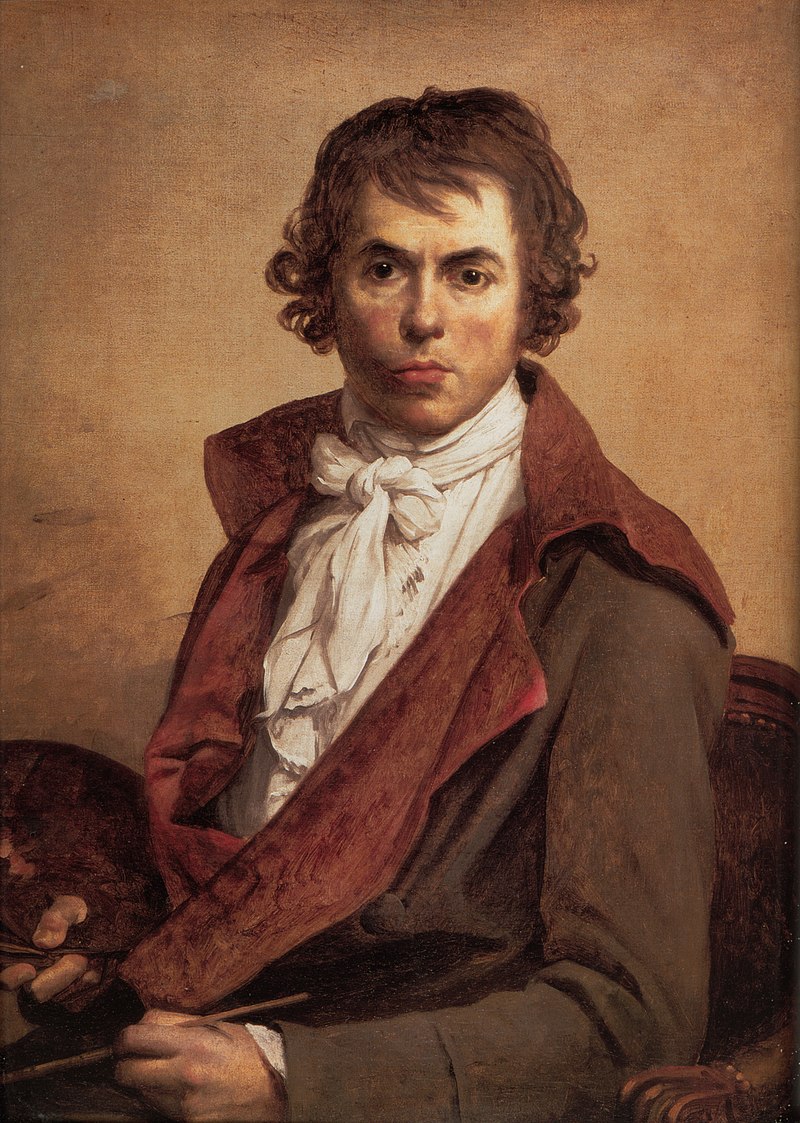
File:David_Self_Portrait.jpg · Wikimedia Commons · See Wikimedia Commons
Jacques-Louis David
Sign in to saveAlso known as Jacques Louis David, J.-L. David, Lui David, Lu-i Ta-wei, Louis David, Ta-wei-tʻe, Zhak Lui David, Cen David
French painter (1748–1825)
Jacques-Louis David was a French painter who lived from 1748 to 1825 and became one of the most influential artists of his era. He is historically important because his classical style and grand historical paintings shaped European art during the late 18th and early 19th centuries and reflected the major political changes of the French Revolution and Napoleonic periods.
AI-generated from the Wikipedia summary — may contain errors.
In the Vinony graph
Vinony catalogs Jacques-Louis David in its Prix de Rome collection (1,063 entries).
Vinony's link graph records 1,404 inbound references to Jacques-Louis David, and connects out to Louvre Museum, Jean-Jacques Rousseau and Antoine Lavoisier.
Vinony files it under 1748 births, 1825 deaths and 18th-century French male artists.
Vinony links it to 87 Wikipedia language editions.
Wikidata facts
- Instance of
- human
- Family name
- David
- Gender
- male
- Citizenship
- France
- Place of birth
- Paris
- Place of death
- Brussels
- Occupation
- architectural draftsperson
- Educated at
- Beaux-Arts de Paris
- Political party
- Jacobins
- Languages spoken
- French
- Native language
- French
- Award
- Prix de Rome
- Notable work
- The Death of Marat
- Participant in
- Documenta IX
- Student of
- Joseph-Marie Vien
- Genre
- religious painting
- Movement
- Neoclassicism
- Image
- David Self Portrait.jpg
- Work location
- Rome
Show 18 more facts
- Commons gallery
- Jacques-Louis David
- has works in the collection
- Pushkin Museum of Fine Arts
- Commons category
- Jacques-Louis David
- date of birth
- 1748-08-30
- date of death
- 1825-12-29
- Commons Creator page
- Jacques-Louis David
- topic's main category
- Category:Jacques-Louis David
- member of
- Académie des beaux-arts
- name in native language
- Jacques-Louis David
- place of detention
- Luxembourg Palace
- sponsor
- Napoleon
- manner of death
- natural causes
- archives at
- Archives nationales
- cause of death
- stroke
- on focus list of Wikimedia project
- Wikipedia:Vital articles/Level/4
- ethnic group
- French
- affiliation
- The Mountain
Sources (11)
via Wikidata · CC0
Works in European collections
36 objects attributed to Jacques-Louis David, held across European museums, libraries & archives · via Europeana
Portrait of envoy M. Meyer
Portrait of Jean-Baptiste Milhaud (1766-1833)
Venus disarming Mars
Portrait of the Lord of Joubut
The oath of Horatians
The Sabines
Portrait of Pierre Sériziat (1757-1847)
The Crazy
Death of Marat
Madame Vigée-Lebrun
Consecration of field signs
Portrait of Alphonse Leroy, doctor of the artist
Portrait of Emilie Pécoul, wife of Pierre Sériziat, with her son Emile (born 1793)
View of Luxembourg
Death of Joseph Barra
The greengrocer
Amor and the Graces
Portrait of Juliette (Julie) Récamier, born Bernard (1777-1849)
Portrait of Napoleon I
The oath of the Horatians (sketch of the Louvre picture)
Self-portrait
Portrait of Duroc
Self-portrait

Untitled
Untitled
Untitled
Untitled
Untitled
Untitled
Untitled
Untitled
Untitled
Untitled
Untitled
Untitled
Untitled
~40 min read
Encyclopedic overview
Jacques-Louis David ( French: [ʒaklwi david]; 30 August 1748 – 29 December 1825) was a French painter in the Neoclassical style, considered to be the preeminent painter of the era. In the 1780s, his cerebral brand of history painting marked a change in taste away from Rococo frivolity toward classical austerity, severity, and heightened feeling, which harmonized with the moral climate of the final years of the Ancien Régime.
David later became an active supporter of the French Revolution and friend of Maximilien Robespierre (1758-1794), and was effectively a dictator of the arts under the French Republic. Imprisoned after Robespierre's fall from power, he aligned himself with yet another political regime upon his release: that of Napoleon, the First Consul of France. At this time he developed his Empire style, notable for its use of warm Venetian colours. After Napoleon's fall from Imperial power and the Bourbon revival, David exiled himself to Brussels, then in the United Kingdom of the Netherlands, where he remained until his death. David had many pupils, making him the strongest influence in French art of the early 19th century, especially academic Salon painting.
Excerpted from Wikipedia’s “Jacques-Louis David” article, available under the CC BY-SA 4.0 licence.
Gallery (12)
Available in 87 languages
- Español
- Français
- Deutsch
- 中文
- 日本語
- Русский
- Português
- Italiano
- العربية
- Afrikaans
- Aragonese
- Armenian
- Asturian
- Azerbaijani
- Bahasa Indonesia
- Balinese
- Bashkir
- Basque
Show 68 more
- bat_smg
- be_x_old
- Belarusian
- Bosnian
- Breton
- Bulgarian
- Catalan
- Cebuano
- Central Kurdish
- Chuvash
- Croatian
- Czech
- Danish
- Egyptian Arabic
- Esperanto
- Estonian
- Ewe
- Fiji Hindi
- Filipino
- Finnish
- Galician
- Georgian
- Greek
- Hebrew
- Hungarian
- Icelandic
- Interlingua
- Irish
- Kannada
- Kazakh
- Kyrgyz
- Latin
- Latvian
- Lithuanian
- Macedonian
- Malagasy
- Malayalam
- Mingrelian
- Nederlands
- Norwegian
- Norwegian Nynorsk
- Occitan
- Polski
- Romanian
- Scottish Gaelic
- Serbian
- Serbian (Latin)
- simple
- Sinhala
- Slovak
- Slovenian
- Svenska
- Tamil
- Tiếng Việt
- Türkçe
- Ukrainian
- Urdu
- Uzbek
- Waray
- Welsh
- West Flemish
- Wu Chinese
- Yakut
- zh_min_nan
- zh_yue
- فارسی
- ไทย
- 한국어
via Wikidata sitelinks · CC0