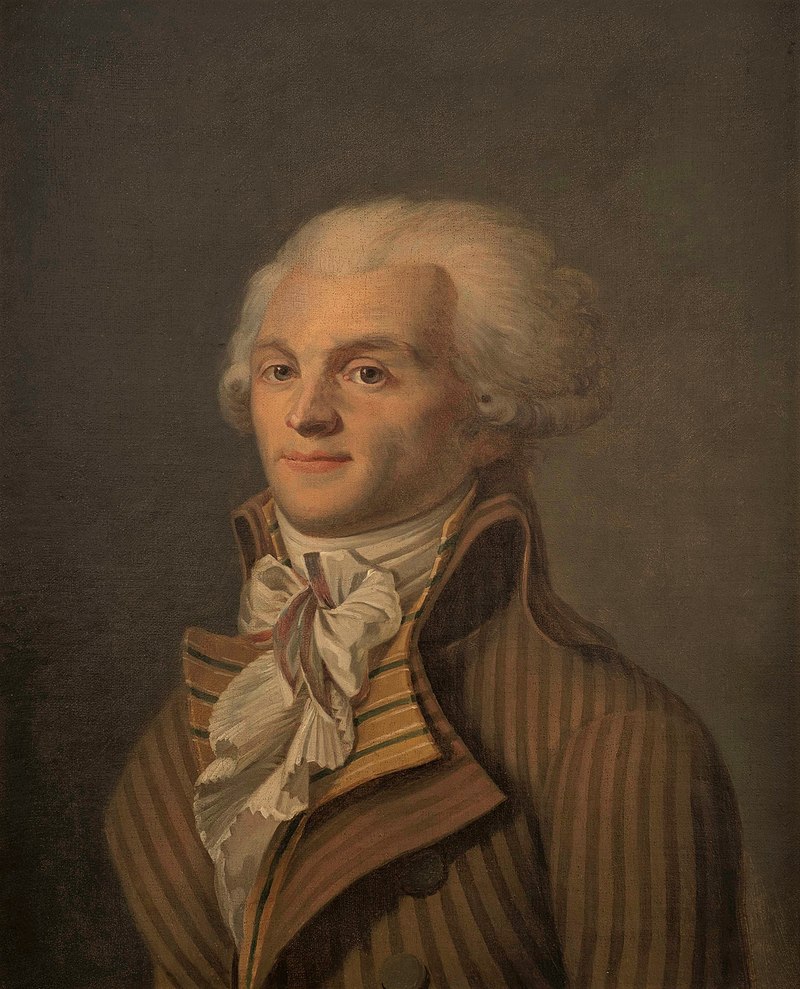
File:Robespierre.jpg · Wikimedia Commons · See Wikimedia Commons
Maximilien Robespierre
Sign in to saveAlso known as Maximilien Marie Isidore de Robespierre, Maximilien de Robespierre, Maximilien-François-Marie-Isidore de Robespierre, Robespierre, The Incorruptible
French revolutionary lawyer and politician (1758–1794)
OverviewAI-generated
Maximilien Robespierre was a French politician, lawyer, journalist, and revolutionary who participated in the French Revolution. Born in Arras in 1758, he was educated at Lycée Louis-le-Grand and the University of Paris. He was a member of the Jacobins political party and served as a member of the French National Assembly. Robespierre spoke and wrote in French and Italian, and his worldview was deist.
He authored numerous works, including *Discours de Maximilien Robespierre*, *Le défenseur de la constitution*, and *The political testament of Maximil. Robertspierre*. Robespierre died in Paris in 1794 by decapitation. He is buried at the Errancis Cemetery and the Catacombs of Paris. His siblings were Augustin Robespierre and Charlotte de Robespierre. He received the Concours général award.
Synthesized by Vinony from 27 facts across 2 sources: Wikidata, Open Library. Generated from structured data (not the Wikipedia text) and checked against those facts — may still contain errors.
Person · Open Library
- Born
- 1758
- Died
- 1794
- Works
- 166
Top works
- Discours de Maximilien Robespierre
- Die letzte rede
- Le défenseur de la constitution
- Discours ...
- The political testament of Maximil. Robertspierre
via Open Library + Wikidata
Wikidata facts
- Instance of
- human
- Gender
- male
- Citizenship
- France
- Place of birth
- Arras
- Place of death
- Paris
- Sibling
- Charlotte de Robespierre
- Occupation
- revolutionary
- Educated at
- University of Paris
- Political party
- Jacobins
- Languages spoken
- Italian
- Native language
- French
- Religion
- deism
- Award
- Concours général
- Participant in
- French Revolution
- Academic degree
- Bachelor of Laws
- Field of work
- politician
- Image
- Robespierre.jpg
- Work location
- Paris
- Convicted of
- homicide
Show 16 more facts
- Commons category
- Maximilien de Robespierre
- date of birth
- 1758-05-06
- date of death
- 1794-07-28
- Commons gallery
- Maximilien de Robespierre
- topic's main category
- Category:Maximilien Robespierre
- Commons Creator page
- Maximilien de Robespierre
- cause of death
- decapitation
- archives at
- Archives nationales
- place of burial
- Catacombs of Paris
- writing language
- French
- name in native language
- Maximilien de Robespierre
- manner of death
- capital punishment
- P8168
- Žuta Lokva
- on focus list of Wikimedia project
- Wikipedia:Vital articles/Level/4
- influenced by
- Jean-Jacques Rousseau
- P12749
- Kelmis
via Wikidata · CC0
~40 min read
Encyclopedic overview
Maximilien François Marie Isidore de Robespierre (/ˈroʊbzpjɛər/; French: [maksimiljɛ̃ ʁɔbɛspjɛʁ]; 6 May 1758 – 28 July 1794) was a French lawyer and statesman, widely recognised as one of the most influential figures of the French Revolution. Robespierre fervently campaigned for the voting rights of all men and their unimpeded admission to the National Guard. Additionally, he advocated the right to petition, the right to bear arms in self-defence, and the abolition of the Atlantic slave trade.
A radical Jacobin leader, Robespierre was elected as a deputy to the National Convention in September 1792, and in July 1793, he was appointed a member of the Committee of Public Safety. Robespierre faced growing disillusionment with other revolutionaries which led him to argue for the harsh measures of the Reign of Terror. Increasingly, members of the Convention turned against him, and accusations of excesses came to a head on 9 Thermidor. Robespierre was arrested and with around 90 others, he was executed without trial.
Excerpted from Wikipedia’s “Maximilien Robespierre” article, available under the CC BY-SA 4.0 licence.
Gallery (12)
Available in 100 languages
- Español
- Français
- Deutsch
- 中文
- 日本語
- Русский
- Português
- Italiano
- العربية
- हिन्दी
- Afrikaans
- Albanian
- Albanian
- Aragonese
- Armenian
- Asturian
- azb
- Azerbaijani
Show 81 more
- Bahasa Indonesia
- Bangla
- Basque
- Belarusian
- Bosnian
- Breton
- Bulgarian
- Burmese
- Catalan
- Central Kurdish
- Chuvash
- Croatian
- Czech
- Danish
- Egyptian Arabic
- Esperanto
- Estonian
- Filipino
- Finnish
- Galician
- Georgian
- gpe
- Greek
- Haitian Creole
- Hebrew
- Hungarian
- Icelandic
- Ido
- Interlingua
- Irish
- Javanese
- Kazakh
- Kurdish
- Latin
- Latvian
- Lithuanian
- Luxembourgish
- Macedonian
- Malagasy
- Malay
- Malayalam
- Maltese
- Mazanderani
- Mingrelian
- Mongolian
- Nederlands
- Nepali
- Norwegian
- Norwegian Nynorsk
- Occitan
- Picard
- Polski
- Punjabi
- Romanian
- Rusyn
- Scots
- Serbian
- Serbian (Latin)
- simple
- Sinhala
- Slovak
- Slovenian
- Svenska
- Swahili
- Tiếng Việt
- Türkçe
- Ukrainian
- Urdu
- Uzbek
- Venetian
- Waray
- Western Frisian
- Western Panjabi
- Wu Chinese
- Yakut
- zh_classical
- zh_min_nan
- zh_yue
- فارسی
- ไทย
- 한국어
via Wikidata sitelinks · CC0