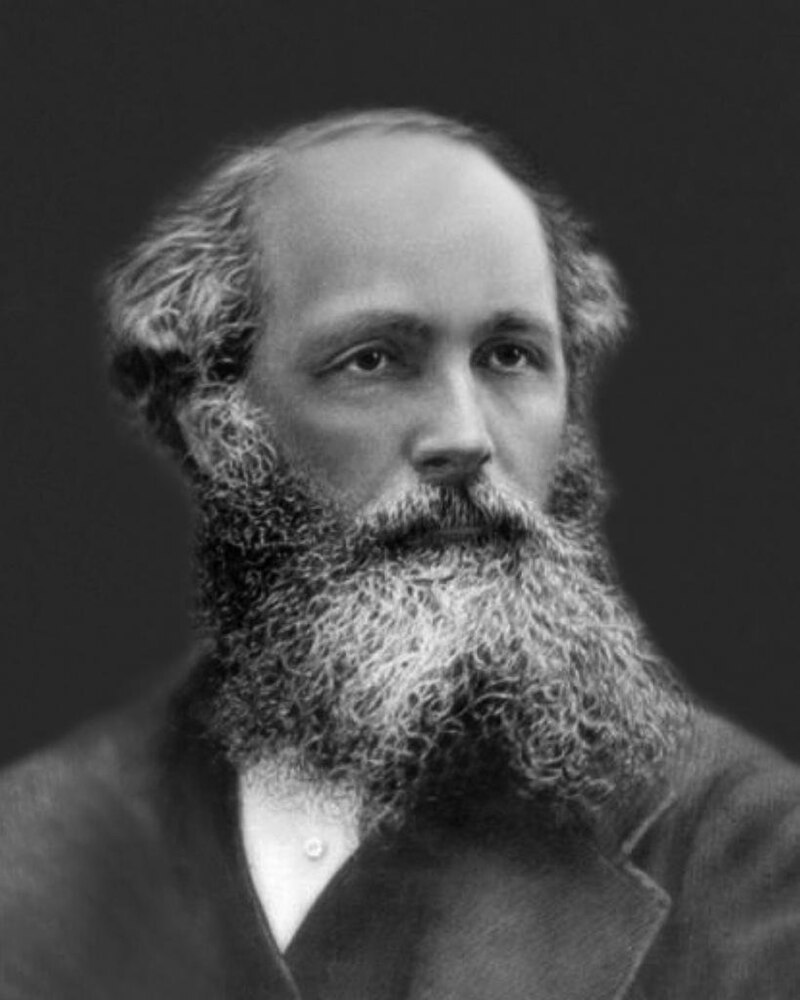
File:James-Clerk-Maxwell-1831-1879.jpg · Wikimedia Commons · See Wikimedia Commons
OverviewAI-generated
James Clerk Maxwell was a British physicist, mathematician, inventor, and photographer. Born in Edinburgh in 1831, he received his education at the University of Edinburgh, Peterhouse, Edinburgh Academy, and Trinity College. He worked in Aberdeen and Cambridge, holding positions at King's College London, the University of Aberdeen, the University of Cambridge, and Marischal College. His doctoral advisor was William Hopkins.
Maxwell’s fields of work included physics, mechanics, mathematics, and the electromagnetic field. He was a member of the Royal Society, the American Academy of Arts and Sciences, the Royal Society of Edinburgh, and the Royal Netherlands Academy of Arts and Sciences. He received the Fellow of the Royal Society, the Rumford Medal, the Royal Society Bakerian Medal, and the Keith Medal. He died of stomach cancer in Cambridge in 1879 and is buried at Westminster Abbey.
Synthesized by Vinony from 24 facts across 2 sources: Wikidata, Vinony collections. Generated from structured data (not the Wikipedia text) and checked against those facts — may still contain errors.
Wikidata facts
- Instance of
- human
- Given name
- James
- Gender
- male
- Citizenship
- United Kingdom of Great Britain and Ireland
- Place of birth
- Edinburgh
- Place of death
- Cambridge
- Spouse
- Katherine Clerk Maxwell
- Position held
- Cavendish Professor of Physics
- Educated at
- University of Cambridge
- Employer
- Marischal College
- Languages spoken
- English language
- Native language
- English language
- Religion
- Christian socialism
- Notable work
- Maxwell's demon
- Doctoral advisor
- William Hopkins
- Doctoral student
- John Strutt, 3rd Baron Rayleigh
- Field of work
- kinetic theory
- Image
- James-Clerk-Maxwell-1831-1879.jpg
- Work location
- Cambridge
Show 21 more facts
- Commons category
- James Clerk Maxwell
- date of birth
- 1831-06-13
- date of death
- 1879-11-05
- topic's main category
- Category:James Clerk Maxwell
- cause of death
- stomach cancer
- described by source
- Granat Encyclopedic Dictionary
- Commons Creator page
- James Clerk Maxwell
- manner of death
- natural causes
- Commons gallery
- James Clerk Maxwell
- name in native language
- James Clerk Maxwell
- student
- Richard Glazebrook
- ethnic group
- Scottish people
- relative
- Jemima Blackburn
- on focus list of Wikimedia project
- Wikipedia:Vital articles/Level/4
- writing language
- English language
- influenced by
- Michael Faraday
- start of work period
- 1860-01-01
- end of work period
- 1865-01-01
- contributed to creative work
- Popular Science
- maintained by WikiProject
- WikiProject Mathematics
Sources (10)
via Wikidata · CC0
~40 min read
Encyclopedic overview
James Clerk Maxwell FRS FRSE (13 June 1831 – 5 November 1879) was a Scottish physicist and mathematician who was responsible for the classical theory of electromagnetic radiation, which was the first theory to describe electricity, magnetism and light as different manifestations of the same phenomenon. Maxwell's equations for electromagnetism achieved the second great unification in physics, where the first one had been realised by Isaac Newton. Maxwell was also key in the creation of statistical mechanics.
Maxwell graduated from Trinity College, Cambridge, in 1854, where he earned distinction in mathematics and the Smith’s Prize. He remained at Cambridge briefly, publishing early mathematical work and investigations into optics, particularly the principles of colour combination and colour-blindness. He later held the Chair of Natural Philosophy at Marischal College in Aberdeen, where he studied the rings of Saturn and correctly proposed that they were composed of numerous small particles, work that earned him the Adams Prize in 1859. During this time he married Katherine Mary Dewar, who assisted him in his laboratory work. From 1860 to 1865, he served as the Professor of Natural Philosophy at King’s College London, where he developed his theory of electromagnetic fields. His publication of "A Dynamical Theory of the Electromagnetic Field" in 1865 demonstrated that electric and magnetic fields travel through space as waves moving at the speed of light, proposing that light is an undulation in the same medium that is the cause of electric and magnetic phenomena. His unification of light and electrical phenomena led to his prediction of the existence of radio waves.
Excerpted from Wikipedia’s “James Clerk Maxwell” article, available under the CC BY-SA 4.0 licence.
Gallery (12)
On the map
Available in 138 languages
- Español
- Français
- Deutsch
- 中文
- 日本語
- Русский
- Português
- Italiano
- العربية
- हिन्दी
- Adyghe
- Afrikaans
- Albanian
- Albanian
- Amharic
- Aragonese
- Armenian
- Assamese
Show 119 more
- Asturian
- azb
- Azerbaijani
- Bahasa Indonesia
- Balinese
- Bangla
- Bashkir
- Basque
- bat_smg
- be_x_old
- Belarusian
- Bosnian
- Breton
- btm
- Bulgarian
- Burmese
- Catalan
- Central Kurdish
- Chechen
- Cornish
- Croatian
- Czech
- Danish
- Egyptian Arabic
- Esperanto
- Estonian
- Fiji Hindi
- Filipino
- Finnish
- Galician
- Gan Chinese
- Georgian
- Greek
- Guarani
- Haitian Creole
- Hebrew
- Hungarian
- Icelandic
- Ido
- Iloko
- Interlingua
- Irish
- Javanese
- Kabyle
- Kannada
- Kanuri
- Kazakh
- Kurdish
- Kyrgyz
- Latin
- Latvian
- Limburgish
- Lithuanian
- Lombard
- Low German
- Luxembourgish
- Macedonian
- Madurese
- Malagasy
- Malay
- Malayalam
- Marathi
- Mingrelian
- Mongolian
- Nederlands
- Nepali
- Newari
- Northern Frisian
- Norwegian
- Norwegian Nynorsk
- Occitan
- Odia
- olo
- Pampanga
- Pashto
- Piedmontese
- Polski
- Pontic
- Punjabi
- Quechua
- Romanian
- Rusyn
- Sanskrit
- Santali
- Scots
- Serbian
- Serbian (Latin)
- simple
- Sindhi
- Slovak
- Slovenian
- Sundanese
- Svenska
- Swahili
- szy
- Tajik
- Tamil
- Tatar
- Telugu
- Tiếng Việt
- Türkçe
- Ukrainian
- Urdu
- Uzbek
- Veps
- Waray
- Welsh
- Western Frisian
- Western Panjabi
- Wu Chinese
- Yakut
- Yiddish
- Yoruba
- zh_min_nan
- zh_yue
- Zhuang
- فارسی
- ไทย
- 한국어
via Wikidata sitelinks · CC0