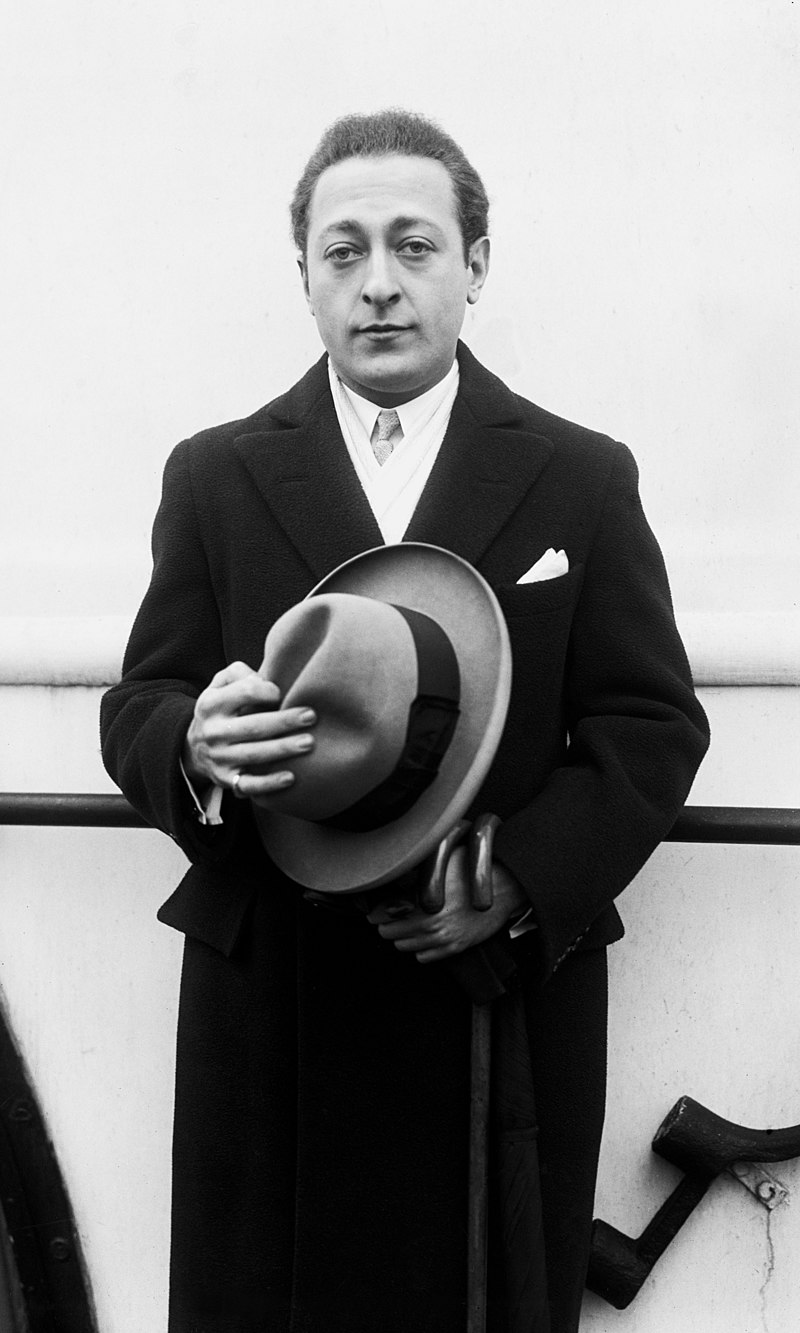
File:Heifetz_LOC_38890u.jpg · Wikimedia Commons · See Wikimedia Commons
Jascha Heifetz
Sign in to saveRussian-American violinist (1901–1987)
Film & TV
Vilnius, Lithuania
From Wikipedia Jascha Heifetz (/ˈhaɪfɪts/; February 2 [O.S. January 20] 1901 – December 10, 1987) was a Lithuanian-born American violinist. He was born in Vilnius. As a teen, he moved with his family to the United States, where his Carnegie Hall debut was rapturously received. He had a long and successful performing and recording career; after an injury to his right (bowing) arm, he focused…
Known for
- Jascha Heifetz: God's Fiddler — Self (Archival footage)2011
- The Art of Conducting: Great Conductors of the Past — Self (archive footage)1993
- Rubinstein: In Performance — Self1977
- Great Performances — Self1971
- Jascha Heifetz Master Classes — Self1962
- Of Men and Music — Self1951
- Carnegie Hall — Jascha Heifetz1947
- They Shall Have Music — Himself1939
- Arthur Rubinstein — Self
via TMDB
Music · MusicBrainz
- Type
- Person
- Gender
- Male
- Origin
- United States
- Active from
- 1901
- Active to
- 1987
Discography
- Violin Concerto No. 2 In D Minor, Op. 44 / Violin Concerto No. 2 In D Minor, Op. 221956
- Violin Concerto1958
- Jascha Heifetz in Concert1975
- The Heifetz Collection: Vol. 6 (1950 - 1955), The new Era1975
- Jascha Heifetz Recital1993
- The Virtuoso Jascha Heifetz1993
- Le violon du Siècle1994
- Selections from the Heifetz Collection1994
- The Heifetz Collection, Volume 18: EMI Masters1994
- The Heifetz Collection, Volume 19: 51 Miniatures 1944-19461994
via MusicBrainz · CC0
Listeners · Last.fm
- Listeners
- 59,618
- Total plays
- 594,047
Tags
Jascha Heifetz (2 February 1901 – 10 December 1987) was a violinist widely regarded as the greatest violinist of the 20th Century. Heifetz made his first commercial recording on 7 November 1917. Throughout his career, he continued to record, almost always for RCA Victor. He had an immaculate technique and expressive vibrato. From time to time, his near-perfect technique and conservative stage demeanor caused some to accuse him of being overly mechanical, even cold. <a href="https://www.last.fm/
Key facts
- Born
- ( 1901-02-02 ) February 2, 1901, Vilna , Russian Empire
- Died
- December 10, 1987 (1987-12-10) (aged 86), Los Angeles , California, U.S.
- Occupation
- Violinist
- Spouses
- Florence Vidor ( married</span>"}]]}'>m. August 1928</span>"}]]}'>1928 ; divorced</span>"}]]}'>div. December 1945</span>"}]]}'>1945 ) Frances Spiegelberg ( married</span>"}]]}'>m. January 1947</span>"}]]}'>1947 ; divorced</span>"}]]}'>div. January 1963</span>"}]]}'>1963 )
- Website
- Official website
via Wikipedia infobox
Wikidata facts
- Instance of
- human
- Gender
- male
- Citizenship
- United States
- Place of birth
- Vilnius
- Place of death
- Cedars-Sinai Medical Center
- Spouse
- Florence Vidor
- Occupation
- teacher
- Educated at
- Saint Petersburg Conservatory
- Languages spoken
- English language
- Genre
- classical music
- Instrument
- violin
- Record label
- Victor Talking Machine Company
- Official website
- www.jaschaheifetz.com
- Image
- Jascha Heifetz 1 1953.jpg
- Significant event
- concert
Show 9 more facts
- Commons category
- Jascha Heifetz
- date of birth
- 1901-02-02
- date of death
- 1987-12-11
- Commons gallery
- Jascha Heifetz
- partner in business or sport
- William Primrose
- significant person
- Sergei Prokofiev
- start of work period
- 1911-00-00
- social media followers
- 14800
- subject has role
- child prodigy
Sources (7)
via Wikidata · CC0
~21 min read
Encyclopedic overview
Jascha Heifetz (/ˈhaɪfɪts/; February 2 [O.S. January 20] 1901 – December 10, 1987) was a Russian-American violinist, widely regarded as one of the greatest violinists of all time. Born in Vilna, he was soon recognized as a child prodigy and was trained in the Russian violin school in St. Petersburg. Accompanying his parents to escape the violence of the Russian Revolution, he moved to the United States as a teenager, where his Carnegie Hall debut was rapturously received. Fritz Kreisler, another leading violinist of the twentieth century, said after hearing Heifetz's debut, "We might as well take our fiddles and break them across our knees."
By the age of 18, Heifetz was the highest-paid violinist in the world. He had a long and successful concert career, including wartime service with the United Service Organizations (USO). After an injury to his right (bowing) arm in 1972, he switched his focus to teaching.
Excerpted from Wikipedia’s “Jascha Heifetz” article, available under the CC BY-SA 4.0 licence.