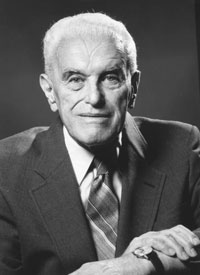
File:John_Harsanyi.jpg · Wikimedia Commons · See Wikimedia Commons
Key facts
- Born
- János Károly Harsányi , ( 1920-05-29 ) May 29, 1920, Budapest , Hungary
- Died
- August 9, 2000 (2000-08-09) (aged 80), Berkeley, California , U.S.
- Citizenship
- Hungary United States
- Alma mater
- University of Lyon , University of Budapest , University of Sydney , Stanford University
- Known for
- Bayesian games , Utilitarian ethics , Equilibrium selection
- Spouse
- Anne Klauber
- Awards
- Nobel Memorial Prize in Economic Sciences (1994), John von Neumann Award
- Fields
- Economics
- Institutions
- University of California, Berkeley , Wayne State University , Australian National University , University of Queensland
- Doctoral advisor
- Kenneth Arrow
via Wikipedia infobox
Nobel Prize
- The Sveriges Riksbank Prize in Economic Sciences in Memory of Alfred Nobel1994
“for their pioneering analysis of equilibria in the theory of non-cooperative games”
Shared · 1/3 portion
Wikidata facts
- Instance of
- human
- Given name
- John
- Gender
- male
- Citizenship
- United States
- Place of birth
- Budapest
- Place of death
- Berkeley
- Occupation
- researcher
- Educated at
- University of Sydney
- Employer
- University of Queensland
- Languages spoken
- English language
- Religion
- lapsed Catholic
- Doctoral advisor
- Kenneth Arrow
- Field of work
- economics
- Image
- John Harsanyi, Eger.JPG
Show 11 more facts
- Commons category
- John Harsanyi
- date of birth
- 1920-05-29
- date of death
- 2000-08-09
- member of
- Econometric Society
- Erdős number
- 8
- cause of death
- myocardial infarction
- manner of death
- natural causes
- medical condition
- Alzheimer's disease
- maintained by WikiProject
- WikiProject Mathematics
- name in native language
- John Charles Harsanyi
- interested in
- economics
Sources (6)
via Wikidata · CC0
~11 min read
Encyclopedic overview
John Charles Harsanyi (Hungarian: Harsányi János Károly; May 29, 1920 – August 9, 2000) was a Hungarian-American economist who spent most of his career at the University of California, Berkeley. He was the recipient of the Nobel Memorial Prize in Economic Sciences in 1994.
Harsanyi is best known for his contributions to the study of game theory and its application to economics, specifically for his developing the highly innovative analysis of games of incomplete information, so-called Bayesian games. He also made important contributions to the use of game theory and economic reasoning in political and moral philosophy (specifically utilitarian ethics) as well as contributing to the study of equilibrium selection. For his work, he was a co-recipient along with John Nash and Reinhard Selten of the 1994 Nobel Memorial Prize in Economic Sciences.
Excerpted from Wikipedia’s “John Harsanyi” article, available under the CC BY-SA 4.0 licence.