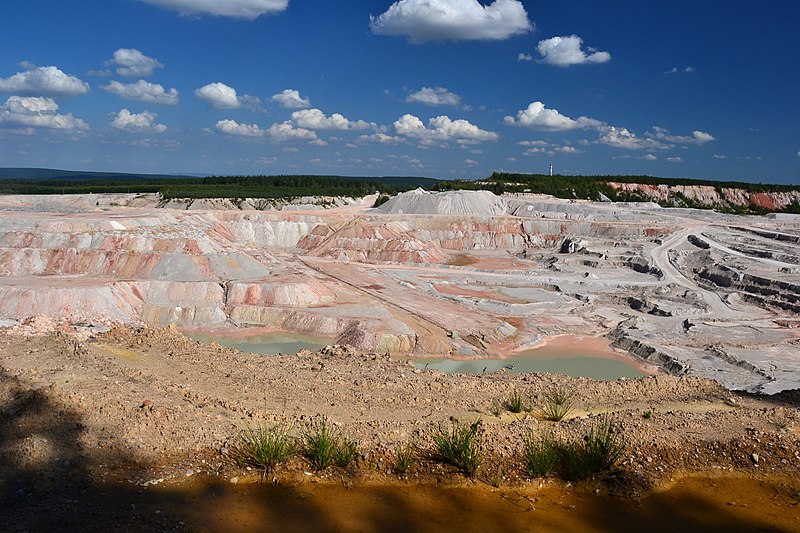
File:Kaznějov_-_kaolin_quarry.jpg · Wikimedia Commons · See Wikimedia Commons
kaolin
Sign in to saveAlso known as porcelain clay, china clay, kaolinite clay, paper clay, lithomarge, lithomarga, kao-lin, gaoling
clay rich in kaolinite
Key facts
- Category
- Phyllosilicate minerals
- Group
- Kaolinite- Serpentine group, kaolinite subgroup
- Formula
- Al 2 Si 2 O 5 (OH) 4 , or in oxide notation: Al 2 O 3 · 2SiO 2 · 2H 2 O
- Ima symbol
- Kln
- Strunz classification
- 9.ED.05
- Crystal system
- Triclinic
- Crystal class
- Pedial (1) , (same H-M symbol )
- Space group
- P 1
- Unit cell
- a = 5.13 Å , b = 8.89 Å , c = 7.25 Å; α = 90° , β = 104.5°, γ = 89.8°; Z = 2
- Color
- White to cream, sometimes red, blue or brown tints from impurities and pale-yellow; also often stained various hues, tans and browns being common.
- Crystal habit
- Rarely as crystals, thin plates or stacked. More commonly as microscopic pseudohexagonal plates and clusters of plates, aggregated into compact, claylike masses.
- Cleavage
- Perfect on {001}
- Tenacity
- Flexible but inelastic
- Mohs scale hardness
- 2–2.5
- Luster
- Pearly to dull earthy
- Streak
- White
- Specific gravity
- 2.16–2.68
- Optical properties
- Biaxial (–)
via Wikipedia infobox
Wikidata facts
Show 1 more fact
- Commons category
- Kaolin
Sources (2)
via Wikidata · CC0
~22 min read
Encyclopedic overview
Kaolinite (/ˈkeɪ.ələˌnaɪt, -lɪ-/ KAY-ə-lə-nyte, -lih-; also called kaolin) is a clay mineral, with the chemical composition Al2Si2O5(OH)4. It is a layered silicate mineral, with one "tetrahedral" sheet of silicate tetrahedra (SiO4) linked to one "octahedral" sheet of aluminate octahedrons (AlO2(OH)4) through oxygen atoms on one side, and another such sheet through hydrogen bonds on the other side.
Kaolinite is a soft, earthy, usually white, mineral (dioctahedral phyllosilicate clay), produced by the chemical weathering of aluminium silicate minerals like feldspar. It has a low shrink–swell capacity and a low cation-exchange capacity (1–15 meq/100 g).
Excerpted from Wikipedia’s “kaolin” article, available under the CC BY-SA 4.0 licence.