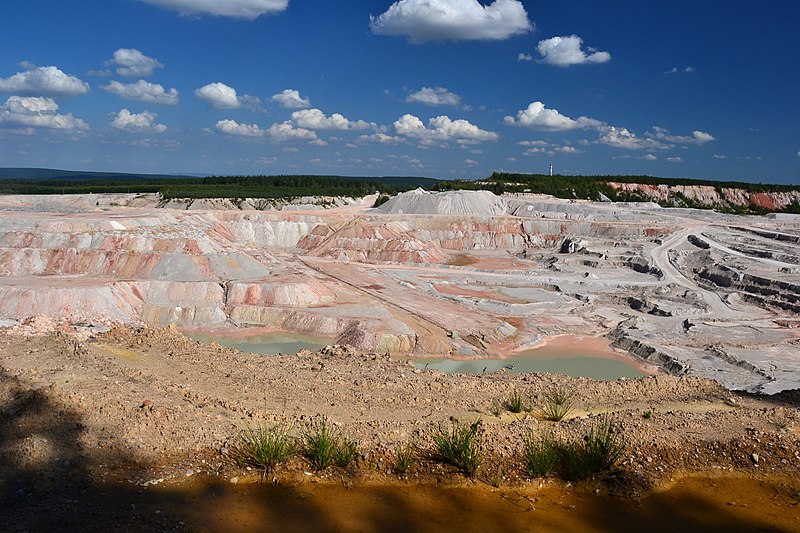
File:Kaznějov_-_kaolin_quarry.jpg · Wikimedia Commons · See Wikimedia Commons
Kaolin
Sign in to saveAlso known as porcelain clay, china clay, kaolinite clay, paper clay, lithomarge, lithomarga, kao-lin, gaoling
weiße Tonerde
Key facts
- Category
- Phyllosilicate minerals
- Group
- Kaolinite- Serpentine group, kaolinite subgroup
- Formula
- Al 2 Si 2 O 5 (OH) 4 , or in oxide notation: Al 2 O 3 · 2SiO 2 · 2H 2 O
- Ima symbol
- Kln
- Strunz classification
- 9.ED.05
- Crystal system
- Triclinic
- Crystal class
- Pedial (1) , (same H-M symbol )
- Space group
- P 1
- Unit cell
- a = 5.13 Å , b = 8.89 Å , c = 7.25 Å; α = 90° , β = 104.5°, γ = 89.8°; Z = 2
- Color
- White to cream, sometimes red, blue or brown tints from impurities and pale-yellow; also often stained various hues, tans and browns being common.
- Crystal habit
- Rarely as crystals, thin plates or stacked. More commonly as microscopic pseudohexagonal plates and clusters of plates, aggregated into compact, claylike masses.
- Cleavage
- Perfect on {001}
- Tenacity
- Flexible but inelastic
- Mohs scale hardness
- 2–2.5
- Luster
- Pearly to dull earthy
- Streak
- White
- Specific gravity
- 2.16–2.68
- Optical properties
- Biaxial (–)
via Wikipedia infobox
Wikidata facts
Show 1 more fact
- Commons category
- Kaolin
Sources (2)
via Wikidata · CC0
Article · Deutsch
Kaolin, auch als Porzellanerde, Porzellanton, weiße Tonerde, China Clay oder in der Apotheke als Bolus alba oder Pfeifenerde bezeichnet, ist ein feines, eisenfreies, weißes Gestein, das als Hauptbestandteil Kaolinit, ein Verwitterungsprodukt des Feldspats, enthält. Weitere Bestandteile sind verschiedene andere Tonminerale und unzersetzte Feldspatteilchen. Kaolin wird hauptsächlich bei der Herstellung von Papier und zur Bereitung von Porzellan . Daneben wird Bolus alba unter anderem als Bestandteil mancher Pudergrundlagen verwendet und auch Lebensmitteln zugesetzt (siehe ). Der Preis für eine Tonne Kaolin betrug in den Jahren 2006 bis 2012 zwischen 137 und 190 US-Dollar. Im Jahre 2003 wurde ein Verbrauch von 45 Millionen Tonnen durch eine Fördermenge von 45,6 Millionen Tonnen abgedeckt. 2013 wurde mit dem Kaolin erstmals ein Lockergestein Gestein des Jahres.
Abstract from DBpedia / Wikipedia · CC BY-SA