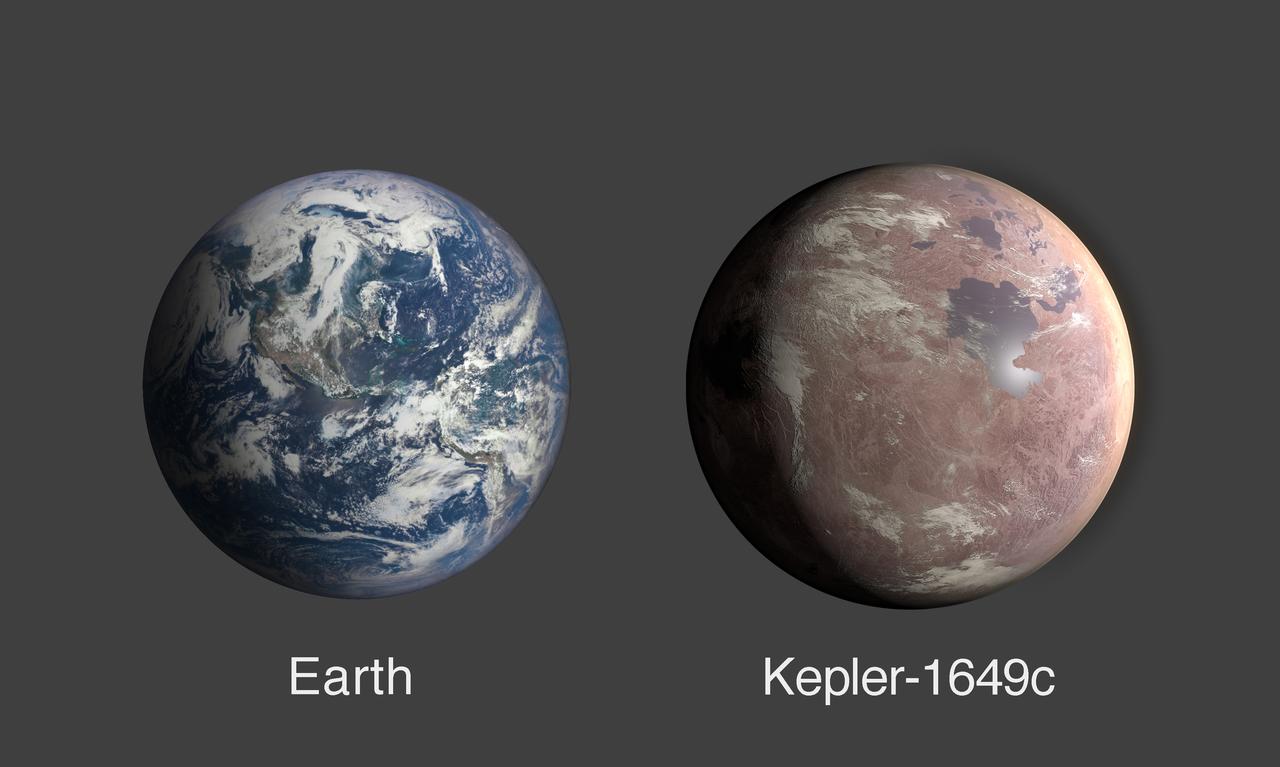
ACD20-0044-003_1 · NASA · NASA — public domain
Kepler-1649c
Sign in to saveKepler-1649c is an Earth-sized exoplanet, likely rocky, orbiting within the habitable zone of the red dwarf star Kepler-1649, the outermost planet of the planetary system discovered by Kepler’s space telescope. It is located about away from Earth, in the constellation of Cygnus.
Key facts
- Planet.name
- Kepler-1649c
- Planet.image
- PIA23774-Comparison-Earth-Keper1649c-20200415.jpg
- Planet.caption
- Size comparison of Earth and Kepler-1649c ''(artist's impression)''
- Planet.discovery_method
- Transit
- Planet.discovered
- 15 April 2020
- Planet.discoverer
- Kepler spacecraft
- Planet.semimajor
- 0.0649 AU
- Planet.period
- 19.5352551 d
- Planet.inclination
- 89.65
- Planet.star
- Kepler-1649
- Planet.mean_radius
- 1.06
- Planet.mass
- 1.2
- Planet.single_temperature
- Teq:
via Wikipedia infobox
Wikidata facts
- Constellation
- Cygnus
- Parent body
- Kepler-1649
- Radius
- 0.095
- Orbital period
- 19.53527
- Image
- PIA23774-Comparison-Earth-Keper1649c-20200415.jpg
Show 12 more facts
- catalog code
- KOI-3138c
- discoverer or inventor
- Kepler Space Telescope
- time of discovery or invention
- 2020-04-00
- discovery method
- transit method
- epoch
- J2000.0
- parallax
- 10.8187
- right ascension component of proper motion
- -135.842
- declination component of proper motion
- -99.232
- Commons category
- Kepler-1649 c
- right ascension
- 292.5029676
- declination
- 41.8299933
- orbital inclination
- 89.339
Sources (1)
via Wikidata · CC0
~4 min read
Encyclopedic overview
9 sectionsContents
- Physical characteristics
- Mass, radius and temperature
- Host star
- Orbit
- Habitability
- Climate
- See also
- References
- External links
Kepler-1649c is an Earth-sized exoplanet, likely rocky, orbiting within the habitable zone of the red dwarf star Kepler-1649, the outermost planet of the planetary system discovered by Kepler’s space telescope. It is located about away from Earth, in the constellation of Cygnus.
Kepler-1649c orbits its star a distance of from its host star with an orbital period of roughly 19.53 days, has a mass 1.2x times that of Earth, and has a radius of around 1.02 times that of Earth. Based on its mass and radius, it is likely a terrestrial planet, though its proximity to its star means it may likely be tidally locked. Kepler-1649c is estimated to receive about three-quarters of radiation from its host star as Earth does from the Sun.
Excerpted from Wikipedia’s “Kepler-1649c” article, available under the CC BY-SA 4.0 licence.
Gallery (7)
Available in 21 languages
- Español
- Français
- Deutsch
- 日本語
- Русский
- Português
- Italiano
- العربية
- Azerbaijani
- Belarusian
- Hebrew
- Nederlands
- Polski
- Romanian
- Tiếng Việt
- Türkçe
- Ukrainian
- فارسی
via Wikidata sitelinks · CC0