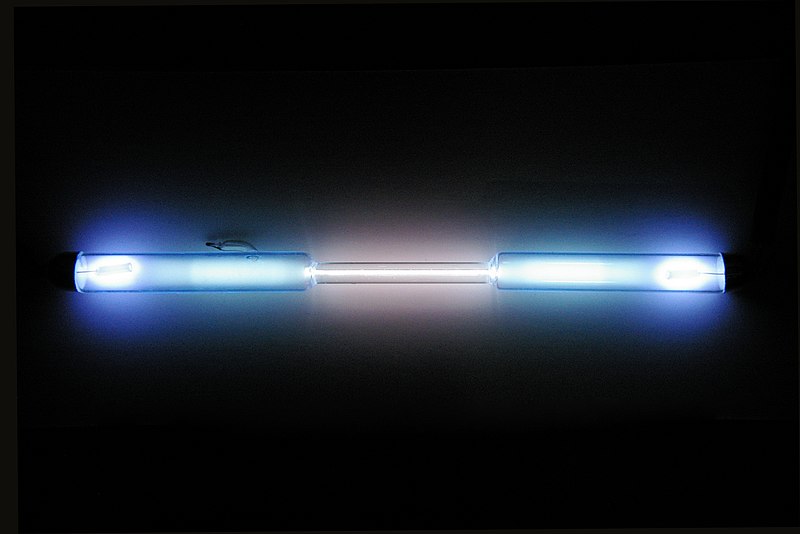
File:Krypton_discharge_tube.jpg · Wikimedia Commons · See Wikimedia Commons
Krypton
Sign in to saveAlso known as Kr, element 36, 36Kr
chemisches Element mit dem Symbol Kr und der Ordnungszahl 36
OverviewAI-generated
Krypton is a chemical element with the symbol Kr and atomic number 36. It has a standard atomic weight of 83.798, while PubChem lists its weight as 83.80. The element was discovered in 1898. Its electron configuration is described as 1s² 2s² 2p⁶ 3s² 3p⁶ 4s² 3d¹⁰ 4p⁶ or [Ar] 3d¹⁰ 4s² 4p⁶. The canonical SMILES representation is [Kr].
Physicochemical properties include an electronegativity of 3 and a standard molar entropy of 164. The molecule has a topological polar surface area of 0, with zero hydrogen bond donors and acceptors, and a charge of 0. The Unicode character for krypton is 氪. In academic literature, a PubMed query for krypton yields 3040 results. Additionally, the subject is referenced by 631 other encyclopedia articles.
Synthesized by Vinony from 24 facts across 4 sources: Wikidata, PubChem, PubMed, Vinony graph. Generated from structured data (not the Wikipedia text) and checked against those facts — may still contain errors.
Chemical data
- Formula
- Kr
- Molecular weight
- 83.8 g/mol
- IUPAC name
- krypton
- SMILES
- [Kr]
- InChIKey
- DNNSSWSSYDEUBZ-UHFFFAOYSA-N
- Polar surface area
- 0 Ų
- H-bond donors
- 0
- H-bond acceptors
- 0
- Formal charge
- 0
via PubChem
Drug data · ChEMBL
- Max clinical phase
- Approved
- Molecule type
- Small molecule
- First approval
- 1982
- Admin. routes
- topical
via ChEMBL · EBI
Research
3,040 papers- Krypton-81m.Progress in nuclear medicine · 1978Goris M, Daspit S
- Krypton-derivatization highlights O(2)-channeling in a four-electron reducing oxidase.Chemical communications (Cambridge, England) · 2020Engilberge S, Wagner T, Carpentier P et al.DOI: 10.1039/d0cc04557h
- HEART.ReviewAnnual review of physiology · 1964BERNE RM, LEVY MNDOI: 10.1146/annurev.ph.26.030164.001101
- A krypton-83m generator.The International journal of applied radiation and isotopes · 1971Moghissi AA, Hupf HBDOI: 10.1016/0020-708x(71)90130-x
- Validation of krypton as a new tracer gas for the standardization tests of collective and individual protection systems.Annals of work exposures and health · 2024Cabaset E, Marchal M, Santandrea A et al.DOI: 10.1093/annweh/wxad071
- Deep-mantle krypton reveals Earth's early accretion of carbonaceous matter.Nature · 2021Péron S, Mukhopadhyay S, Kurz MD et al.DOI: 10.1038/s41586-021-04092-z
- [The pharmacology of the rare gases (helium, neon, argon, krypton, xenon)].ReviewActualites pharmacologiques · 1974Featherstone RM, Settle W
- The krypton thunderbolt.Hospital practice · 1976Commoner BDOI: 10.1080/21548331.1976.11707001
via PubMed
Wikidata facts
- Instance of
- atmophile element
- Part of
- noble gases
- Named after
- hiding
- Mass
- 83.798
- Image
- KrTube.jpg
Show 16 more facts
- electronegativity
- 3
- element symbol
- Kr
- Commons category
- Krypton
- topic's main category
- Category:Krypton
- atomic number
- 36
- Commons gallery
- Krypton
- chemical formula
- Kr
- canonical SMILES
- [Kr]
- time of discovery or invention
- 1898-00-00
- discoverer or inventor
- Morris Travers
- location of discovery
- United Kingdom
- standard molar entropy
- 164
- Unicode character
- 氪
- electron configuration
- [Ar] 3d¹⁰ 4s² 4p⁶
- on focus list of Wikimedia project
- Wikipedia:Vital articles/Level/4
- different from
- kryptonite
Sources (7)
via Wikidata · CC0
Article · Deutsch
Krypton (altgriechisch κρυπτός kryptós „verborgen“) ist ein chemisches Element mit dem Elementsymbol Kr und der Ordnungszahl 36. Im Periodensystem steht es in der 8. Hauptgruppe, also der 18. IUPAC-Gruppe und zählt daher zu den Edelgasen. Wie die anderen Edelgase ist es ein farbloses, äußerst reaktionsträges, einatomiges Gas. In vielen Eigenschaften wie Schmelz- und Siedepunkt oder Dichte steht es zwischen dem leichteren Argon und dem schwereren Xenon. Krypton zählt zu den seltensten Elementen auf der Erde und kommt nur in geringen Mengen in der Atmosphäre vor. Das Edelgas wurde 1898 von William Ramsay und Morris William Travers durch fraktionierte Destillation flüssiger Luft entdeckt. Krypton wird auf Grund seiner Seltenheit nur in geringen Mengen, vor allem als Füllgas von Glühlampen, verwendet. Eine geringe Anzahl an Kryptonverbindungen ist bekannt, von denen Kryptondifluorid eines der stärksten Oxidationsmittel ist, das bekannt ist.
Abstract from DBpedia / Wikipedia · CC BY-SA
Gallery (13)
Available in 155 languages
- Español
- Français
- Deutsch
- 中文
- 日本語
- Русский
- Português
- Italiano
- العربية
- हिन्दी
- abstract
- Afrikaans
- Albanian
- Amharic
- Angika
- Aragonese
- Armenian
- Asturian
Show 136 more
- azb
- Azerbaijani
- Bahasa Indonesia
- Balinese
- Bangla
- Bashkir
- Basque
- be_x_old
- Belarusian
- Bhojpuri
- Bikol
- Bosnian
- Breton
- Bulgarian
- Burmese
- Catalan
- cdo
- Cebuano
- Central Kurdish
- Church Slavic
- Chuvash
- Cornish
- Corsican
- Croatian
- Czech
- Danish
- Egyptian Arabic
- Erzya
- Esperanto
- Estonian
- Faroese
- Fiji Hindi
- Filipino
- Finnish
- Friulian
- Galician
- Gan Chinese
- Ganda
- Georgian
- Greek
- Gujarati
- Haitian Creole
- Hakka Chinese
- Hebrew
- Hungarian
- Icelandic
- Ido
- Interlingua
- Irish
- Javanese
- Kalmyk
- Kannada
- Kazakh
- kbp
- Komi
- Kyrgyz
- Latin
- Latvian
- Ligurian
- Limburgish
- Lithuanian
- Lojban
- Lombard
- Low German
- Luxembourgish
- Macedonian
- Malay
- Malayalam
- Manx
- Marathi
- Mongolian
- Moroccan Arabic
- Nederlands
- Nepali
- Newari
- Northern Frisian
- Norwegian
- Norwegian Nynorsk
- Novial
- Occitan
- Odia
- olo
- Ossetic
- Pashto
- Piedmontese
- Polski
- Punjabi
- Quechua
- roa_rup
- Romanian
- Sanskrit
- Sardinian
- Saterland Frisian
- Scottish Gaelic
- Serbian
- Serbian (Latin)
- Sicilian
- simple
- Sindhi
- Sinhala
- Slovak
- Slovenian
- Somali
- Standard Moroccan Tamazight
- Sundanese
- Svenska
- Swahili
- Tajik
- Tamil
- Tatar
- Telugu
- Tibetan
- Tiếng Việt
- Toki Pona
- Türkçe
- Ukrainian
- Urdu
- Uyghur
- Uzbek
- Veps
- Waray
- Welsh
- Western Frisian
- Western Mari
- Western Panjabi
- Wu Chinese
- Yakut
- Yiddish
- Yoruba
- zh_classical
- zh_min_nan
- zh_yue
- Zulu
- فارسی
- ไทย
- 한국어
via Wikidata sitelinks · CC0