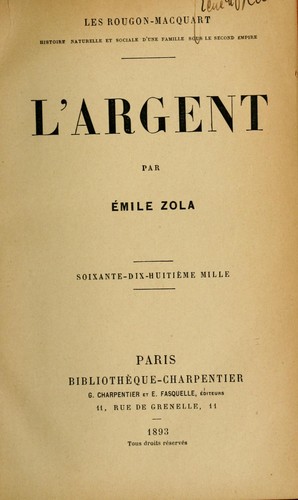
Cover via Open Library · Open Library
L'Argent
Sign in to save'''' ("Money") is the eighteenth novel in the Rougon-Macquart series by Émile Zola. It was serialized in the periodical Gil Blas'' beginning in November 1890 before being published in novel form by Charpentier et Fasquelle in March 1891.
Book · Open Library
- Author
- Émile Zola
- First published
- 1891
- Editions
- 56
- Subjects
- French drama, Money in literature, Continental european fiction (fictional works by one author), Fiction, Banks and banking, History, Fiction, general, Prices
via Open Library
Key facts
- Book.image
- ZolaMoney.jpg
- Book.image_size
- 160px
- Book.author
- Émile Zola
- Book.country
- France
- Book.language
- French
- Book.series
- Les Rougon-Macquart
- Book.genre
- Novel
- Book.publisher
- Charpentier & Fasquelle (book form)
- Book.release_date
- 1890-1891 (serial) and 1891 (book form)
- Book.media_type
- Print (serial, hardback and paperback)
- Book.pages
- 432 (paperback)
- Book.preceded_by
- The Kill
- Book.followed_by
- The Dream
via Wikipedia infobox
Full text
Das Geld – Emile Zola
projekt-gutenberg.org →Link to the full text · 4,581 chars · not written by Vinony
Wikidata facts
- Read free · Project Gutenberg
- #17516
- Image
- ZolaMoney.jpg
Show 4 more facts
- title
- L'Argent
- work available at URL
- www.projekt-gutenberg.org/zola/dasgeld/dasgeld.html
- Commons category
- L'Argent
- publication date
- 1891-00-00
via Wikidata · CC0
~9 min read
Article
9 sectionsContents
- Plot summary
- Historical background
- Relation to the other ''Rougon-Macquart'' novels
- English translations
- Expurgated
- Unexpurgated
- Adaptations
- References
- External links
'''' ("Money") is the eighteenth novel in the Rougon-Macquart series by Émile Zola. It was serialized in the periodical Gil Blas'' beginning in November 1890 before being published in novel form by Charpentier et Fasquelle in March 1891.
The novel focuses on the financial world of the Second French Empire as embodied in the Paris Bourse and exemplified by the fictional character of Aristide Saccard. Zola's intent was to show the terrible effects of speculation and fraudulent company promotion, the culpable negligence of company directors, and the impotency of contemporary financial laws.