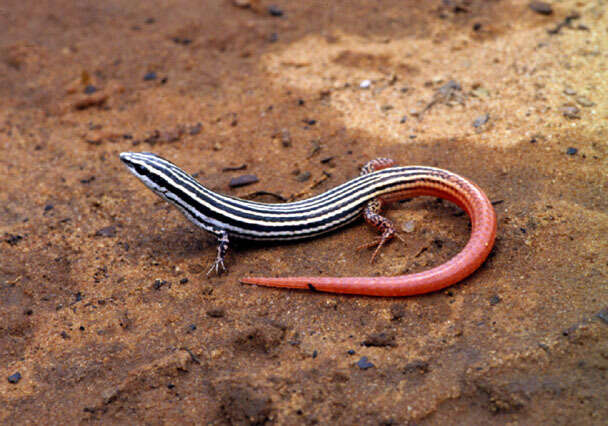
Encyclopedia of Life · EOL (see source)
Lacertoidea
Sign in to saveAlso known as Lacertoid, Lacertoids
The Lacertoidea is a group of squamate reptiles that includes the Lacertidae, Teiidae, Gymnophthalmidae, and Amphisbaenia. The finding from molecular phylogenetic studies that the burrowing Amphisbaenia were nested in a clade with the lizard forms led Vidal & Hedges (2005) to propose a new name for the group based on shared morphogical characters, Laterata, "referring to the presence of tile-like (squarish or quadrangular, and sometimes raised) scales that form the rings in Amphisbaenia, and are also present ventrally in Lacertiformata and Teiformata".
Species
Laterata es un suborden de escamosos que incluye a las familias de lagartos Lacertidae, Teiidae, Gymnophthalmidae, Alopoglossidae y los anfisbénios (Amphisbaenia). El nombre "laterata" se refiere a la presencia de escamas en forma de teja (cuadrangulares o cuadrangulares, ya veces elevadas) que forman los anillos los anfisbénios, y también están presentes ventralmente en Lacertidae y Teiidae. Los estudios de anatomía han agrupado tradicionalmente a las familias anteriores con Scincomorpha, sin embargo estudios genéticos más recientes han encontrado que están relacionado con el origen de los anfisbénios y los han colocado como un grupo más estrechamente relacionados con el clado venenoso Toxicofera. Las relaciones de los anfisbénios con otros escamosos han sido un misterio durante mucho tiempo; aunque superficialmente se asemeja a las serpientes, su anatomía y locomoción es bastante distinta a la de las serpientes, los anfisbénios tienen un pulmón derecho reducido en contraposición a las serpientes que tienen el pulmón izquierdo reducido. Sin embargo, no se parecen mucho a ningún otro grupo de lagartos. Estudios genéticos recientes sugieren que los anfisbénios se agrupan con los La
via
Wikidata facts
- Instance of
- taxon
- Image
- Jaszczurka-Lacerta agilis.jpg
Show 5 more facts
- taxon name
- Lacertoidea
- start time
- 60000000-0
- Commons category
- Laterata
- taxon rank
- superfamily
- topic's main category
- Category:Lacertoidea
Sources (1)
via Wikidata · CC0
~2 min read
Encyclopedic overview
1 sectionsContents
- References
The Lacertoidea is a group of squamate reptiles that includes the Lacertidae, Teiidae, Gymnophthalmidae, and Amphisbaenia. The finding from molecular phylogenetic studies that the burrowing Amphisbaenia were nested in a clade with the lizard forms led Vidal & Hedges (2005) to propose a new name for the group based on shared morphogical characters, Laterata, "referring to the presence of tile-like (squarish or quadrangular, and sometimes raised) scales that form the rings in Amphisbaenia, and are also present ventrally in Lacertiformata and Teiformata".
Studies of anatomy have traditionally grouped the lacertoids with skinks; however, more recent studies focusing on DNA have placed them as a distinct group of lizards, more closely related to the venomous Toxicofera. The relationships of the Amphisbaenia to other lizards have long been a mystery; although superficially snakelike, their anatomy and locomotion is quite distinct from that of snakes, Amphisbaenia have a reduced right lung as opposed to snakes which have their left lung reduced. However, they do not closely resemble any other group of lizards. Recent molecular studies suggest that amphisbaenians are grouped with the Lacertidae, in a group named the Lacertibaenia.
Excerpted from Wikipedia’s “Lacertoidea” article, available under the CC BY-SA 4.0 licence.
Available in 10 languages
via Wikidata sitelinks · CC0