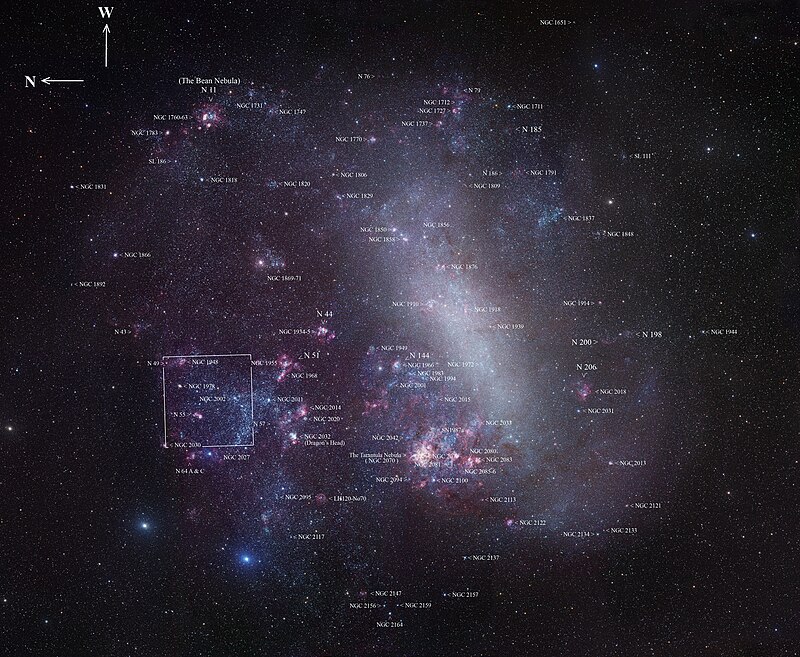
File:Eso1021d.jpg · Wikimedia Commons · See Wikimedia Commons
The Large Magellanic Cloud is an irregular galaxy that orbits the Milky Way as one of its satellite galaxies. It matters to astronomers because studying it helps us understand how galaxies interact and evolve, and it serves as a nearby laboratory for observing stellar processes and cosmic phenomena.
AI-generated from the Wikipedia summary — may contain errors.
Wikidata facts
- Instance of
- galaxy
- Part of
- Milky Way subgroup
- Has part
- NGC 1866
- Named after
- Ferdinand Magellan
- Constellation
- Dorado
- Parent body
- Milky Way
- Distance from Earth
- 50.12
- Radius
- 2.1
- Mass
- 13000000000
- Image
- Large.mc.arp.750pix.jpg
Show 18 more facts
- Commons category
- Large Magellanic Cloud
- topic's main category
- Category:Large Magellanic Cloud
- catalog code
- 2FHL J0526.6-6825e
- redshift
- 0.00093
- galaxy morphological type
- SB(s)m
- apparent magnitude
- 0.4
- right ascension
- 80.89417
- declination
- -69.75611
- radial velocity
- 262.2
- epoch
- J2000.0
- discoverer or inventor
- Abd al-Rahman al-Sufi
- time of discovery or invention
- 0964-00-00
- metallicity
- -0.55
- absolute magnitude
- -18.5
- right ascension component of proper motion
- 1.910
- declination component of proper motion
- 0.229
- short name
- VMO
- on focus list of Wikimedia project
- Wikipedia:Vital articles/Level/4
via Wikidata · CC0
Article · Português
Grande Nuvem de Magalhães (comumente abreviada como LMC, do inglês Large Magellanic Cloud) é uma galáxia anã satélite que orbita a Via Láctea. O seu diâmetro é vinte vezes menor do que o da Via Láctea e o seu número de estrelas dez vezes menor. Embora parte de sua morfologia seja irregular, a Grande Nuvem de Magalhães tem traços de uma estrutura espiralada. Ela contém moléculas orgânicas complexas, como metanol, éter dimetílico e metanoato de metila. Alguns especulam que a Grande Nuvem de Magalhães já foi uma galáxia espiral barrada que rompeu da Via Láctea para tornar-se uma galáxia irregular. A Grande Nuvem de Magalhães é o quarto maior membro do Grupo Local, precedida da Andrômeda, a Via Láctea, e a galáxia do Triângulo.
Abstract from DBpedia / Wikipedia · CC BY-SA
Gallery (12)
Available in 70 languages
- Español
- Français
- Deutsch
- 中文
- 日本語
- Русский
- Português
- Italiano
- العربية
- हिन्दी
- Afrikaans
- Armenian
- Asturian
- Bahasa Indonesia
- Bangla
- Bashkir
- Basque
- Belarusian
Show 51 more
- Breton
- Bulgarian
- Burmese
- Catalan
- Croatian
- Czech
- Danish
- Egyptian Arabic
- Esperanto
- Estonian
- Finnish
- Galician
- Georgian
- Greek
- Guarani
- Hebrew
- Hungarian
- Ido
- Irish
- Latin
- Latvian
- Lithuanian
- Macedonian
- Malay
- Malayalam
- Nederlands
- Norwegian
- Norwegian Nynorsk
- Occitan
- Polski
- Romanian
- Serbian
- Serbian (Latin)
- Sinhala
- Slovak
- Slovenian
- Svenska
- Swahili
- Tiếng Việt
- Türkçe
- Udmurt
- Ukrainian
- Urdu
- Waray
- Western Panjabi
- Wu Chinese
- Zaza
- zh_yue
- فارسی
- ไทย
- 한국어
via Wikidata sitelinks · CC0