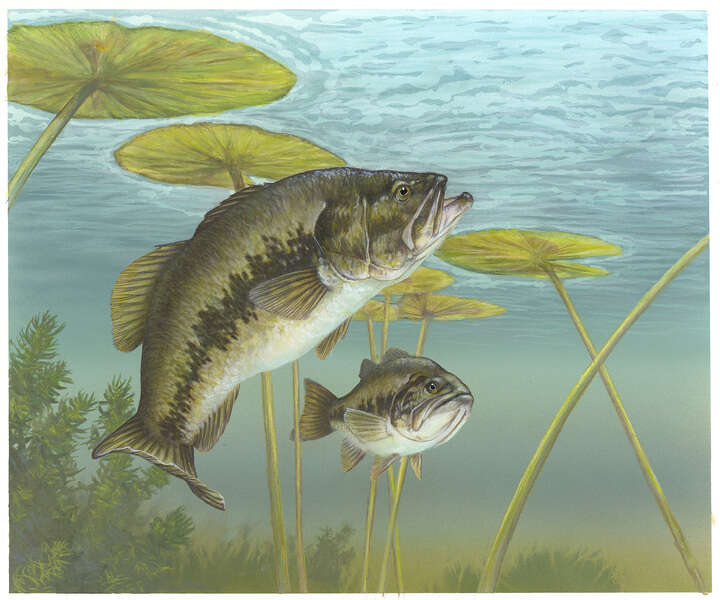
Encyclopedia of Life · EOL (see source)
largemouth bass
Sign in to saveAlso known as largemouth, bigmouth bass, big-mouth bass, large-mouth bass, widemouth bass, black bass, Grystes salmoide, Grystes salmoide Cuvier 1829 gen. nov comb. nov
species of black bass
OverviewAI-generated
The largemouth bass, scientifically known as *Micropterus salmoides*, is a species of freshwater fish. It belongs to the family Centrarchidae within the order Centrarchiformes. The taxon is classified under the class Teleostei and the phylum Chordata. Its scientific name is attributed to Lacepède, 1802, and it is also referred to by common names such as American Black Bass and Black Bass.
The species has an accepted taxonomic status. Its range includes China, and it is noted as invasive to Malawi. The IUCN Red List assessed the conservation status of the largemouth bass as Least Concern in 2019.
Synthesized by Vinony from 23 facts across 4 sources: Wikidata, WoRMS, IUCN Red List, Vinony graph. Generated from structured data (not the Wikipedia text) and checked against those facts — may still contain errors.
Species
Least Concernlargemouth bass
Species
- PhylumChordata
- ClassTeleostei
- OrderCentrarchiformes
- FamilyCentrarchidae
Maximum longevity: 23 years (wild) Observations: Females appear to outlive males considerably (http://www.dlia.org/atbi/index.html).
via IUCN
Wikidata facts
- Instance of
- taxon
- Parent taxon
- Micropterus
- Image
- Micropterus salmoides Lake Biwa Museum1.jpg
Show 9 more facts
- taxon rank
- species
- taxon name
- Micropterus salmoides
- Commons category
- Micropterus salmoides
- IUCN conservation status
- Least Concern
- Commons gallery
- Micropterus salmoides
- taxon common name
- perca americana
- invasive to
- Malawi
- taxon range
- China
- short name
- M. salmoides
via Wikidata · CC0
~12 min read
Encyclopedic overview
The largemouth bass (Micropterus nigricans) is a carnivorous, freshwater, ray-finned fish in the Centrarchidae (sunfish) family, native to the eastern and central United States, southeastern Canada and northern Mexico. It is known by a variety of regional names, such as the widemouth bass, bigmouth bass, black bass, largie, potter's fish, Florida bass or Florida largemouth, green bass, bucketmouth bass, green trout, growler , Gilsdorf bass, Oswego bass, southern largemouth, northern largemouth, Alabama bass or Alabama largemouth, marsh bass, and swamp bass.
The largemouth bass, as it is known today, was first described by French naturalist Georges Cuvier in 1828. A 2022 study concluded that the correct scientific name for the Florida bass is Micropterus salmoides, while the largemouth bass is Micropterus nigricans. It is the largest species of the black bass, with a maximum recorded length of 29.5 inches (75 cm) and an unofficial weight of 25 pounds 1 ounce (11.4 kg). Reports from Cuba speculate bass as large as 13.5 kg (30 lb), where invasive largemouth thrive.
Excerpted from Wikipedia’s “largemouth bass” article, available under the CC BY-SA 4.0 licence.