Encyclopedia of Life · EOL (see source)
Species
SPECIES
- KingdomPlantae
- PhylumTracheophyta
- ClassMagnoliopsida
- OrderLamiales
- FamilyOrobanchaceae
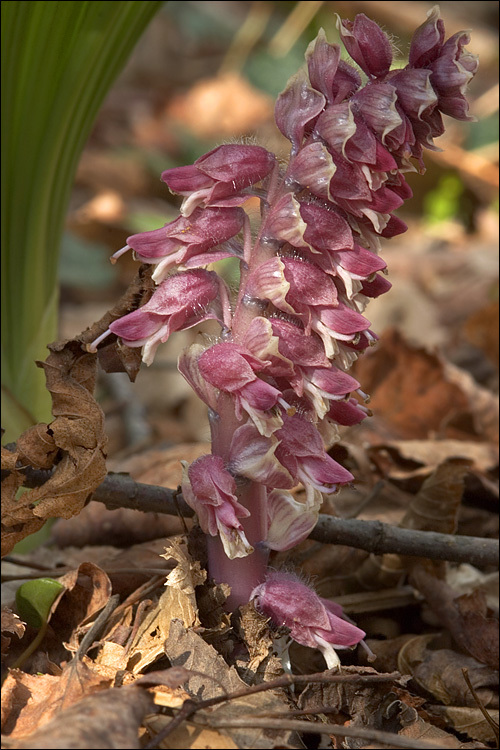
Lathraea squamaria, Pollen, gefärbt Die Gewöhnliche Schuppenwurz (Lathraea squamaria), auch Aufrechte Schuppenwurz, ist eine Pflanzenart aus der Gattung der Schuppenwurzen (Lathraea) in der Familie der Sommerwurzgewächse (Orobanchaceae). Inhaltsverzeichnis 1 Beschreibung 2 Vorkommen 3 Systematik 4 Ökologie 5 Etymologie 6 Literatur 7 Einzelnachweise 8 Weblinks Beschreibung Schuppenwurz (Lathraea squamaria), Illustration Vollständige Pflanze, Illustration Die Gewöhnliche Schuppenwurz ist eine ausdauernde[1], krautige, fast chlorophyllfreie Schmarotzerpflanze, die oberirdisch einen etwa 10–30 cm hohen Spross ausbildet. Die Blüten sind trübrosa bis -lila gefärbt und in einer einseitswendigen übergebogenen Traube angeordnet. Unterirdisch bildet sie ein reich verzweigtes, bis zu 2 m langes Rhizom aus, das ein Gewicht von bis zu 5 kg erreichen kann. Das Rhizom ist mit fleischigen stärkereichen Schuppen besetzt, die umgewandelte Niederblättchen mit Speicherfunktion darstellen. Das Rhizom besitzt zudem kleine Saugorgane (Haustorien), mit denen die Pflanze in das Gewebe von Bäumen oder anderen Wirtspflanzen eindringt und dort deren Saft saugt. Da die Schuppenwurz keine Blätter ausbildet, feh
via GBIF · Kew POWO
Museum specimens
- Specimen records
- 1,575
- With media
- 946
- Family
- Orobanchaceae
- Collections
- DEK, NHA, NCU, MICH, ANSP, US
- Recorded in
- Poland, Ukraine, Switzerland, Pakistan, India, United Kingdom, Sweden, Netherlands
Wikidata facts
Show 6 more facts
- Commons category
- Lathraea squamaria
- taxon rank
- species
- taxon name
- Lathraea squamaria
- Commons gallery
- Lathraea squamaria
- taxon common name
- pähkinäsuomukka
- short name
- L. squamaria
via Wikidata · CC0
~2 min read
Encyclopedic overview
Lathraea squamaria, the common toothwort, is a species of flowering plant in the family Orobanchaceae. It is widely distributed in Europe and also occurs in Turkey.
It is parasitic on the roots of hazel and alder, and occasionally other trees, and represents the second occasion on which a member of the family Orobanchaceae lost the ability to photosynthesize and became parasitic. It occurs in shady places such as deciduous woodland and hedge sides. The plant consists of a branched whitish underground stem closely covered with thick, fleshy, colourless leaves, which are bent over so as to hide under the surface. The only portions that appear above ground in April to May are the short flower-bearing shoots, which bear a spike of two-lipped dull purple flowers, but is also able to produce cleistogamic underground flowers which fertilise themselves. It is also able to regenerate from broken fragments of the underground stem.
Excerpted from Wikipedia’s “Lathraea squamaria” article, available under the CC BY-SA 4.0 licence.