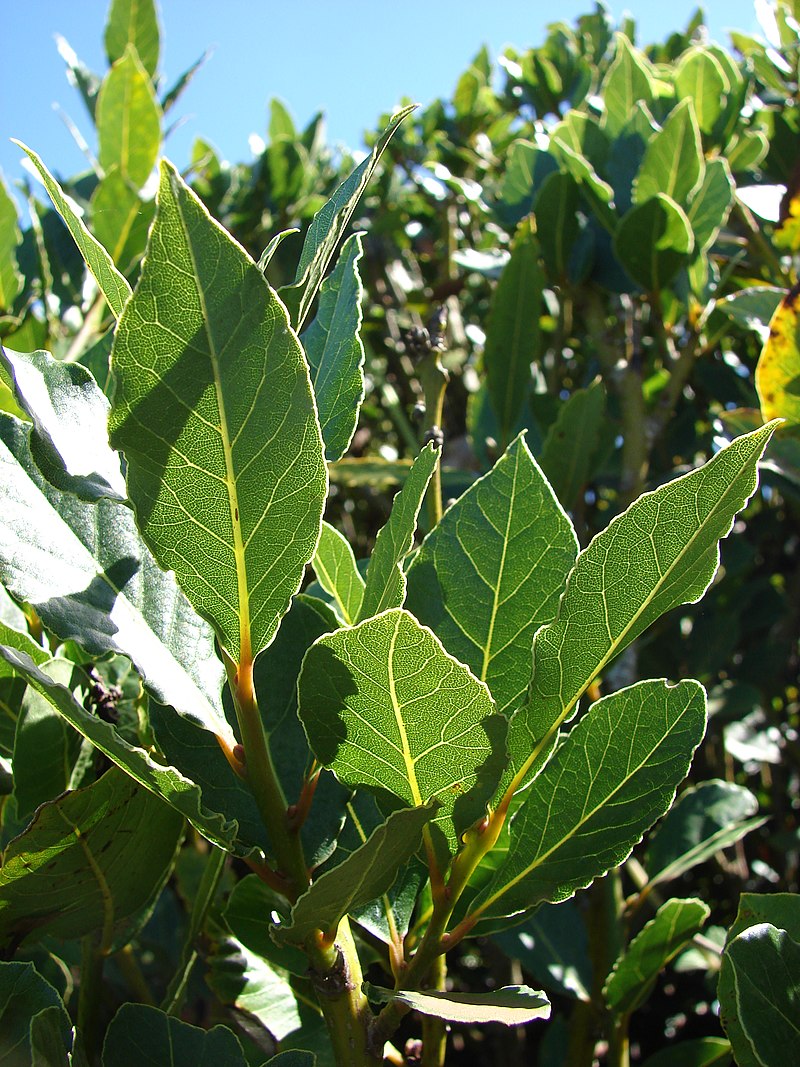
File:Starr-071024-0195-Laurus_nobilis-leaves-Enchanting_Floral_Gardens_of_Kula-Maui_(24867859296).jpg · Wikimedia Commons · See Wikimedia Commons
OverviewAI-generated
Laurus nobilis, commonly known as sweet bay, is a species of plant in the family Lauraceae. It belongs to the order Laurales, class Magnoliopsida, and phylum Tracheophyta within the kingdom Plantae. The species is a subclass of useful plants and serves as a source of bay leaf. Its uses include food, spice, medicinal applications, and afforestation. The fruit type is a drupe.
The native range of Laurus nobilis includes Albania, Algeria, Corse, Cyprus, East Aegean Is., France, Greece, Italy, Kriti, Lebanon-Syria, Libya, and Morocco. It has been introduced to the Azores, Baleares, Great Britain, Ireland, Korea, Krym, North Caucasus, Portugal, Spain, Transcaucasus, and Vietnam. Taxon range data also lists China, Fujian, Guangdong, and Gabon. The IUCN conservation status is Least Concern, assessed in 2018.
Synthesized by Vinony from 50 facts across 8 sources: Wikidata, GBIF, Gbif Occ, IUCN Red List, Plants of the World, WoRMS, iDigBio, Vinony graph. Generated from structured data (not the Wikipedia text) and checked against those facts — may still contain errors.
Species
Least ConcernLaurus nobilis
SPECIES
- KingdomPlantae
- PhylumTracheophyta
- ClassMagnoliopsida
- OrderLaurales
- FamilyLauraceae
月桂(学名:Laurus nobilis),又稱月桂樹、桂冠樹、甜月桂、月桂冠,是調味料月桂葉的來源。原產於地中海沿岸及小亞細亞一帶灌木岩石區,現已遍佈世界各地。 叶片深绿色,椭圆形,革质,味苦,清香。干燥后,苦味减少,香气增强,可以用作调料,即“香叶”。 古代希腊人用月桂的小枝条編織成桂冠,授予皮西安競技會(Pythian Games)的胜利者,象征荣耀與胜利。
via GBIF · IUCN · Kew POWO
Museum specimens
- Specimen records
- 1,223
- With media
- 794
- Family
- Lauraceae
- Collections
- CHSC, CDA, IRVC, DAV, CM, OBI
- Recorded in
- United States, Greece
Wikidata facts
- Instance of
- taxon
- Subclass of
- useful plant
- Parent taxon
- Laurus
- Image
- Laurier.jpg
- Has use
- spice
Show 14 more facts
- taxon name
- Laurus nobilis
- taxon rank
- species
- Commons category
- Laurus nobilis
- Commons gallery
- Laurus nobilis
- taxon common name
- navadni lovor
- has fruit type
- drupe
- IUCN conservation status
- Least Concern
- different from
- Laurier
- taxon range
- Gabon
- short name
- L. nobilis
- taxon author citation
- L.
- present in work
- Georgics
- external data available at URL
- www.gbif.org/dataset/31dc1507-a6e1-4233-a8df-c7a78596a7e4
Sources (7)
via Wikidata · CC0
~11 min read
Encyclopedic overview
Laurus nobilis /ˈlɔːrəs ˈnɒbɪlɪs/ is an aromatic evergreen tree or large shrub with green, glabrous (smooth) leaves. It is in the flowering plant family Lauraceae. According to Muer, Jahn, & Sauerbier, the stem can be 1 metre in diameter and the tree can be as high as 20 metres. It is native to the Mediterranean region and is used as bay leaf for seasoning in cooking. Its common names include bay tree (esp. United Kingdom), bay laurel, sweet bay, true laurel, Grecian laurel, or simply laurel. Laurus nobilis figures prominently in classical Greco-Roman culture.
Worldwide, many other kinds of plants in diverse families are also called "bay" or "laurel", generally due to similarity of foliage or aroma to Laurus nobilis.
Excerpted from Wikipedia’s “Laurus nobilis” article, available under the CC BY-SA 4.0 licence.
Gallery (13)
Available in 82 languages
- Español
- Français
- Deutsch
- 中文
- 日本語
- Русский
- Português
- Italiano
- العربية
- Abkhazian
- Afrikaans
- Albanian
- Aragonese
- Asturian
- Azerbaijani
- Bahasa Indonesia
- Basque
- bat_smg
Show 63 more
- Bikol
- Bosnian
- Bulgarian
- Catalan
- Cebuano
- Corsican
- Croatian
- Czech
- Danish
- Egyptian Arabic
- Esperanto
- Estonian
- Filipino
- Finnish
- Galician
- Greek
- Haitian Creole
- Hebrew
- Hungarian
- Irish
- Javanese
- Kabyle
- Latin
- Latvian
- Ligurian
- Limburgish
- Lithuanian
- Lombard
- Macedonian
- Malagasy
- Malay
- Manx
- Nederlands
- Northern Frisian
- Norwegian
- Norwegian Nynorsk
- nrm
- Occitan
- Ossetic
- Piedmontese
- Polski
- Romanian
- Sardinian
- Scots
- Serbian
- Serbian (Latin)
- Sicilian
- simple
- Slovak
- Slovenian
- Svenska
- Tiếng Việt
- Türkçe
- Ukrainian
- Upper Sorbian
- Venetian
- Waray
- Welsh
- Wolof
- Wu Chinese
- zh_yue
- فارسی
- 한국어
via Wikidata sitelinks · CC0