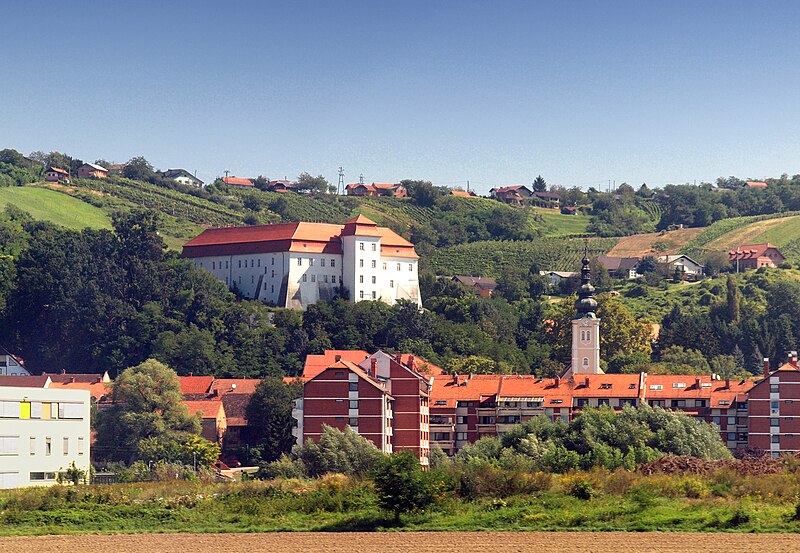
File:Lendava-Le_chateau.jpg · Wikimedia Commons · See Wikimedia Commons
Lendava
Sign in to saveAlso known as Lendva, Lindau, Alsólendva
Lendava (; formerly Dolnja Lendava, in older sources also Dolenja Lendava; , formerly Alsólendva; , formerly Unter-Limbach) is a town in Slovenia in the region of Prekmurje. It is the seat of the Municipality of Lendava. It forms part of the border crossing with Hungary at Dolga Vas–Rédics and it is near the border with Croatia at Mursko Središće. Alongside Slovene, Hungarian serves as an official language of the municipality.
OverviewAI-generated
Lendava is a city and border town in Slovenia, serving as the capital of the Municipality of Lendava. It is situated at an elevation of 160 meters above sea level and covers an area of 123 square kilometers. The town has a population of 10,464, with 1,511 males and 1,443 females recorded in specific demographic data. Its postal code is 9220, and it operates within the UTC+01:00 and UTC+02:00 time zones.
The municipality is a member of the Climate Alliance and owns the Lendava Sports Park. Lendava maintains twinned relationships with Zalaegerszeg, Seiersberg, Lenti, and Budapest District I. The local area includes residential streets such as Ulica Lajcsija Pandurja.
Synthesized by Vinony from 49 facts across 7 sources: Wikidata, Openweathermap, Open Meteo, OpenStreetMap, GeoNames, Vinony graph, Geo. Generated from structured data (not the Wikipedia text) and checked against those facts — may still contain errors.
Weather now
7-day forecast
via Open-Meteo
Place details
- Locality
- Lendava / Lendva
- Region
- Municipality of Lendava
- Country
- Slovenija
- Population
- 3,129
- Timezone
- Europe/Ljubljana
via OpenStreetMap · GeoNames
Key facts
- Settlement.official_name
- Lendava
- Settlement.other_name
- Lendva (Hungarian)
- Settlement.settlement_type
- Town
- Settlement.image_caption
- From top, left to right: Overview of Lendava, St. Catherine's Church, Synagogue, Old manor, Lendava Castle
- Settlement.image_flag
- Flag of Lendava.gif
- Settlement.pushpin_map
- Slovenia
- Settlement.pushpin_label_position
- left
- Settlement.pushpin_map_caption
- Location in Slovenia
- Settlement.subdivision_type
- Country
- Settlement.subdivision_name
- Slovenia
- Settlement.subdivision_type1
- Traditional region
- Settlement.subdivision_name1
- Prekmurje
- Settlement.subdivision_type2
- Statistical region
- Settlement.subdivision_name2
- Mura
- Settlement.subdivision_type3
- Municipality
- Settlement.subdivision_name3
- Lendava
- Settlement.area_total_km2
- 5.66
- Settlement.population_as_of
- 2019
via Wikipedia infobox
Wikidata facts
- Instance of
- border city
- Country
- Slovenia
- Located in
- Municipality of Lendava
- Population
- 2954
- Area
- 123
- Elevation
- 160
- Time zone
- UTC+02:00
- Capital of
- Municipality of Lendava
- Official website
- www.lendava.si
- Image
- Lendava-Le chateau.jpg
Show 9 more facts
- twinned administrative body
- Budapest District I
- Commons category
- Lendava
- topic's main category
- Category:Lendava
- postal code
- 9220
- member of
- Climate Alliance
- different from
- Municipality of Lendava
- P8168
- Hermine Hug-Hellmuth
- female population
- 1443
- male population
- 1511
Sources (8)
via Wikidata · CC0
Travel guide
Understand
thumb|Lendava castle and hills The first traces of settlement in Lendava date back to Roman times, when the settlement on the Poetovio–Savaria route (today Ptuj-Szombathely) was named Halicanum. The first mentions of modern Lendava go back to the 9th century, as the church was said to have been consecrated there in 853, and the town of Lindva, named after the local river, was first mentioned in records dating from 1192. Because of its position on the main transit routes, Lendava first grew into a market town in the 14th century, then a parish in 1334. The rulers of Lendava and surroundings in Middle Ages, Hungarian nobles Banffys, started the first developments of the city, and were succeeded by the House of Esterhazy in 1644. The area was under Hungarian and Turkish rule throughout most of the 17th century. In 1867 Lendava became a town and administrative district seat.
Lendava, or in Hungarian Lendva, has a big Hungarian minority, which is normal, considering the long period Lendava was part of Hungary. One third of the population are Hungarians, and every sight in the city is signposted in both Slovenian and Hungarian. Even some statues in the city are of famous Hungarians who lived in Lendava. Despite good relations between countries and harmonious ethnic relations, Lendava is off the beaten path for both countries and many travelers miss this city.
See
One of the most interesting sights in the city are its urban vineyards. Lendava wines are among the most famous Slovenian wines.
Travel guide from Wikivoyage (CC BY-SA 4.0)
~4 min read
Encyclopedic overview
12 sectionsContents
- Name
- History
- Jewish community
- Geography
- Climate
- Landmarks
- Church
- Castle
- Twin towns – Sister cities
- Sport
- References
- External links
Lendava (; formerly Dolnja Lendava, in older sources also Dolenja Lendava; , formerly Alsólendva; , formerly Unter-Limbach) is a town in Slovenia in the region of Prekmurje. It is the seat of the Municipality of Lendava. It forms part of the border crossing with Hungary at Dolga Vas–Rédics and it is near the border with Croatia at Mursko Središće. Alongside Slovene, Hungarian serves as an official language of the municipality.
The town is the centre of the Hungarian minority in Slovenia. It is also known for the monumental theater and Hungarian Community Centre designed by the architect Imre Makovecz.
Excerpted from Wikipedia’s “Lendava” article, available under the CC BY-SA 4.0 licence.
Gallery (17)
On the map
3 mapped locations